
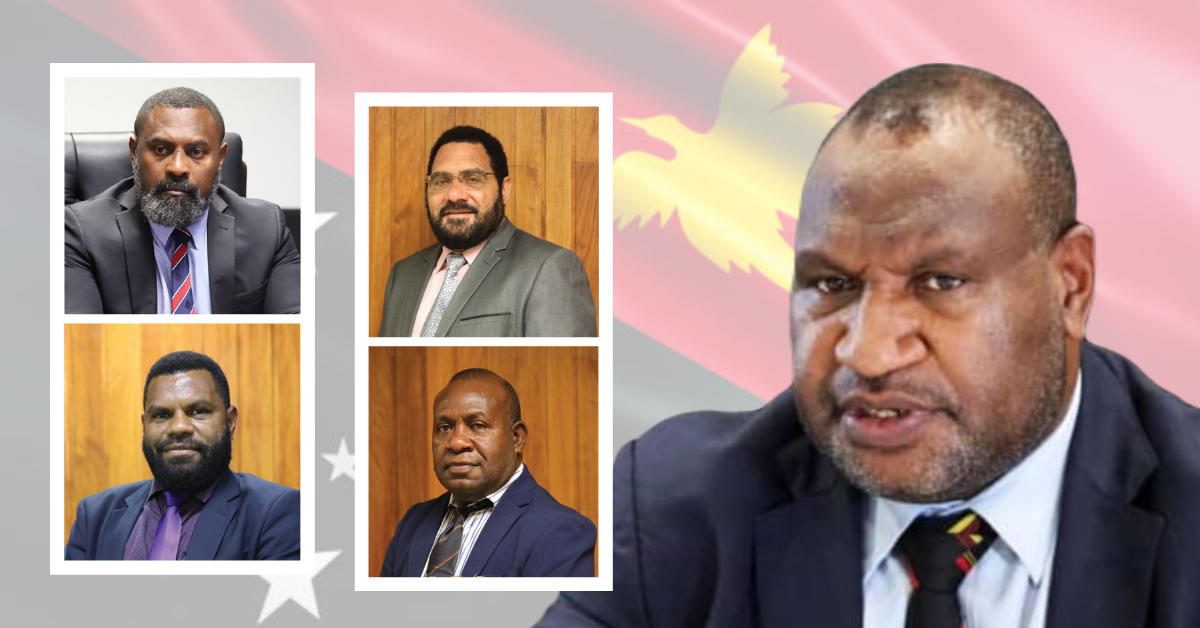
Prime Minister James Marape has signalled what he describes as a major performance-based reshuffle of his government, swearing in three new ministers on Tuesday.
While the Prime Minister framed the move as a strategic “reset” following Papua New Guinea’s 50th Independence anniversary, the reshuffle comes at a time of heightened scrutiny of government delivery and internal power dynamics within the Marape-Rosso administration.
Coalition Maintenance or Meritocracy?
The swearing-in of Kompiam-Ambum MP, Sir John Pundari, Tewai-Siassi MP, Dr. Kobby Bomareo and Menyamya MP, Solen Loifa at Government House on Tuesday, according to Prime Minister Marape, is a direct response to the growing influence of the “Our Pati” bloc.
Marape acknowledged the political necessity of the move, noting that Our Pati is now the second-largest party in the coalition.
“Some of the key reforms that were made would not have been passed without the numerical strength and contribution of Our Pati,” the Prime Minister admitted.
By elevating Solen Loifa, the Prime Minister is attempting to project an image of renewal.
“He belongs to the cadre of young emerging leaders… who must be brought into Cabinet to prepare them to lead even when some of us are out of time,” Marape stated.
While political observers often describe the elevation of younger MPs as a tactic to build personal loyalty within the executive council, Marape was quick to clarify in a statement that these are not merely political rewards.
“These are not ceremonial appointments. They come with hard tasks and clear deadlines,” he stated, emphasizing that the new ministers are entering a “decisive 20-year development window.”
Accountability and the 90-Day Housing Mandate
In a move that puts the entire front bench on notice, Marape has demanded “health and performance reports” from all ministers.
Nowhere is this pressure more evident than in the Housing portfolio. Re-appointed Minister Dr. Kobby Bomareo has been issued a 90-day deadline to deliver a comprehensive national housing and land access programme.
Marape stressed that the goal is to make home ownership achievable for the workforce by removing GST and Stamp Duty on first-home purchases under K700,000.
“This is not just about buildings. It is about making land and housing accessible to our people,” he said.
Recalling the “Old Guard” for National Security
The return of Sir John Pundari, a veteran politician whose career began in 1992, suggests that despite “reset” rhetoric, the administration remains heavily reliant on the political “old guard.” However, the appointment goes beyond mere recycling; it exposes a desperate reliance on provincial identity over systemic reform.
Marape specifically linked Pundari’s appointment to the Ministry of Police to his roots in Enga Province, framing his proximity to the chaos as a strategic asset.
“Sir John comes from a province that is rife with guns, rife with tribal fighting and criminal activity… We felt he should take this problem head-on, remove guns, stop tribal fighting and restore order,” Marape said.
This justification, however, invites a scathing critique of Pundari’s decades-long tenure. If Pundari’s deep-rooted connection to Enga is his greatest strength, one must ask why that same influence failed to stem the tide of high-powered weaponry during his thirty years in the political upper echelon.
By setting a 12-month target for national stabilization, Marape is essentially gambling on the idea that the same political machinery that watched Enga descend into gun-fuelled anarchy can now, suddenly, dismantle it.
The “Old Guard” isn’t just returning to fix the problem; they are returning to fix a crisis that matured under their long-term stewardship.
The ICT Leadership Question: Who is in Charge?
As Peter Tsiamalili Jnr moves into the heavyweight role of Works and Highways Minister, a pressing question remains for the public: Is he still the Acting Minister for ICT?
Tsiamalili has held the acting ICT role since July 2025, covering for Timothy Masiu, who was on medical leave. With Tsiamalili now tasked with a massive K1.7 billion infrastructure budget, questions arise about the status of the ICT ministry.
Who is actually steering PNG’s digital future?
This leadership vacuum comes at a critical time for the Digital Government Act 2022. The public remains anxious about how their personal information is being stored and used within the new “SevisPNG” digital ID ecosystem, especially as the government pushes for 100% digital integration by 2027.
The Starlink Standoff: Connectivity vs. Law
The lack of a permanent ICT head has intensified the debate over Starlink.
As of mid-January 2026, industry regulator NICTA has confirmed that Starlink services remain prohibited and unlawful in PNG.
Despite more than 160 active users, a 2024 Ombudsman Commission directive has legally blocked NICTA from issuing a license, and the matter is now tied up in a Judicial Review before the National Court.
“Until the Ombudsman Commission withdraws its position or the courts overturn that decision, this remains the formal status of Starlink in Papua New Guinea,” stated Acting NICTA CEO Lume Polume.
For the average citizen, the standoff feels like a contradiction. While the “Reset@50” agenda promises universal internet access, the country’s most viable satellite solution is currently being “hunted” by regulators. Without a clear ministerial lead to navigate the legal battle with the Ombudsman, many fear PNG will remain a digital outlier in the Pacific; disconnected, over-regulated and left behind.
Mining: Resetting the Resource Framework
Solen Loifa takes over the Mining portfolio with a strict deadline.
Marape intends to overhaul the nation’s resource laws within the year.
“Before September 16, 2026, we want to announce to the country and to the investment community the regime under which mining, petroleum and other resource sectors will operate,” Marape said, signalling a shift toward “taking back more for PNG.”
Ministerial 90-day Performance tracker (Q1 2026)
| Portfolio & Minister | Primary 90-day Target | Key Metric & Big Bets |
| Housing (Dr Kobby Bomareo) | National Housing & Land Access Program | • Finalize removal of GST and Stamp Duty for first-time home buyers. • Identify specific state land parcels for first-home worker allocations. |
| Police (Sir John Pundari) | Highlands Stabilization Framework | • Deploy strategies to “remove guns” and stop tribal fighting in Enga, Hela, and SHP. • Integration of village court official payments into the formal system. |
| Mining (Solen Loifa) | Resource Regime Finalization | • Progress the Wafi-Golpu and Porgera strategic developments. • Draft the new “Take Back PNG” policy framework for the Sept 2026 deadline. |
| Works & Highways (Peter Tsiamalili Jnr) | Connect PNG Implementation | • Oversee the K1.7 billion infrastructure budget. • Audit existing contracts to ensure no “conflict of interest” in construction projects. |

Comments are closed.