
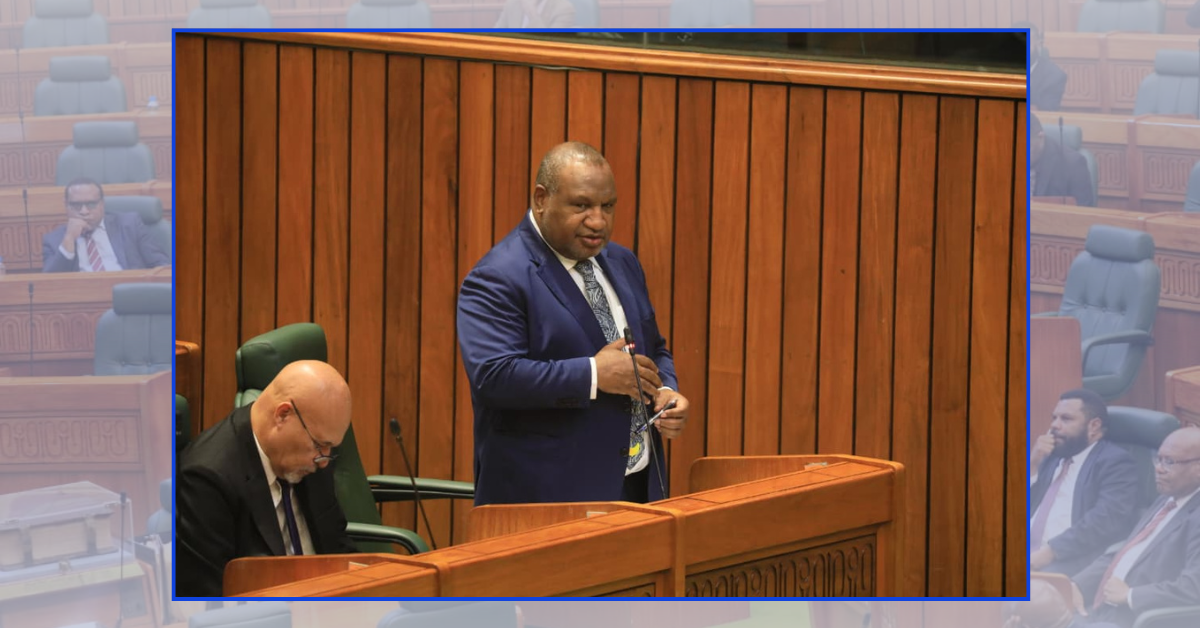
Papua New Guinean Prime Minister James Marape has rejected suggestions that PNG’s reaffirmation of its One China Policy was the result of political pressure or economic coercion.
Marape said the issues between Beijing and Taipei are matters for those directly concerned to resolve peacefully.
“Papua New Guinea does not intend to become entangled in issues that fall outside our jurisdiction or our national interests,” said Marape.
Marape rejected the assertions that Papua New Guinea’s decision resulted from coercion.
His comments come as a response to remarks by Taiwan’s Foreign Minister Lin Chia-lung regarding Papua New Guinea’s decision to close the Taiwan representative office in Port Moresby and the reaffirmation of PNG’s longstanding recognition of the People’s Republic of China.
Marape described the claims as inaccurate and a misunderstanding of Papua New Guinea’s sovereign foreign policy.
“Papua New Guinea is an independent and sovereign nation. Our foreign policy is determined by our national interests and by decisions made through our constitutional processes, not by pressure from any external power,” said Marape.
Marape said the PNG Government has maintained a One China Policy since 1976.
“This has been the consistent position of successive governments for nearly five decades and remains the official policy of the Independent State of Papua New Guinea,” said Marape.
Last Friday, PNG Foreign Minister Justin Tkatchenko announced the immediate cessation of operations and the physical presence of the Chinese Taipei Economic Office in Port Moresby.
The directive to close the Taipei Economic and Cultural Office in Papua New Guinea came 36 years after it was first set up in 1990 as the Trade Mission of the Republic of China (on Taiwan) in Papua New Guinea.
Marape said this is a conscious Government policy decision and reflects Papua New Guinea’s long-established foreign policy and our commitment to international law and the principles of the United Nations Charter.
“We recognize the Government of the People’s Republic of China in Beijing as the sole legitimate Government of China. We also recognize and respect China’s sovereignty and territorial integrity, just as we expect all nations to respect Papua New Guinea’s sovereignty and territorial integrity,” said Marape.
The Prime Minister said Papua New Guinea has no intention of becoming involved in the cross-Strait dispute.
In the statement Tkatchenko released last week, it linked the decisive action to NEC decision No. 144/2026 that the physical presence of the Chinese Taipei office will no longer be recognized or required under the jurisdiction of Papua New Guinea.
Tkatchenko said this decision was communicated to the Chinese Ambassador in Port Moresby, Yang Xianguang, before a formal statement was released on the government decision to close the Taipei Office located in Port Moresby.
“The National Government views this administrative alignment as a necessary step toward deepening state-to-state trust, reinforcing the shared values, and elevating the bilateral relationship between Papua New Guinea and the People’s Republic of China,” said Tkatchenko.
However, Taiwan’s Ministry of Foreign Affairs Spokesperson Hsiao Kuang-wei said the move was made without prior consultation with Taipei, prompting Taiwan to lodge a strong protest and continue engaging with Papua New Guinea through diplomatic channels.
Hsiao added that Taiwan does not accept PNG’s unilateral decision, further elaborating that the representative office would remain open, safeguard Taiwan’s rights and interests, and provide necessary services to Taiwanese citizens.
The statement from Tkatchenko’s Office said Papua New Guinea deeply values its long-standing, strong partnership with China and the Marape-Rosso Government will look forward to exploring new avenues of strategic cooperation, expanded trade, and economic development that will benefit both countries.
Marape concluded that PNG’s position is clear, principled, and unchanged and will continue to uphold the One China Policy while maintaining friendly relations with all countries based on mutual respect, peaceful cooperation, and our shared commitment to international law.
