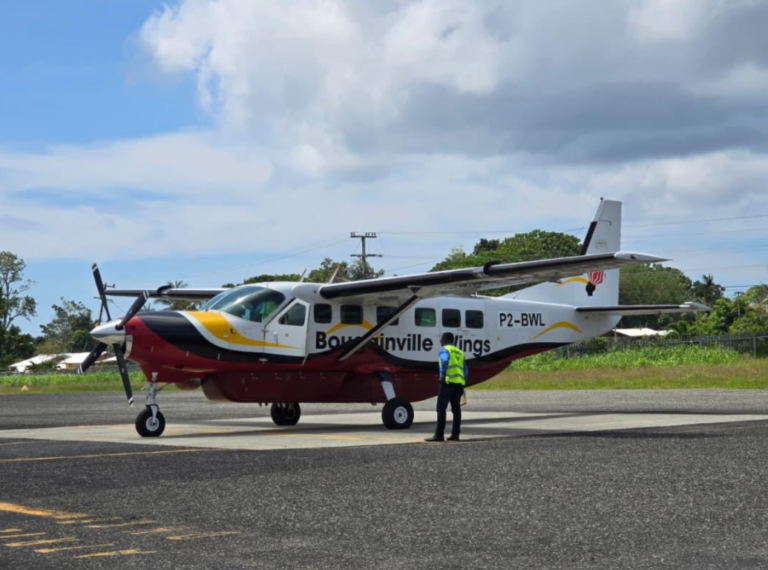
The Autonomous Bougainville Government has launched Bougainville Wings Limited, describing it as Bougainville’s flag carrier and a milestone for the region’s aviation sector.
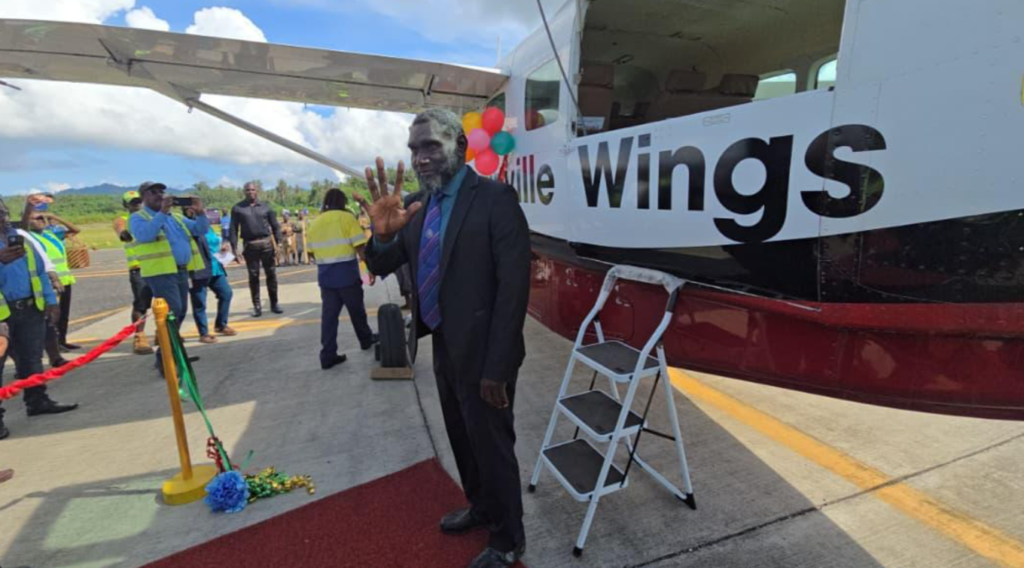
President Ishmael Toroama officially launched the airline at Buka Airport yesterday.
Bougainville Wings is a joint venture between the ABG and Outback Aviation. The ABG holds a 70 per cent majority share through the Bougainville Public Investment Corporation Limited, while industry partners hold the remaining 30 per cent.
“The aviation industry in Bougainville has long awaited progress and we are looking forward to expand this significant beginning,” President Toroama said in his address.
President of the Autonomous Region of Bougainville, Ishmael Toroama, standing beside the aircraft, Bougainville wings. (PHOTO/ABG Media)
He said his government was committed to ensuring the national carrier’s success.
“Under my leadership and the department of Commerce, Trade, Industry and Economic Development, we are committed to making sure that Bougainville Wings is well established and managed to bring revenue to the ABG government, as it is intended.”
The launch was attended by members of the ABG, Commerce, Trade, Industry and Economic Development Minister Hon. Robin Wilson, Bougainville Wings Limited Chairman Mr. Sylvester Kenatsi, the Secretary for the Department of Economic Development, and other invited guests.
Minister Wilson said the airline had moved from planning to operations after securing regulatory approval.
“We are no longer planning, we are operating. Bougainville Wings successfully secured its certificate of Airworthiness from CASA PNG on the 20th of December 2025,” he said.
Bougainville Wings is expected to play a key role in supporting the Bougainville 2052 Vision by improving connectivity across the region, particularly for remote and underserved communities such as Nissan, Buin, Torokina, and the Atolls.
The ABG said the launch marks a “humble yet significant beginning” for Bougainville’s aviation industry, with a focus on sustainability, growth, and expansion.
Targeted consultations with Panguna landowners and their representative groups will resume on Monday, April 20, 2026, as the Autonomous Bougainville Government moves to address grievances raised over lack of proper consultation on the EL01 licence.
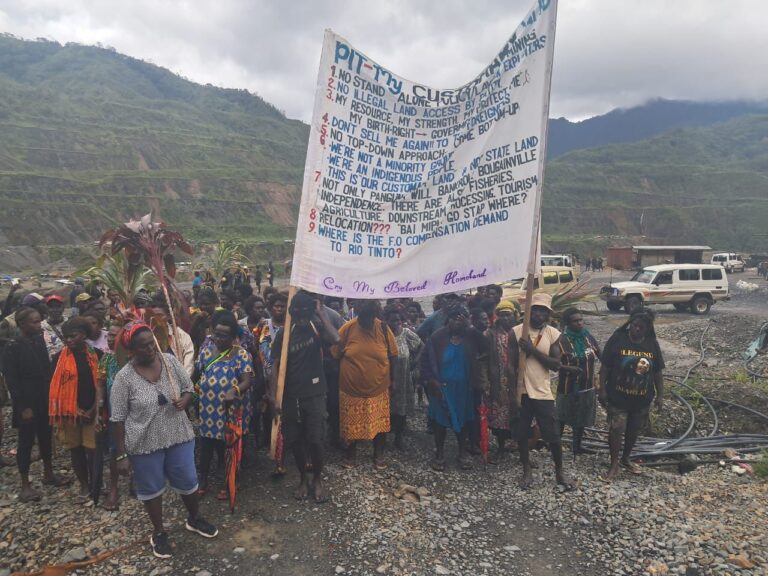
The announcement follows a protest last Friday by landowners in the Panguna Mine Pit area who opposed the reopening of the mine, citing unconsented entry and lack of consultation with actual mine site owners.
President Ishmael Toroama, who is also Minister for Mining, said engagement activities had been temporarily suspended for two weeks due to Cyclone Maila, which affected accessibility and community readiness.
“The ABG, in coordination with relevant stakeholders, will now recommence its structured engagement program following these disruptions,” President Toroama said.
The consultations will involve Panguna landowners, Community Government representatives, Ward Members, and other local authorities. They mark the continuation of stakeholder and landowner engagement efforts disrupted by the cyclone.
President Toroama said this phase will focus on addressing key issues and grievances identified during earlier consultations. This includes strengthening understanding of the Cooperation Agreement between Bougainville Copper Limited (BCL) and Lloyds Metals & Energy Ltd (LMEL), and clearly outlining the roles and responsibilities of all parties.
“The process will also seek to build consensus among landowners and ensure that engagement is carried out in an inclusive, transparent, and orderly manner,” he said.
In parallel, the ABG, through the Central Parliamentary Committee (CPC), will undertake constituency-level engagements across Central Bougainville focused on the dissemination of factual information on Panguna-related matters. These are intended to strengthen communication between leaders and communities, said President Toroama.
Toroama stated the Representatives from BCL and LMEL will participate in the engagement program to provide further clarification on their respective roles and responsibilities under the Cooperation Agreement.
President Toroama acknowledged there are differing views within the community regarding developments at Panguna.
“A key priority of this engagement process is to promote inclusive participation, including constructive engagement with individuals and groups who may have concerns or who oppose aspects of the current process. The Government remains committed to ensuring that all voices are heard,” he said.
In the announcement made yesterday, the ABG will also provide further clarity on grievance mechanisms available to landowners under the Bougainville Mining Act 2015, as well as those outlined in the Land Access and Compensation Agreement (LACA) signed between Panguna Landowners and Bougainville Copper Limited in late 2024. The agreement applies to BCL and any entity authorised by BCL to undertake activities under the EL01 Panguna licence, including LMEL under the Cooperation Agreement.
“The Autonomous Bougainville Government reiterates its commitment to a peaceful, inclusive, and transparent process that reflects the aspirations and best interests of the people of Bougainville,” President Toroama said.
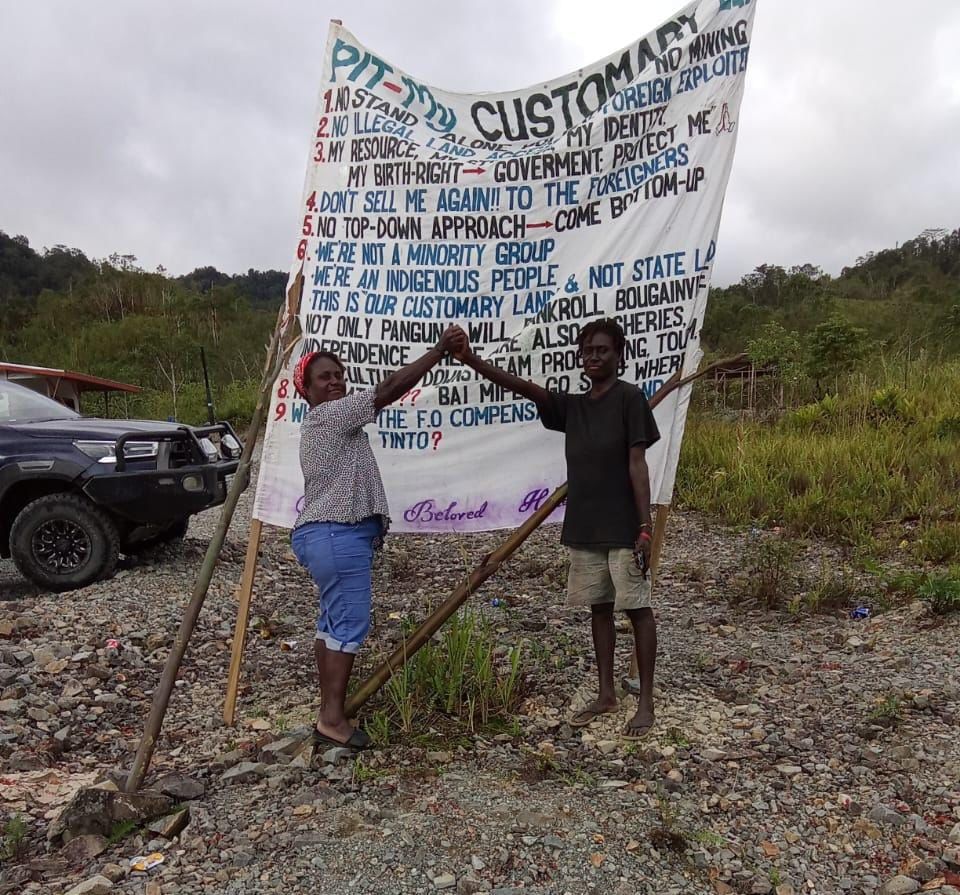
Traditional landowners from Bougainville staged a protest on Friday against plans by the region’s autonomous government to let an Indian company reopen the long-shuttered Panguna gold and copper mine.
At least several dozen staged a protest near the mine site in central Bougainville against Autonomous Region of Bougainville (AROB) President Ishmael Toroama’s plans to allow India-based Lloyds Metals and Energy Limited (LMEL) restart the mine, which was shut down by a local uprising over 35 years ago.
Female landowners from the villages of Guava and Moroni led the protest, which involved the ceremonial placement of a plant in the ground.
“To the Lloyds company and BCL (Bougainville Copper Limited) and others, we are planting this as a cultural symbol: we don’t want the Panguna Mine to reopen. This is a cultural ritual to put a stop to the reopening of the mine,” Chieftess Genevieve Ampa’oi said.
Picture supplied by Panguna Osikaiang
The protest comes amid opposition from prominent Bougainvillean community leaders including Domana Ward member and former rebel commander Moses Pipiro. Critics say Toroama has not properly consulted with the local land and resource owners of the Panguna mine site.
Community members have also raised concerns about what they say is the engagement of veterans from other areas of central Bougainville as security for LMEL, which they fear could lead to conflict.
Toroama’s office declined to comment when contacted by Inside PNG.
Experts estimate that tens of billions of dollars of mineral wealth remains in the mine site, but plans to reopen the mine over the years have been stymied by community opposition and deliberations over cleanups and compensation related to environmental damage from the mine’s previous operations.
This initiative, part of a long-standing inter-parliamentary cooperation, underscores Bougainville’s commitment to strengthening democratic institutions as it navigates its post-referendum path.
The visiting delegation, comprising Peter Topura, Clerk of the Bougainville House of Representatives; Adrian Hihiru, Assistant Legal Counsel; and Wesley Porake, Director of Finance and Administration, represents a focused effort to gain practical insights from a fellow Pacific Island nation.
A FOUNDATION OF REGIONAL COOPERATION
The attachment is a direct outcome of a parliamentary twinning arrangement established in 2007 under the Commonwealth Parliamentary Association’s Pacific Twinning Program.
This partnership, which also includes the Parliament of New South Wales (NSW), Australia, aims to strengthen institutional capacity, promote democratic governance, and nurture regional parliamentary cooperation.
Clerk of the National Parliament of Solomon Islands Jefferson Hallu explained that under the twinning program “each state parliament in Australia is paired with one or two island countries in the Pacific.”
“The main aim is to foster collaboration, knowledge-sharing and capacity building. It’s something that is important in our legislatures,” he added.
“Apart from Australia, there are only other Pacific countries and in order for ‘Birds of the same feather to flock together’, we have to collaborate, share our common challenges and learn from each other, strengthen the democratic processes and procedures and in a way, strengthen Pacific parliaments and the parliamentary democratic process.”
Hallu noted that past activities under the twinning program typically took place in Sydney, Australia.
“The activities we have engaged in the past include, training placements, we’ve had good opportunity to be placed with respective departments in the more matured jurisdictions in New South Wales; and NSW has sent colleagues to us.”
BHOR’s visit to the Solomon Islands is a first of its kind within their twinning partnership and it has been very exciting and insightful.
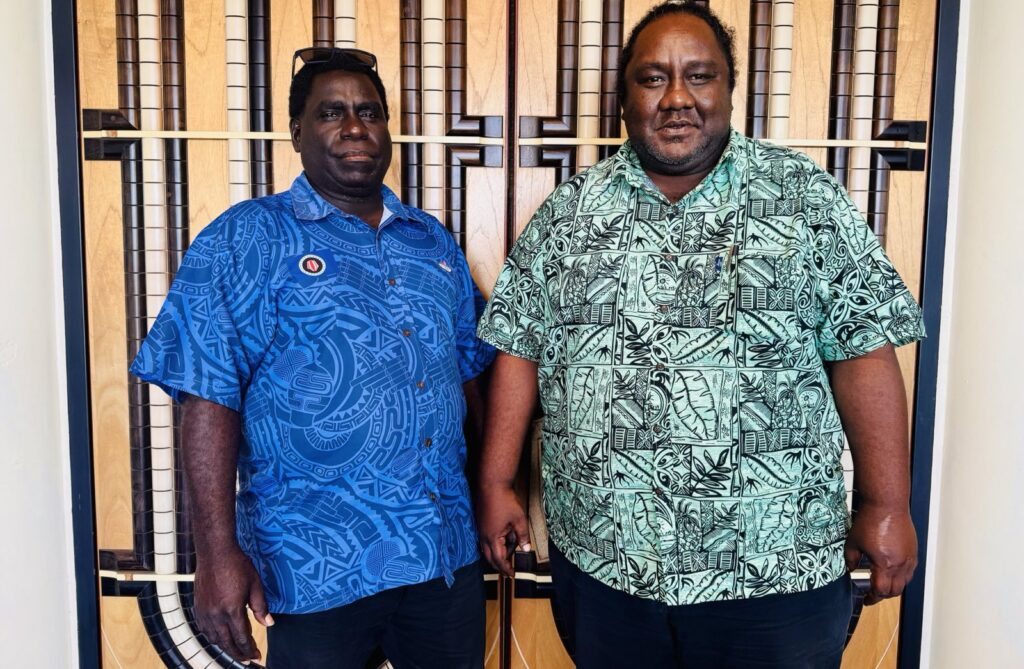
Clerk of the Bougainville House of Representatives, Peter Topura(Left) and Clerk of the National Parliament of Solomon Islands, Jefferson Hallu.
Clerk of the Bougainville House of Representatives, Peter Topura said, the visit by BHOR had a focus on committee work and procedure, however, he has now decided to include the Finance aspect in Parliamentary service to their list of learnings.
“Now my thoughts are to include the finance aspect in parliamentary service so we can understand how parliamentary service finance works in parliamentary procedures and legal service work here in the Solomon Islands.
“Because our focus is to learn and twinning is part of collaboration and learning from each other.
“In Papua New Guinea, we have a parliamentary partnership with the National Parliament and we do an attachment with PNG, that is within the country. This one is outside of the country under the Commonwealth Parliamentary Association,” Topura added.
He explained that BHOR joined the CPA in 2006 and has since attended various conferences, seminars, and workshops.
When the twinning concept was introduced in 2007, BHOR officially became part of the partnership in 2010.
Both Hallu and Topura, who were appointed between 2024 and 2025, said the partnership has helped them exchange knowledge and grow professionally and contribute to their respective parliaments.
GAINING PRACTICAL EXPERTISE FOR BOUGAINVILLE’S FUTURE
Throughout their time in Honiara, the Bougainville officials are engaging directly with key departments of the National Parliament of the Solomon Islands.
This immersive experience is designed to provide first-hand insights into the administrative, procedural, and legal functions vital for effective parliamentary operations.
Meetings are scheduled with the Parliamentary Procedure Office, Finance and Administration, Committee Secretariat, Library, Research and Information services, Public Engagement Department (including Civic Education and Media), and the Hansard Department.
When asked about their specific objectives for the attachment, Topura shared, “in terms of politics and what we do at the Parliamentary level, we are more focused on building parliaments, that’s what we do”.
“In terms of finance, how parliament is supported by the Government in doing its work; committee work and supporting members constituency responsibilities.
“In terms of procedures we are understanding how bills are brought to parliament and what stages they go through and basically how the parliament prepares its bills; where does it go until the bill is passed.”
The delegation expressed optimism about applying these learnings to Bougainville’s unique context.
Topura said context in any situation, any location can be different but the processes of any parliament remain the same.
This targeted learning is particularly crucial as Bougainville continues its journey towards greater autonomy and self-determination.
BUILDING RESILIENT INSTITUTIONS
Hallu and Topura also reflected on the broader challenges and opportunities facing their respective Houses.
“One of the values we hold dear to our work in Parliament is to remain apolitical and not to let political convictions and abuse affect our work as a staff of parliament,” said Hallu.
In the same tune, Topura added that their roles are to be impartial and neutral at all times, however, within the Melanesian societies where our ways are deeply rooted to our culture, it poses the biggest challenge.
He said in Australia, they’ve barely seen this as much of a challenge, hence amplifying the significance of their partnerships with the PNG and Solomon Islands parliaments.
“That’s something we are working on and discussing with the PNG National Parliament and Solomon Islands National parliament, we want to learn how to deal with this.”
A MESSAGE OF COLLABORATION
This visit reaffirms the unwavering commitment of both the Bougainville House of Representatives and the National Parliament of Solomon Islands to ongoing collaboration and mutual learning.
For the National Parliament of Solomon Islands, hosting such programs also offers reciprocal benefits.
“Now we are in discussions on how we can work together, and they (SINP) can come to Bougainville as part of the Twinning Program,” said Topura.
In agreement, Hallu said “SINP is looking forward to strengthening the partnerships by reciprocating visits and exchanges between the BHOR and SINP.”
Looking ahead, the commitment to regional stability and democratic development remains paramount.
And while they appreciate the support and training from international relations including that they have received in twinning placements in NSW parliament, both BHOR and SINP agree that greater collaboration among Melanesian nations and the wider Pacific region is crucial to strengthening regional unity and stability.
Ultimately, this attachment program underscores the vital role of regional partnerships in building resilient parliamentary institutions, laying crucial groundwork for Bougainville’s self-governing future and reinforcing the Solomon Islands National Parliament’s contributions to a stronger, more democratic Pacific.
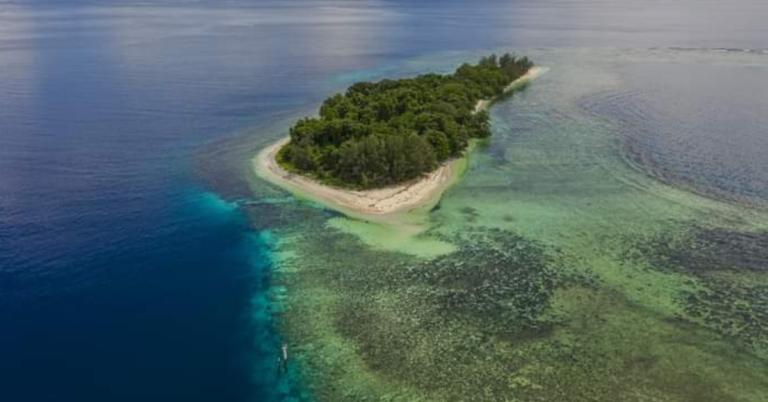
It seems incredible, given the vast ocean surrounding the atolls in Bougainville’s north, that these palm-clad places could experience drought.
Yet the tiny specks in the Solomon Sea to Australia’s northeast have suffered six months without rainfall, imperilling lives and sparking a mighty effort to bring relief.
Gideon Haukani, who grew up on the Nuguria islands, says the desperation has forced the closure of schools “because teachers need to go and look for food for their family”.
Locals wake as early as 2am to paddle by canoe to nearby islands on the hunt for coconuts or food to bring home.
As well as obvious challenges like water shortages and failing crops, the drought has drawn less expected difficulties.
Dwindling water sources have led to sandfly and mosquito populations intensifying near human settlements, leading to mass bites and infections.
Around 150km southwest of Nuguria, on Nissan Island, Sylvia Rennethsie says the unyielding heat eviscerated her yam crop and took a toll on her community.
“A widow fell off and slit her face on a stone because she was hungry,” she tells AAP.
“She got skin disease due to excessive heat. To make it worse, there was no medicine … the government cannot afford medicine so we suffer the consequences.”
Mr Haukani’s Nuguria is one of a series of atolls and islands in the north of Bougainville, the wantaway region in Papua New Guinea’s far east.
Tourism is non-existant and few outsiders visit, though whaling ships passed through in the 19th century.
Nissan Island was briefly a theatre of World War II visited by future US President Richard Nixon, then a humble supply officer.
For thousands of years before that, the isolated chain has been home to subsistence-focused communities.
“People are living a simple life,” Mr Haukani says.
That was until the drought, which began in November last year, which Mr Haukani rates the worst elderly locals can remember.
Needing humanitarian relief, Australia answered the call, funding a $500,000 package through CARE Australia including immediate needs – primarily water and food – and later, the installation of water tanks.
But it is one thing to offer relief and quite another to deliver it.
Emily Meren, CARE Papua New Guinea‘s humanitarian projects manager, says they received a green light in April to take aid to Pinapel Island and Nuguria, deemed to have the highest need.
That involved procuring and sailing goods from Morobe province on mainland PNG some 900 kilometres east to Buka, the Bougainville capital, taking two weeks.
As that ship had other contracts to attend to, the group was then stranded in Buka for a fortnight while sourcing another vessel to sail north for the 11-day distribution journey.
Logistical difficulties such as these are a reality of life in under-developed and under-resourced PNG, and Ms Meren encountered no different on arrival at Mantoia on Pinapel Island.
“There was no jetty, mind you, so we had to anchor offshore and the community had only two outboard motors functioning,” she says.
“The whole community’s lined up to like an assembly line to pass the relief items to shore and it took us well into the evening … it was exhausting for everyone.”
Next came packing and a fair distribution negotiated through chiefs, before a second drop-off at the village of Rogos on Pinapel’s other side.
“We had to ask the leaders in Mantoia to walk across (the island) to support their people at Rogos to speed it up,” Ms Meren says.
Then, another 12 hour overnight sailing north to finish the job at Nuguria, where conditions were worsened by previous storms.
“In good times, they have bananas or cassava growing,” Ms Meren says.
“When the drought heats, all of those dry up so they have to go back to mangrove seeds and coconuts to live on, which means drinking water from coconuts as well.
“But in Nuguria, there was a king tide last year and so many of the coconut trees died out.”
The logistical delays meant that by the time they landed, minor rainfall had arrived, along with some rice from another aid effort, helping avoid a catastrophic situation.
The aid allowed locals to top up their dwindling tanks – installed more than a decade ago as part of another CARE relief effort – and turn their minds to prevention efforts.
Islanders are in no doubt more is needed to safeguard the communities: regular ferries, economic development, better health support.
“Because it’s so isolated, when teachers or others come back for their break, its very hard to get back,” Mr Haukai says.
“A health officer came to Buka and was stranded because there was no transport going back home for six months.
“There is no economic projects that are happening … we have resources in the sea, we have fish, sea cucumbers, copra, coconut but we don’t have a relay-able service to ship their products.”
Ms Rennethsie also laments the changing climate and increasing likelihood sea level rise will alter their lives.
When a patchy signal allows, she shares a picture of a young child via Whatsapp, explaining the drought caused misery for her family.
“She does not like to eat anything else apart from pawpaw and her parents found it hard to deal with her demands during the drought,” she says.
“I am afraid the effect of climate change might have a great impact on my island … we are a vulnerable community.”
Panguna Mine issues took center stage at the recent CANCONEX Resource week hosted by the Papua New Guinea Camber of Resources and Energy (PNG CORE).
Despite being closed for more than 30 years the mine is in the stages to re-open but legacy issues that have been left by Bougainville Copper Limited’s operations until its closure need to be addressed.
The President and his cabinet of the Bougainville Executive council granted an extension of the exploration license, EL_01 to Bougainville Copper Limited (BCL) on the 28th of January, 2024.
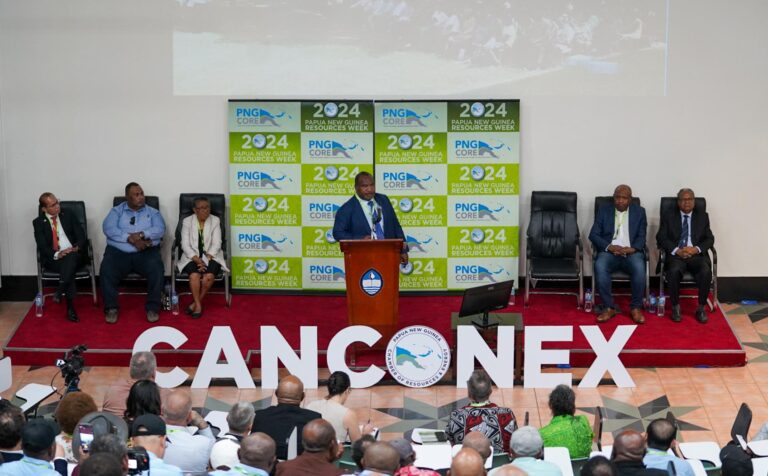
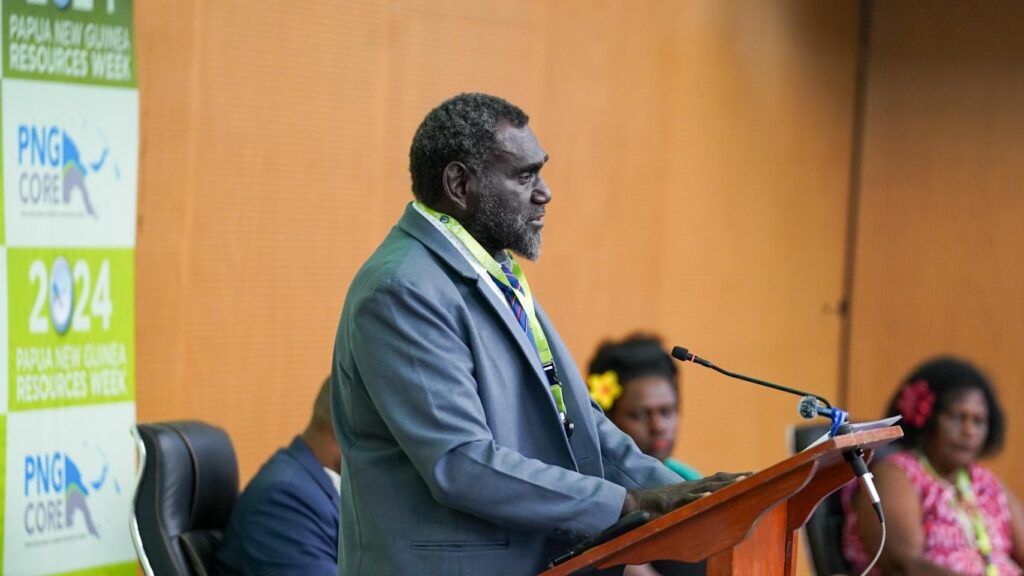
President of the Autonomous Region of Bougainville, Ishmael Toroama speaking during CANCONEX. [[Photo: PNG Media]]
The Panguna Project is already licensed under an Exploration License for a term of five years.
What the Land owners and the people directly affected by the mine want, is to get some closure to the legacy issues, which include the environmental destruction caused by the mine.
Present at CANCONEX was President of the Autonomous Region of Bougainville, Ishmael Toroama, who gave an overall report on the legacy issues of the mine including the way forward to reopening Panguna.
Theonila Roka Matbob, member for the Ioro Constituency in Central Bougainville, is a Panguna mine landowner and she is very vocal about the legacy issues left by the mine.
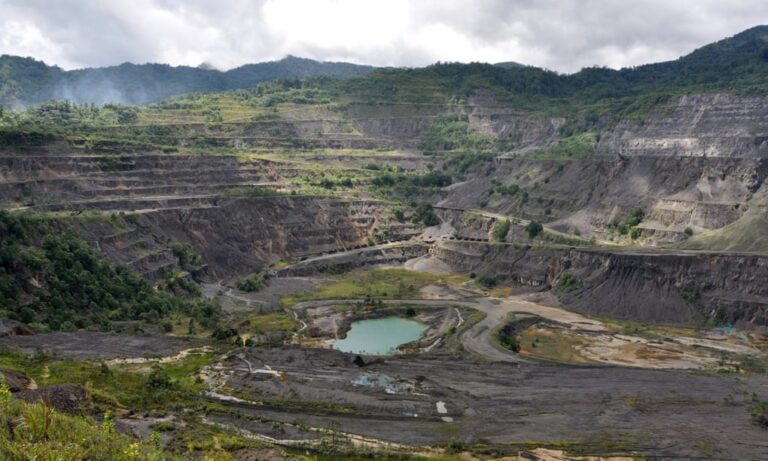
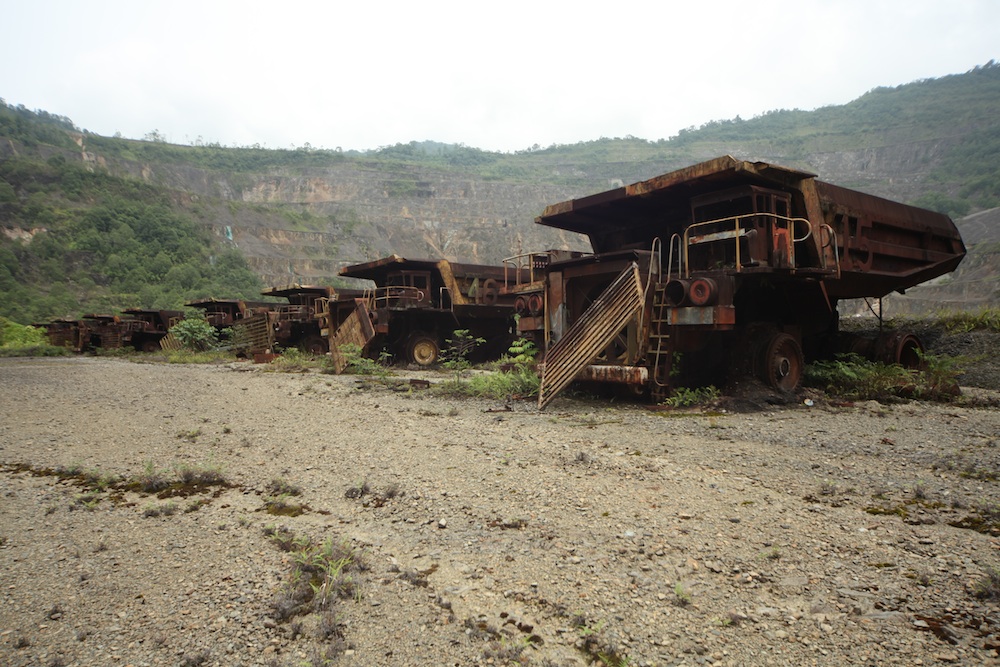
Old Trucks at the Panguna Mine.
She is the Minister for Community Government and also a long time activist on Panguna issues, she said during CANCONEX that they want to close the old chapter of Panguna as they move on to the new chapter.
She mentioned that there is a report; the PANGUNA MINE LEGACY IMPACT ASSESSMENT, which is set to be complete by August.
The report will help the People of Panguna understand the extent of the mine legacy issues.
The Panguna issue remains sensitive but parties in the efforts to re-open the mine are working closely together.
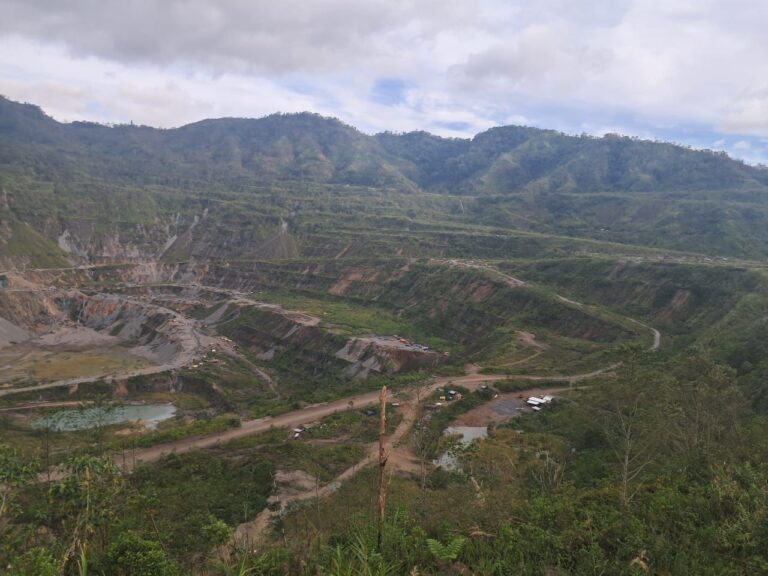
Panguna Mine. [[Photo//Llane Munau]]
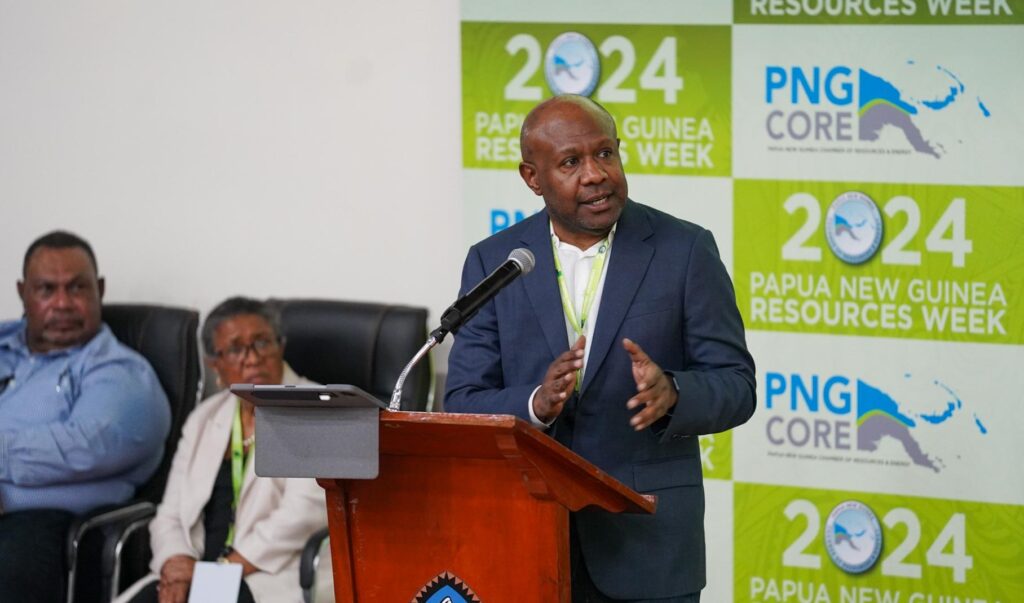
Bougainville Copper Limited Chairman, Sir Mel Togolo was also part of the discussions at CANCONEX, he said BCL had a more community oriented approach and there is widespread acceptance for the mine’s reopening in the Panguna Area.
President Toroama who is also Minister for Minerals & Energy says all the discussions and dialogue between the Land Owners and the ABG, carefully considered support for local content and Resource Owners, he said this was paramount because it is the Land owners that own the Resource.
Theonila Roka stressed that what is important is a plan to see a more viable future for resource owners considering their attachment to the land and its resources, and they can be more sustainable after the project ends.
President of the Papua New Guinea Chamber of Resources and Energy or PNG CORE, Anthony Smare says the Community Affairs and National Content Conference and Expo or CANCONEX is a safe space for uncomfortable courageous conversations.
Smare made the comment during the conclusion of the 2024 National Community Affairs & National Content Conference & Expo. CANCONEX, the conference and Expo started on the 1st and ended on the 3rd of July, and was hosted by the University of Papua New Guinea.
There were presentations by companies and stakeholders in the Mining, Petroleum and Energy sectors, and afterwards panel discussions, creating interaction between Resource Landowners, activists and Major Companies in the extractive and Energy industries.
With the focus on Community Affairs and Local Content, discussions on challenges and innovations in improving and addressing issues of national interest, that affect resource landowners and companies alike, were presented to over a thousand attendees over the three days.
One of the highlights of the CANCONEX was a continuation of last years inaugural CANCONEX in Lae, which featured the Issues of Bougainville; this years edition also welcomed the resource landowners from Bougainville and key partners which included the Autonomous Bougainville Government (ABG), the Bougainville Copper Limited (BCL) and the Panguna Land Owners.
Sensitive discussions on the legacy issues of the Panguna mine and the progress of reopening the mine took center stage, with the audience very much in tune.
The President of the Autonomous Region of Bougainville (AROB), Ishmael Toroama, was present, he gave a speech and later the president was part of a panel discussion with BCL, and representatives of the Landowners, which included Theonila Roka Matbob, member for the Ioro Constituency in Central Bougainville, which is part of the Panguna mine area.
President of PNG CORE, Anthony Smare was invested in the conversations and facilitated the panel discussion, on Bougainville issues, he stressed during the closing of CANCONEX that the discussions were informative and very diverse.
“We need safe spaces for uncomfortable courageous conversations, we saw this in the session, the ABG President was here and Bougainville Copper Limited was here, BCL was not welcome back to Bougainville for 20 years, But I was surprised to hear them say that, mining was essential to grow their economy, as the President had said.
“But they were doing it in a way that they knew they had legacy issues and through processes such as remediation in which the people and the ABG are involved in, and that illustrates the importance of having safe spaces where extremely diverse views can be heard where people don’t take it personally but they realize its important to build a future where people feel included and they own that future,” Smare added.
With the convergence of resource owners and companies together not all views are agreed to, but like the President of PNG CORE alluded to in his closing remarks, the convention attendees are always expected to keep an open mind when observing discussions.
“I salute the companies that support this and that sponsor this, because they know that the people that are most uncomfortable with these conversations are the companies themselves, when they hear being mentioned.
“CANCONEX is successful because of what we want people to commit to when they come in, which is to open your mind to opinions which you don’t agree with, with people you don’t necessarily agree with or that you think you have nothing in common with, someone you have never met before, and this event only works because of the commitment the attendees make, you attend all the sessions and you talk to the interns the CEOs, Resource Landowners and community activists you have a whole spectrum that come here,” Smare added.
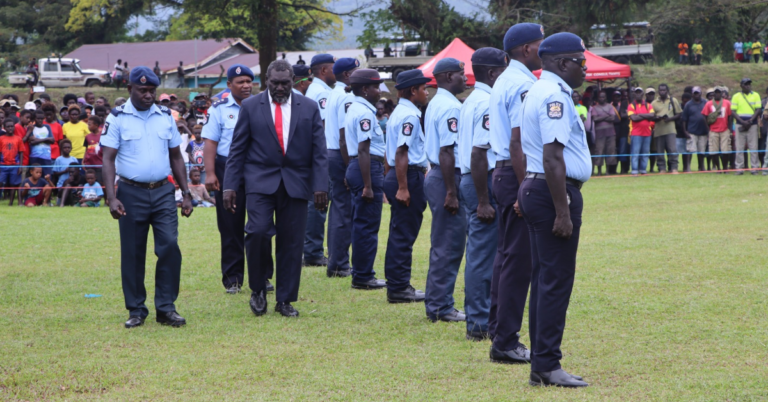
Bougainville President, Ishmael Toroama said the appointment of Assistant Commissioner of Police, Anthony Wagambie Jnr as Deputy Chief of Police in the Bougainville Police Service is not recognized by the Autonomous Bougainville Government.
Toroama’s comments follow a change of command directive issued by police commissioner, David Manning.
“This appointment will not be recognized by the Autonomous Bougainville Government as it is unconstitutional and breaches the Bougainville Peace Agreement,” Toroama said in a statement.
Wagambie was transferred to Port Moresby from Lae and served as the NCD and Central Divisional Commander until his suspension in January over the riots in Port Moresby.
Under Section 26 of the Organic Law on Peace Building on Bougainville and Section 237 of the Bougainville Peace Agreement, “The appointment of the hierarchical officers in the Bougainville Police Service by the Commissioner of Police is to be based on the direct nomination of a suitable candidate by the ABG through the Bougainville Executive Council”
Toroama said the National Government through the Commissioner of the Royal Papua New Guinea Constabulary had ignored his government in this decision
” We were never consulted nor privy to the process of appointing the Deputy Chief of the Bougainville Police Service,” Toroama sai.
He commented further that PNG’s disciplinary forces are barred by the Peace Agreement from instituting any decisions, be it administrative or tactical on Bougainville without the knowledge and input of the Autonomous Bougainville Government.
“I am dissatisfied with the manner in which the National Government of Papua New Guinea has yet again usurped the role of the Autonomous Bougainville Government in implementing the parameters of the Bougainville Peace Agreement,”Toroama said in a statement.
The joint creation of the Bougainville Peace Agreement by the National Government and the people of Bougainville legally requires the joint implementation of its provisions.
‘I want to be clear to the National Government that Mr. Wagambie’s appointment to the Bougainville Police Service by RPNGC Commissioner David Manning is neither welcomed nor recognized by the Autonomous Bougainville Government,”Toroama said.
The Bougainville Peace Agreement does not exist merely to protect the civil liberties of the people of Bougainville and resolve the Bougainville Conflict. The peace agreement is also intended to empower the autonomous arrangements for Bougainville that came into existence as a direct result of the agreement in 2001.
The Autonomous Bougainville Government has given too much quarter to the National Government in usurping the legal process in the administration of Bougainville’s autonomous arrangements and the Post Bougainville Referendum consultations.
Conservation areas within Pirung Wildlife Management Areas in the Bougainville Region was presented through a documentary film in Port Moresby.
Following this, the PWMA documentary will be made accessible to the local communities who host the PWMA through a community viewing program starting on 23 October to 1 November 2023.
Pirung Wildlife Management Area (PWMA) is the only gazetted Protected Area in Bougainville. Located on the South-Eastern part of Bougainville island, it stretches over 60km in length and 10km in width. Making it one of the largest Protected Marine Area in the country.
The documentary is presented by ABG Directorate for Environment, Conservation and Climate Change. Under the Department of Lands and Physical Planning showcases the cultural and biodiversity conservation efforts practiced in the Protected Area.
In watching the documentary, the ABG believes it will enhance people’s understanding. Empowering the communities to protect their marine environment.
Lynette Baratai-Pokas, is the ABG Secretary for Lands, Physical Planning and Environment and Conservation & Climate Change. Her environment officers will be presenting the documentary to the communities. The planned documentary viewing in Bougainville is scheduled as;
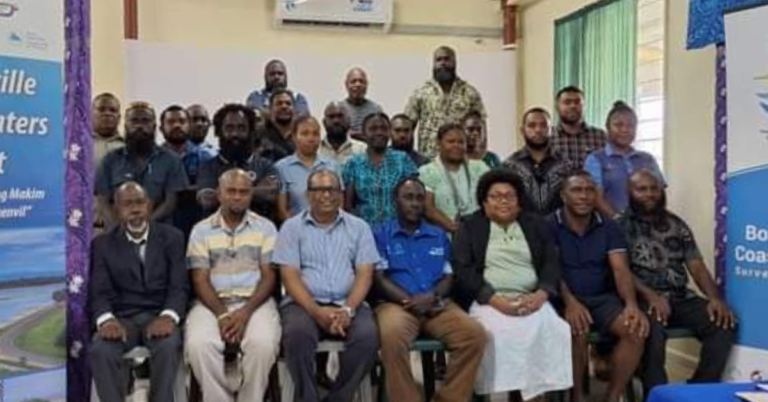
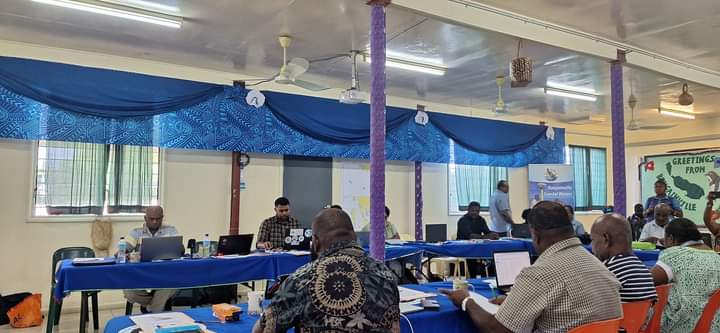
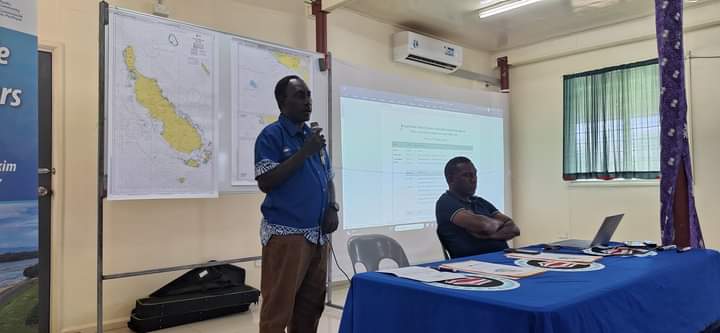
A workshop providing insight into awareness and capacity in modern geospatial and survey techniques has concluding in Buka.
Held ahead of the Bougainville Coastal Waters Survey which is secluded to take place later this month, the awareness is considered critical to equip officers with the necessary technical skills and knowledge as they prepare for the field survey.
The Program is set to map out areas that constitute as ‘Bougainville waters’, as part of the drawdown of fisheries powers and functions to the Autonomous Bougainville Government.
ABG President, Ishmael Toroama launched the Survey today in Buka, making Bougainville the first maritime region in Papua New Guinea to undergo this coastal mapping process.
“Today, we embark on a journey that will play a pivotal role in shaping the future of Bougainville. This Survey will contribute to our preparation for political independence as it will mark the benchmarks for Bougainville’s coastal waters,” Toroama said.
For the Autonomous Region, the completion of the Bougainville Coastal Waters Survey will signify the start of formalizing Bougainville’s maritime boundaries under guidance of the international framework of the United Nations Convention on the Law of the Sea (UNCLOS).
It will further advance the geospatial and survey capabilities of the region, ultimately contributing to the responsible management of coastal waters and maritime resources in Bougainville
The Bougainville Coastal Waters Survey Geospatial Workshop was facilitated through the ABG Department of Primary Industries & Marine Resources, the National Fisheries Authority, the National Department of Justice and Attorney General, the National Maritime Safety Authority and the Geoscience Energy & Maritime (GEM) Division of Pacific Community (SPC).
Toroama said the delimitation of sea boundaries is more than just drawing lines on a map; it is about defining the territorial sovereignty and the rights of the people of Bougainville.
“It is about ensuring that Bougainville’s voice is heard and respected on the global stage as we move closer to realizing their aspirations,” said Toroama.
The mapping of Bougainville’s coastal waters will enhance maritime services, regulate shipping services, reap economic benefits from infrastructure and marine resource development, as well as enable Bougainville to possess reference coordinates that determines its baseline, internal waters and coastal waters.
ABG technical officers from the ABG Departments of Primary Industries, Lands, Commerce, Mineral and Energy Resources and other supporting departments in the Bougainville Public Service, also completed a week-long workshop learning about using modern geospatial techniques to be applied during the field survey.
Beginning on 16 to 28 October 2023, four survey teams will be deployed to identified coastal communities across North, Central and South Bougainville to undergo the field survey of the coastal mapping.




![Panguna Mine. [[Photo//Llane Munau]]](https://insidepng.com/wp-content/uploads/2024/07/WhatsApp-Image-2024-07-13-at-13.10.52.jpeg)