Category

News

Category

by Harlyne Joku

Papua New Guinea companies that pay their workers below the standard minimum wage of the K3.50 per hour rate will be penalized.

PNG’s Deputy Prime Minister responsible for Labour and Industrial Relations, John Rosso  gave this warning last Friday (10th of February).

“Our main focus is enforcing there is compliance. We know that certain companies are not complying with decent work conditions and paying their workers below the minimum wage.  We will be coming down heavily on them,” Minister Rosso said.

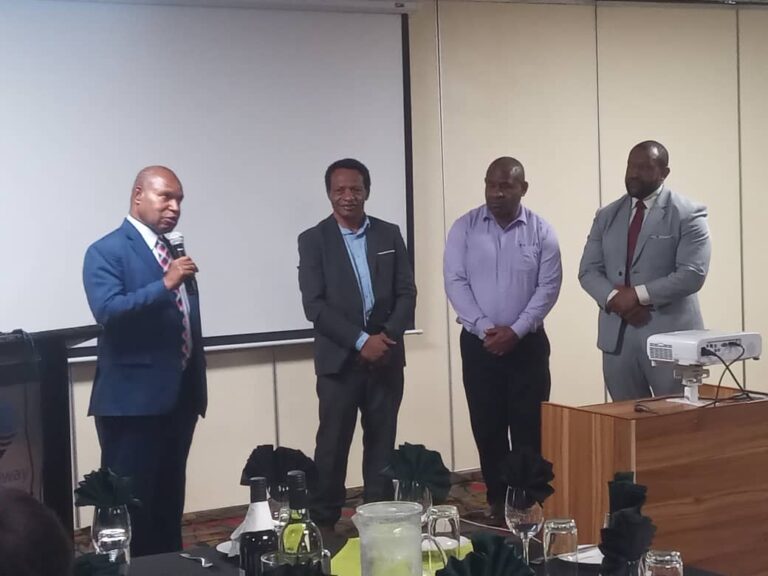
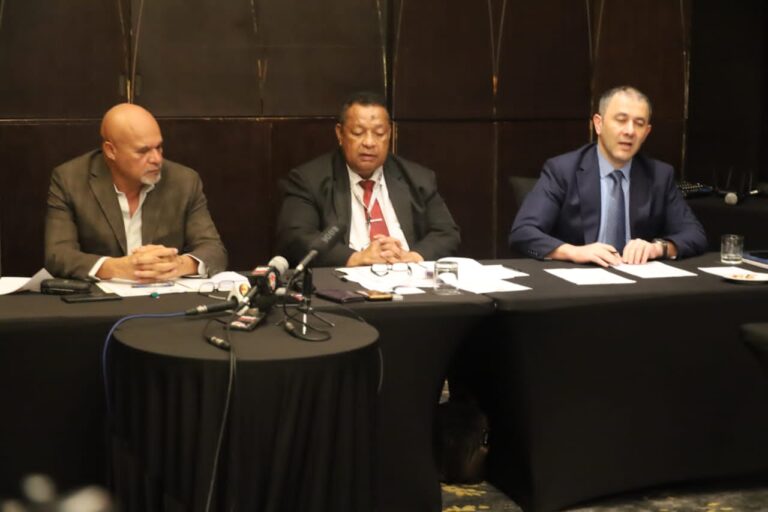
He made the remarks at a press conference last Friday to announce the ratification of three international treaties relating to International Labour Standards. The Treaties were the Violence and Harassment Convention no 190, Labour Inspection Convention 81 and Tripartite Consultation (international Labour Standards) Convention No 144.

DPM Rosso commended the Secretary for Labour and Employment George Taunakekei and his labour team for working hard to review and amend labour laws and draft the laws for parliament to ratify.

Mr Rosso said on the 18th of January 2023, the national parliament of Papua New Guinea passed a resolution by an absolute majority for the ratification of the Labour Inspection Convention 1947, (No 41) and the Tripartite (International Labour Standards) Consultation Convention, 1997 (no 144).

“In an evolving world of work, it is essential that the international labour standards cannot be overlooked.

“Labour Inspection is a vital public function. It is at the core of promoting and enforcing decent working conditions and ensures the respect for the fundamental principles of rights at work.

“ON the same note, the tripartite consultation convention is important. It sets forth an enabling platform for employers and workers to have effective consultation with government on matters relating to the application of international labour standards,’’ Mr R0sso said.

However, PNG’s National Tripartite Consultative Council (NTCC) has not held a meeting for more than two years according to the labour laws.

When asked when and why, Secretary of Labour and Employment Mr Taunakekei said the Covid 19 pandemic was the main cause of the delay plus having the members available to convene.

Mr Rosso also condemned all forms of violence and harassment including gender based violence the workplace.

“Violence and Harassment including Gender based Violence (GBV) in the world of work remains pervasive. In recent times reports and statistics on different forms of violence occurring has become alarming as we continue to read and hear about it not to mention the cases that go unreported each day. There should be no room for acts of violence and harassment in our workplaces.

“I take this stand to condemn all forms of violence and harassment and this includes gender based violence,” the concerned Deputy Prime Minister said.

The ILO International Labour Organisation Director for the Pacific Island Countries Matin Karimli who was present said the ILO will support the government on enforcement.

The PNG Trade Union Congress Vice President Mr Raphael Waiyalaka representing PNG workers said they support the review and new laws and will work closely with the government and employers to ensure the new laws are enforced.

The PNG Employers Federation Representative Winston Yuka also said the same.

Photo Courtesy: Nelson Thom
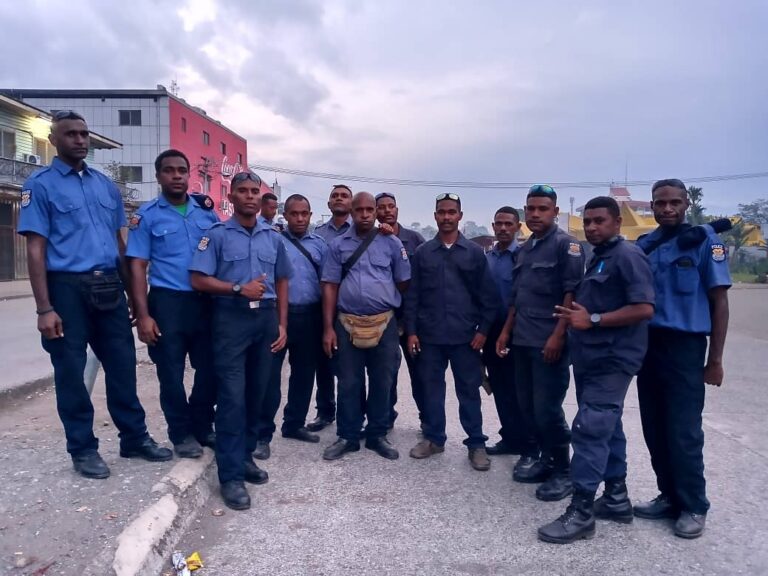
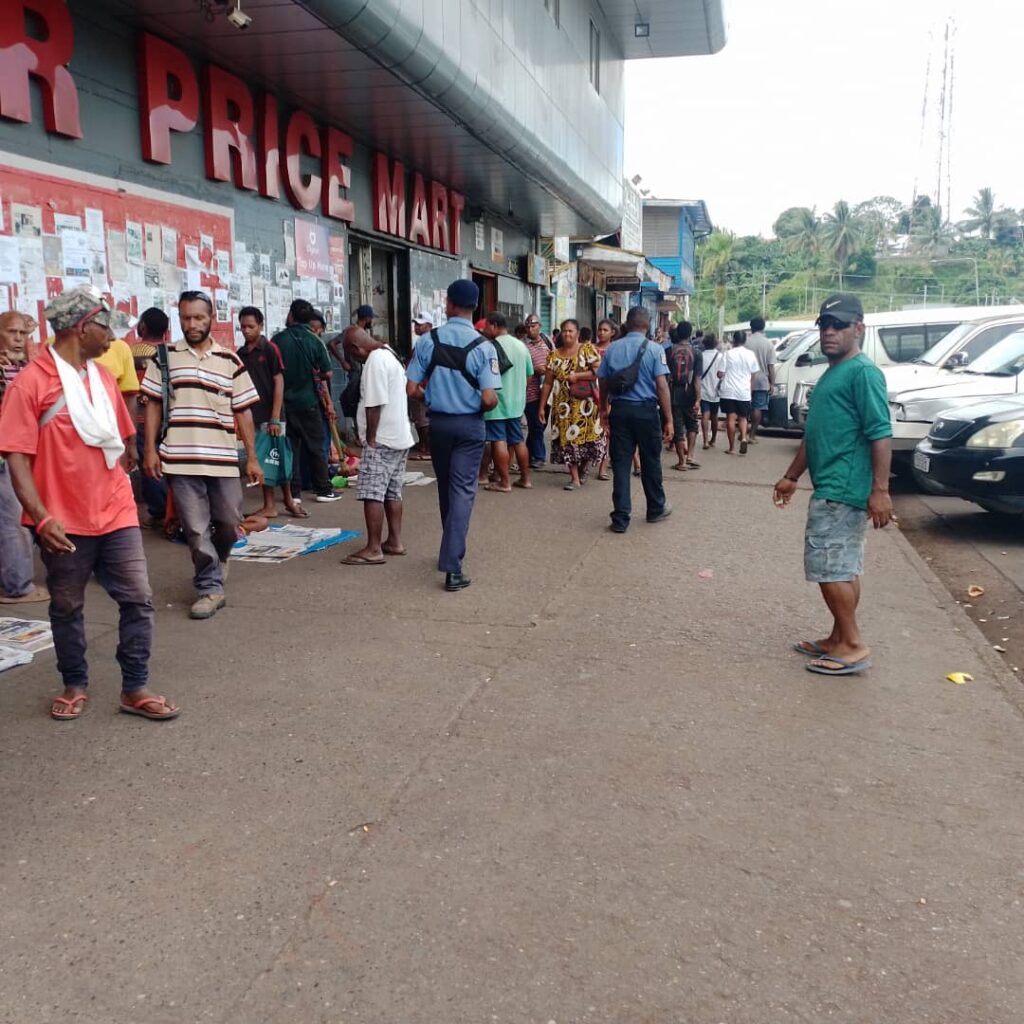
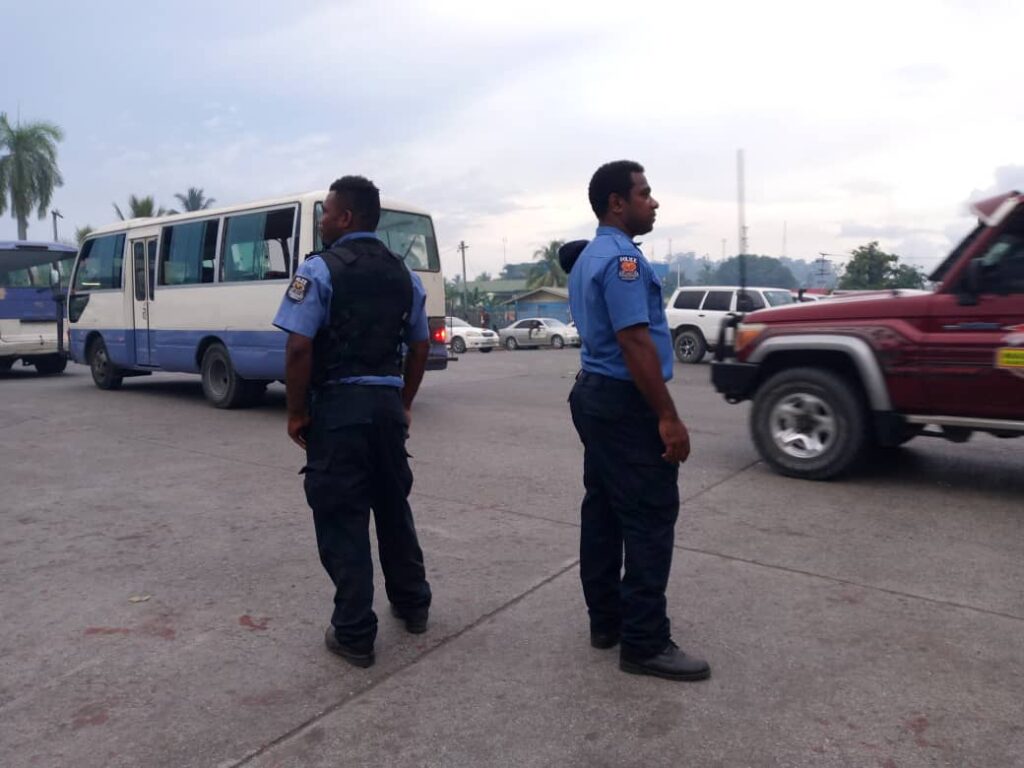
Member for Lae and Deputy Prime Minister, John Rosso said Police personnel conducting foot-beat patrols in the city, especially at Eriku, Top Town and the Market area has minimized petty crimes, and street vending, allowing members of the public to move around freely and safely.

Rosso applauded the police efforts in maintaining law and order in Lae.

“I would like to say thank you and appreciate the new reserve police men, approximately a hundred members who are currently doing foot-beat and attending to petty crimes and illegal vending in our city.

They have recently passed out from a comprehensive training program over 3 months. This is a partnership between the Lae City Authority and the Royal Papua New Guinea Constabulary,” said Rosso.

Officer in Charge of Lae Metropolitan Command Reservists, Sargent Wilson Joseph says public support is needed to counter petty crimes and ensure a better, healthier and safer Lae.

“Street vendors threatening to attack our men because we’re depriving them from their illegal activities. It must stop because it won’t deter us from doing our job.”

“Also, people need to get proper licenses from LCA to do their sales. Illegal markets arising everywhere must stop. Some, are health and traffic hazards to the public,” says Sgt Wilson.

Since 2017, the LCA under the leadership of DPM Rosso has delivered up to 20 police vehicles, built three new police stations and provided continuous administration and logistical support to the Lae Metropolitan Police Command including funding the reserve police program.

“It’s comforting to see these men in blue in public places. All of them are volunteers who have raised their hands to fight crimes and keep our city safe and clean,” says Rosso.

Rosso added that LCA will continue supporting and partnering the law and justice sector to keep Lae city safe for its citizens including investors and visitors.

“Furthermore, my thank you to every single police men and women in Lae both regular and reserve.

DPM Rosso also thanked law abiding citizens of Lae for their support towards efforts in making Lae cleaner and safer.

“To the people who practice illegal activities, illegal street vending and harassment of our mothers and law abiding citizens you have no place in Lae as police will step up their efforts in fighting crime in Lae,” says Rosso.

Lae Metropolitan Commander, Chief Superintendent, Chris Kunyanban thanked DPM Rosso and LCA and other stakeholders for the police reservists’ program which has provided extra manpower to the command.

“Since their (LCA Reservists) introduction, they have performed extremely well during the Morobe Show, Christmas and New Year Operations.

“Another demonstration of their timely and worthwhile assistance is the extra personnel maintaining presence at Eriku, Top Town and Main Market bus stops. We have received heaps of praises from the public and well done LCA reservists,” says Chief Inspector Kunyanban.

The Secretary for the Department of Justice and Attorney General, Dr Eric Kwa was charged this afternoon at the Boroko Police Station for Dangerous Driving causing Death.

National Capital District’s Metropolitan Commander, Silva Sika said the charges fall under section 328, subsection 2 and subsection 5 of the Criminal Code Act.

  • DANGEROUS DRIVING OF A MOTOR VEHICLE.

(2) A person who drives a motor vehicle on a road or in a public place dangerously is guilty of a misdemeanour.

(5) If the offender causes the death of or grievous bodily harm to another person he is liable on conviction on indictment to imprisonment for a term not exceeding five years.

Sika explained that this is usual process for arresting a person alleged to have committed a crime.

“He is still innocent until proven guilty. Everything will be determined by the court but it’s just a due process that we have to follow. Every one of us is subject to the law regardless of our status in the community.”

Bail has also been refused for PNG’s top lawyer.

“Because of the severity of the offence he has committed under the Criminal Code Act, bail has been refused.”

Bail will now be determined by the National Court.

In a press conference hosted by the NCD police boss following the arrest, police acknowledged Dr Kwa’s understanding of the legal process.

Dr Kwa will appear at the Waigani Traffic Court for his court hearings.

If found guilty,  Section 328, subsection 2 of the Criminal Code Act also states that the penalty will include;

On summary conviction–a fine not exceeding K200.00 or imprisonment for a term not exceeding six months, or both.

On conviction on indictment–a fine not exceeding K1,000.00 or imprisonment for a term not exceeding two years, or both.

On the 17th of October 2022, Dr Kwa and some of his staff were involved in a car accident along the Hiritano Highway.

They were enroute to Bereina Station for official work with Constitutional and Law Reform Commission.

Kwa had alleged that the accident was planned and that they were attacked by another vehicle.

While Dr Kwa and his other officers recovered from their injuries, they lost a female colleague.

Dr Kwa was (allegedly) driving the vehicle.

Simbu Governor, Noah Kool said, commercial economic activities in Karimui-Nomane district of the province can turn its provincial revenue numbers ten-fold as well as making it a food basket of the country.

The political head of the province wants to use the large fertile valley to stimulate growth in large scale agriculture, create jobs and business, unlocking its potential as an economic hub.

Karamui in particular is year marked as “A Special Economic Zone (SEZ)” in Simbu.

“Currently its K5 million (provincial revenue), we want to increase it to K50 million SEZ,” Kool said.

According to the Governor, Simbu has been relying heavily on Waigani and hasn’t been generating the internal revenue to run its local affairs.

“After 47 years, we must stop being beggars! Freeing Karamui, unlocking its potential, liberating its people and successfully developing Karamui SEZ will achieve economic independence for Simbu,” he said.

Minister for International Trade and Investments, Richard Maru said the province will become the first in PNG to begin to take the ambitious road of establishing a Special Economic Zone in one of its districts.

“I want to assure the people of Simbu and the Governor, I want to get the tender out by this Friday,” Maru said.

The tender is for Karamui’s own Feasibility study, apart from the nationwide study to establish a comprehensive report on areas that can be used for the SEZ and what’s needed in terms of enabling infrastructure, services, agriculture and business opportunities.

The Japanese through the Japanese Development Institute will help provide the insight into the establishment of the SEZ in Simbu.

Governor Kool said that enabling infrastructure like water, power and roads have to be in place to ensure the SEZ thrives in a business-friendly environment and trusts the Karamui SEZ will be a success because of the political and people drive.

“We believe the Karimui SEZ will be the first successful (one) in the country as all seven members of parliament are on board,” Governor Kool said.

A total of K1m was presented from the Simbu Provincial Government as counterpart funding to the International Trade Investment Ministry.

The Ministry also confirms through Minister Maru that Government has also put forward a K1.3m to begin the preliminary works.

Prime Minister, James Marape says elected leaders in the country must be honest in distributing funds allocated by the National Government to their constituencies to benefit the people.

He said funds must be equally distributed to education, health, law and order, agriculture, infrastructural developments, and other vital sectors.

The Prime Minister made these remarks at the Bats oval in Madang town yesterday during an unofficial visit to Madang.

Marape also tasked public servants in the electorates to be dedicated and serve the people with honesty and integrity.

He stated that public servants are the drivers of development, thus, it is important that they ensure an equal distribution of the allocated funds into the districts.

“People must benefit from agriculture, schools, roads, bridges, and other infrastructural developments in all the districts,” stated Marape.

The Prime Minister said his visit is also good for the Government to work with Madang elected leaders in making sure Madang issues are addressed.

Adding, that funding will also be made available to restore beautiful Madang.

Meanwhile, the Government has projected that for the next five years, all districts will receive K20million.

Thus, Madang would receive K120 million in total for the districts, this does not include funding allocation for the Provincial Government.

“So for the next five years, we will be giving about K100 million to each of the districts and Madang would receive over K600million.”

The Prime Minister made a commitment to look into addressing Madang roads, the airport, PMIZ project, the provincial hospital, law, and order, and a number of issues raised by Madang Governor Ramsey Pariwa.

 “You have a job, I have a job, we all have work to do”.

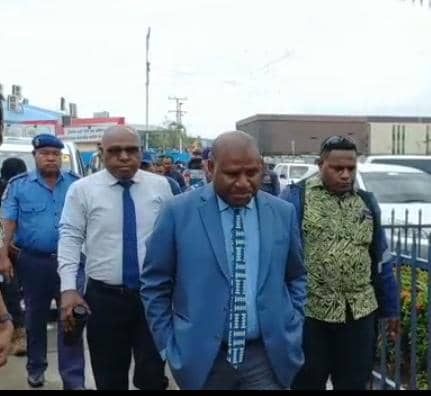
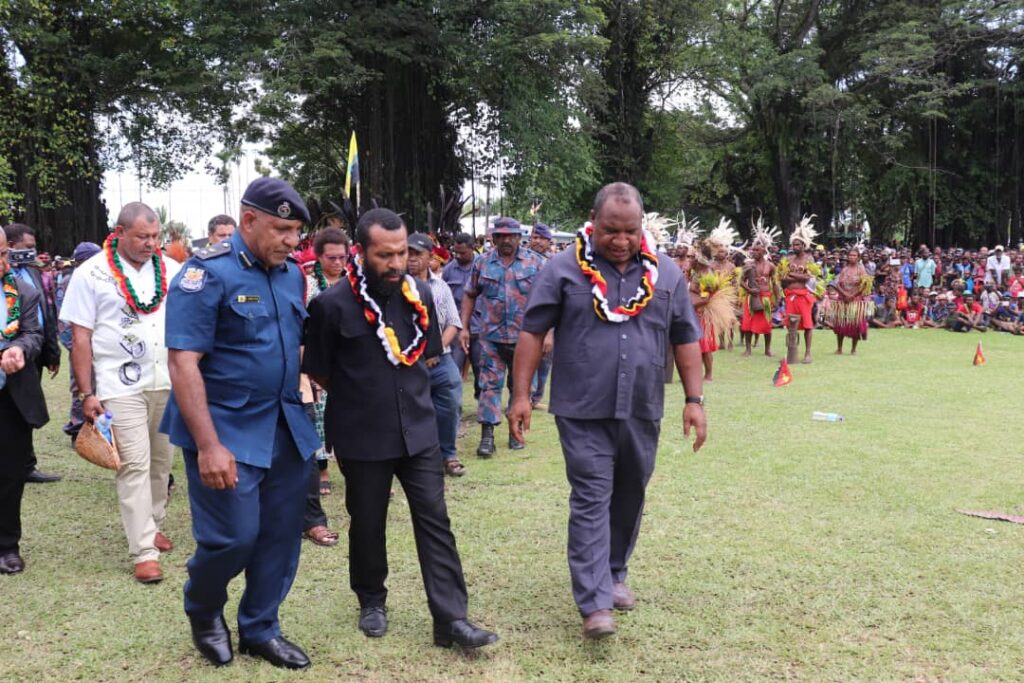
Picture: Prime Minister, James Marape walking alongside Madang Governor, Ramsey Pariwa at the Bats Oval in Madang.

An official date will be set for Madang elected leaders to meet with the Prime Minister and address concerns raised by Governor Pariwa.

The Prime Minister said his four-day road trip from Gulf to Madang to inspect the roads was part of the Government’s connect PNG project.

The road trip was also to convey a message of United Papua New Guinea whilst encouraging Papua New Guineans to till the land.

The government is also subsidizing the price of cash crops like copra, cocoa, and coffee so that farmers can benefit.

The Port Moresby Nature Park is giving away free sapling trees to all its guests who visit during the festive season holidays.

This is part of their Tree for Life Campaign.

” Our vision is to be PNG’s leading recreational space inspiring through education the guardianship of PNG’s unique natural environment. And trees make up a large number of plants that give us air, and food and protect wildlife, the soil from eroding, and rivers. This campaign is supported by One Tree Planted. A non-profit organization that strives to have one tree planted by at least one person living on earth. And Pom Nature Park is proud to have been a partner of OTP for a number of years,” said Dr. Adrian Fowler – CEO of the Port Moresby Nature Park.

In PNG, the Port Moresby Nature Park is a planting partner of One Tree Planted where seedlings are raised in its nurseries.

Currently, the nursery has raised over 10,000 saplings ready to be planted.

 ” Our approach is two-fold. There is an education process for the visitor and then there is the planting process where we ask the Park visitor if they would like to take home the tree to plant or to donate to a community project such as schools, churches, and organizations, such as the NCDC, who have land space to plant hundreds and thousands of these vital earth-saving life-forms that are trees,” said Junior Muli.

The broad categories of trees that will be given away for free are fruit and nut trees, rainforest trees, shade trees, timber trees, and landscaping trees.

The Park has been partnering with numerous communities and institutions for several years to plant trees and has seen the city and outlying communities greened by the initiative.

The Park attracts over 100,000 visitors per year and focuses on three areas of education, conservation, and, recreation.

It relies on the generous support of the public, business community, NCDC, Government, and, development agencies that visit, host events, and financially support programs that promote the protection of PNG’s unique plants and animals.

The government-tabled 2023 money plan has come as welcomed news for the rural majority and individual households.

22 of the country’s second-tier government will benefit from a K5 billion appropriation and households to benefit from a K590 million relief bundle known as the “Household Assistance Package”.

Treasurer Ian Ling-Stuckey in his ever-flamboyant accent in parliament remarked that the government understands the needs of the people.

“The Marape Government understands that families have been doing it tough with the prices of some key goods rising faster than the overall inflation rate,” Minister Ling-Stuckey said.

Minister for Finance and National Planning Rainbo Paita meanwhile said the big slice of the pie to provinces is part of the government’s efforts to decentralize financial powers.

“We are strengthening provincial and District governments to work with us, unlike before when we’ve held most of the budget at National Planning or Department of Works,” he said.

The money year-marked for next year is the single biggest sector allocation making up for more than a quarter of the budget.

The real test now will be on provincial governments to deliver on projects that will directly benefit the people.

According to the National Research Institute in a recent media release, “The Auditor General has not been able to conduct Financial audits of provincial and District Development Authorities since 2016”.

Logging companies and banks will be paying more taxes in 2023 as the government sets its sights on increasing tax revenue.

Treasurer Minister, Ian Ling-Stuckey has announced an additional 20 percent increase in log export taxes as well as an increase in a tax on the banking sector from 30 percent to 45 percent.

He made the announcement in parliament when he tabled the K24 billion 2023 budget.

The tax on loggers builds on existing efforts to stop log exports by 2025 and encourage downstream processing in the country.

In 2020, the government imposed a 50 percent tax on round log exports. In 2023, an additional 20 percent will be added on, bringing the total to 70 percent. The Treasurer said the K30 million generated from this tax will be used to support the UN-backed trust fund.

Banks, meanwhile, have been hit with a 45 percent tax – a 15 percent increase expected to generate K240 million for the government purse.

While the banking sector is yet to respond to the announcements from a profits standpoint, the most obvious long-term impact will be on superfunds whose members’ contributions will be affected.

Superfunds that own shares in banks like BSP will likely see a dip in dividend payments in the next financial year.

Household Support

In January, the minimum tax-free threshold will be increased from K13,000 to K20,000 and the fuel excise suspended for six months until June. This means minimum wage earners earning a maximum of K20,000 will not pay income tax.

Police and Justice Sector

The law and justice sector will see funding increases in 2023. The government has allocated K401 million for the police, the judiciary, and other related sectors. The funding will support the increase in police numbers from 5000 to 7000 in 2026.

Infrastructure

More than K4 billion has been earmarked for infrastructure development with K960 million primarily for district infrastructure alone.

Health and Education

Health and education will also see increases next year with the treasurer indicating more support for frontline workers.

Agriculture and Economic

With the creation of new ministries, the National Government will increase funding for the economic sector from K71.8 million to K983.9 million.

This will see additional funding given to the commodity boards as well as a K2.61 million funding for the new Livestock and Development Corporation.

Home to lush tropical rainforests, magnificent mountains, and pristine islands and seas, Papua New Guinea is one of the world’s 17 megadiverse countries, accounting for about five percent of global biodiversity.

However, climate change and unsustainable growth threaten these natural assets, ones that the people have enjoyed for thousands of years.

Sipora Naraga, a resident of Aromot Island, an atoll off the coast of Umbol Island the Vitiaz Strait of Morobe Province, laments about what has come to pass.

“Our island is smaller now than it was before.”

“The soil isn’t fertile like it used to be, we can’t grow anything here,” she says.

Sipora’s story speaks directly to the impacts of climate change, deforestation, and degradation of land and water.

PNG’s abundant natural assets underpin its potential to manage and use these assets to generate an ‘ecosystem services’ economy – based on fisheries, tourism, and renewable energy. And yet much of the country’s recent growth has been fueled by hydrocarbon-based industrialization and the extractive industries.

In 2019, extractives made up over a quarter of the country’s gross domestic product and accounted for 88% of its export revenues.

And yet, much of the population has not benefited from these revenues.

It is mostly subsistence-based agriculture, forestry, and fishing sectors that account for a quarter of the GDP, and supports over 80% of the population.

Recognizing the threats to its marine and terrestrial environment and acknowledging its global role as a frontier nation in the fight against climate change, the Government of PNG has made several strong international commitments and has advanced its domestic legislation and policy statements.

Implementation, however, has fallen short of the commendable intent and ambition.

A report recently published by the PNG Conservation and Environment Protection Authority (CEPA) and UNDP offers some clear insights.

The report – “Making Nature’s Value Visible” – presents clear evidence and data that the highly concentrated extractive-based growth, combined with insufficient enforcement of environmental standards cannot sustainably and inclusively increase the country’s prosperity.

Read More: “Making Nature’s Value Visible: Valuing the Contribution of Nature to Papua New Guinea Livelihoods ea.’s Economy and”  

The development imperative for PNG is clear. The country will gain significantly in both the short and long run, by pivoting its economy toward its most abundant resource: the natural environment. Moving rapidly to renewable energy, introducing sustainable agriculture and fisheries practices at scale, and restoring and regenerating the country’s marine and terrestrial environments, are all essential investments in the country’s future.

A mini cultural festival was registered, recognized, and launched by National Cultural Commission together with the Tourism Promotion Authority at Komu Village in Upper Bena local level government in the Unggai-Bena District of Eastern Highlands Province last Thursday.

The Sinu cultural festival, named after Mountain Sinu, is a culturally distinctive community that becomes the host and custodian of the festival which will be a feeder or mini-cultural festival to the larger annual Goroka Show.

Tourism Promotion Authority chief executive officer Mr. Eric Mossman Uvovo told the people of Upper Bena and the entire Unggai-Bena, to embrace their distinctive cultural practices and traditions.

Mr. Eric Mossman Uvovo elaborated that it is essential to uphold our diverse oral and written cultural practices and pass them on to the next generation.

“Culture is an important aspect of livelihood, we have to sustain and maintain or keep our culture alive. It is through this event that it will bring changes to the communities.

When you have these organizations coming to the communities they bring changes too, like roads, bridges, electricity, and water supplies into the surrounding villages.”

Mr. Uvovo further announced a K25, 000 donations towards the Komu Resource center which he initially funded.

“This funding is to go towards running training for MSMEs in the villages like sewing, cultural training and etc.,” he said.

“I thanked and appreciate the National Cultural Commission for recognizing, registering, and certifying Sinu Cultural Festival to be a lead-up event to the famous Goroka Show.

Sinu cultural festival will be a lead-up cultural festival to the Goroka show and this festival will be held a week prior to the much bigger show, the annual Goroka show,” added Mr. Uvovo.

The National Cultural Commission (NCC) is a Government agency mandated by an Act of Parliament to preserve, protect, safeguard, promote and market Papua New Guinea’s cultural heritages.

National Cultural Commission when presented K10, 000 to go towards the launching and opening of the Sinu Cultural Festival.

Bola Noho who is the Cultural manager of the National Cultural Commission when presenting the cheque and certification of registration to the Sinu Festival committee elaborated on the importance of maintaining and sustaining our cultures.

Mr. Noho highlighted it’s a sad scenario to see nowadays our culture is dying and our children are losing these vital cultural practices.

“Therefore, it is important we these organizations like the National Cultural Commission and Tourism Promotion Authority (TPA) working under the Ministry of Tourism, Art and Culture to partner and develop our cultures and its practices at the community level,” said Mr. Bola Noho.

Pin It