
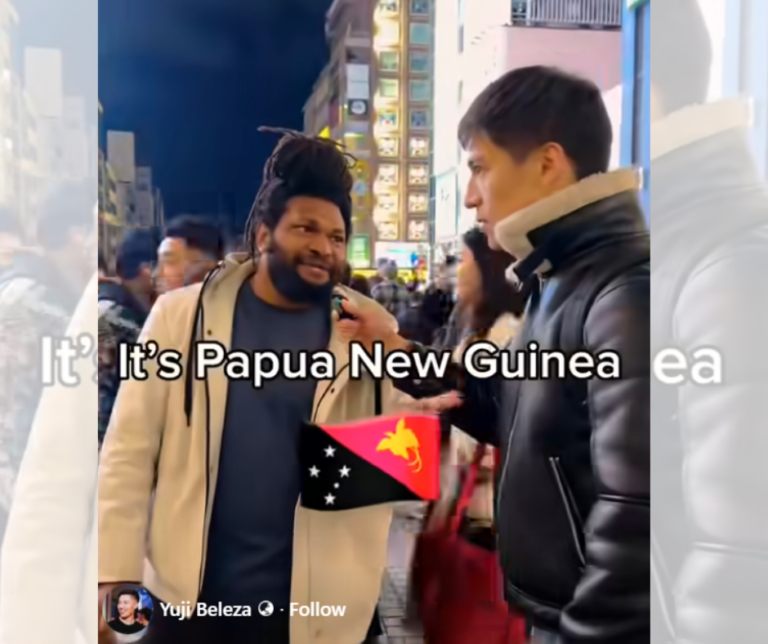
Sparks are flying on social media as a viral video creates a whirlwind of debate around Papua New Guinea and its vast linguistic landscape.
At the center of the storm is a reel uploaded by global influencer Yuji Beleza, who, during his travels in Japan, crossed paths with Papua New Guinean, Joseph Baki Kaore.
As is the nature of Yuji’s content, he asked Kaore to say something in his native language so Yuji could try to guess its origin. Kaore warned Yuji that it might be a difficult guess, but proceeded to give it a try.
“Rabirabi namona,” Kaore answered. A greeting in the Roro language of the Kairuku District in Central Province.
This simple exchange has seen many Papua New Guineans sharing conflicting opinions. A large segment of the audience argued that Kaore’s response did not represent the “main” language of the country, suggesting he should have spoken in Tok Pisin, the most widely used vernacular in Papua New Guinea.
Others, however, stood by Kaore. They pointed out that as a man hailing from Kairuku, a district in the Central Province, he correctly answered in his local Roro dialect. This highlights a crucial distinction: while Tok Pisin is one of Papua New Guinea’s three official recognized languages, it is not an indigenous language in the same way Roro is. Tok Pisin evolved originally as the local creole but languages like Roro are the ancient, rooted identity of the people and the land itself.
Diversity as Strength, Not Conflict
This debate is, in many ways, nonsensical. Papua New Guinea is the most linguistically diverse nation on earth, boasting over 860 distinct languages. The argument over which language “best” represents the country ignores the very fact that defines us.
One single language cannot be the defining tongue of Papua New Guinea because our 1,000+ tribes are built on the foundation of 860+ different ways of speaking.
This viral moment serves as a call to action for the people of Papua New Guinea. Rather than disputing which language is ‘official’ enough, the nation should celebrate this as a victory for all 860+ voices on the global stage. True national identity is found in honoring every local dialect and recognizing that our beauty lies in our complexity, not in a forced uniformity.
Beyond Words: The Greeting Controversy
It wasn’t just the spoken words that were scrutinized. Another point of contention was the greeting Kaore displayed, a respectful act where two people touch foreheads.
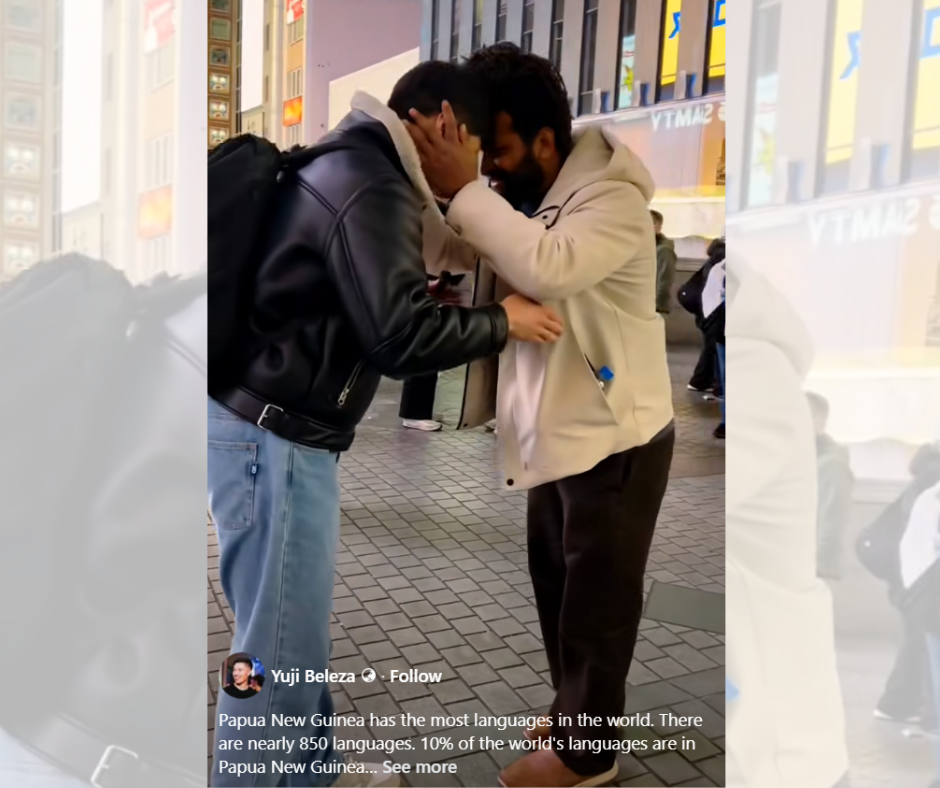
Critics online (largely uninformed) were quick to claim this gesture resembled the Hongi of the Māori culture. However, this form of greeting is traditional practice in the Kairuku culture of the Central Province, as well as several cultures in the Gulf Province.
Rather than labelling this gesture as pirated from Māori culture, it should be viewed as a testament to the deep cultural ties among Pacific nations. While we are geographically spread across the ocean, we share deep ancestral roots and a Pacific history that naturally results in cultural similarities.
A Call for Cultural Education
Instead of dividing ourselves through debate, this viral moment should be viewed as an opportunity to learn. It is a reminder that as people coming from such a diverse background, more education is needed regarding our own neighbors’ customs.
While schools host annual cultural shows and traditional dances are showcased every September 16th for Independence Day, we must ask: Is this enough?
Is enough being done to preserve PNG’s unique dialects and traditions, or is the country falling prey to the homogenizing influence of the Western world? When a “standard” identity is favored over tribal roots, people risk losing the very things that make them unique.
While the world marvels at Papua New Guinea’s diversity in language and cultures, Papua New Guineans must also improve their knowledge about other Papua New Guinean cultures to be able to tell the world about them.