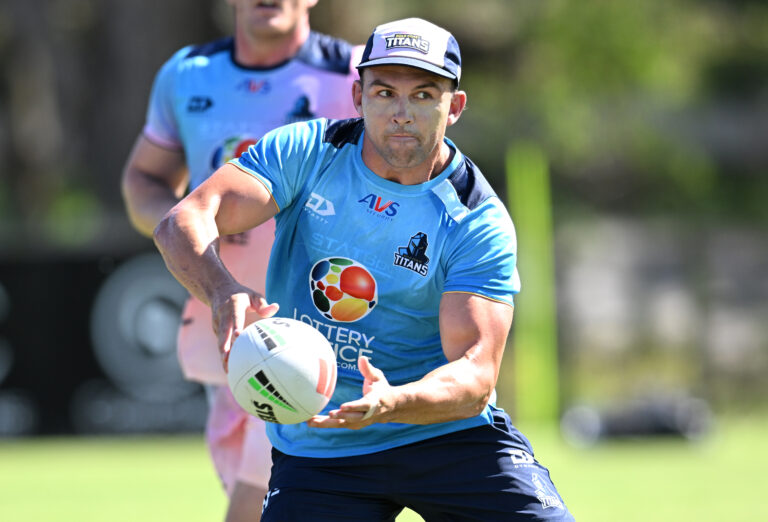
The Gold Coast Titans are undergoing a tactical identity shift under new head coach Josh Hannay, with Chris Randall becoming the latest veteran to trade his utility status for a permanent home in the forward pack.
After spliting his 97-game career between dummy-half and the back row, Randall has officially transitioned into a middle forward for the 2026 season. He follows teammate Klese Haas, who recently confirmed his own departure from the edge.
“I’m not a back-rower any more. I am a middle now,” Haas said.
Hannay’s arrival has brought sweeping changes to Parkwood, including a significant roster overhaul involving 12 departures. Beyond the personnel changes, the coach is prioritizing positional “certainty”—a welcome change for a player like Randall who has often been the team’s “Mr. Fix-it.”
“When Josh first came he chatted to me about trying to lock down one position and giving me that chance to actually get the reps in at the one position,” Randall explained. “I have been training in the middle and not getting moved around. I haven’t had that for a while these past couple of pre-seasons.”
While Randall’s versatility remains an insurance policy for the Titans, he admitted that being a utility player can hinder individual growth.
“I am always happy to jump in where I have to and help the team but it can be a bit of a blessing and a curse. You miss the reps at the one position and you can’t kick on and get better at the one spot because you keep changing,” Randall said. “At the moment I have just been training in the middle and I am really enjoying it. Hopefully I can build off that this year.”
Randall and Haas join a formidable engine room led by Maroons stars Tino Fa’asuamaleaui and Moeaki Fotuaika, alongside Jaiman Jolliffe. This shift is made possible by the Titans’ newfound depth at hooker; with Sam Verrills starting and the arrival of Oliver Pascoe and Luke Sommerton, Randall’s days behind the ruck appear over.
“I haven’t been a hooker at all this pre-season. We have got a few numbers at hooker this year which helps,” Randall noted. “I don’t think I will be a hooker this year.”
With “Tino” capable of playing both prop and lock, Randall is eyeing a potential starting role at No. 13. While the competition is fierce, the former Knight is focused on the upcoming trials to prove he belongs in the run-on side.
“Everyone would love to be starting,” Randall said. “We are all competing for spots. Nothing is ever set in stone and we have got trials coming up and I think Josh will have a few decisions to make. All I can do is keep training my best and hopefully I can get a starting spot, if not on the bench.”
Pressure remains on Australia to increase foreign aid, a year on from the United States’ catastrophic shake-up of development support.
Tuesday marks the anniversary of President Donald Trump’s return to the White House and an unravelling of foreign aid worldwide.
On day one of his second term, Mr Trump signed a stop-work order at the world’s biggest foreign aid agency – USAID – and froze its multibillion-dollar budget.
Much uncertainty, an Elon Musk review and many legal challenges later, USAID was disbanded and tens of billions sucked from the system, worsening the lives of many of the most in-need populations around the world.
An analysis in medical journal Lancet predicted the cuts killed hundreds of thousands of children under five in 2025, making it the first year this century child mortality has grown.
Other studies suggest four to six million deaths this decade.
Australian Council for International Development chief executive Matthew Maury says the changes have brought “a sharp deterioration in humanitarian and development outcomes globally”.
The staggering impacts in developing nations extend beyond grim mortality statistics.
Reproductive rights were hit by a withdrawal in support for contraceptives, while health outcomes worsened from the axing of programs to provide clean water or treat tuberculosis and other diseases.
A documentary, Rovina’s Choice, highlights the impact of USAID cuts on one South Sudanese mother attempting to keep a sick child alive.
Pacific nations are some of the least-hit, reflecting the US investment prior to the cuts.
However, the region has suffered the ripple effects of major international agencies weakened by mass layoffs, which must re-organise to counter funding shortfalls elsewhere.
The US move also led to other nations gutting their foreign aid budgets, as hard-up governments looked for funds to increase defence spending at America’s behest.
“Probably the most concerning to our sector was when we saw the UK announce aid cuts because they were a centre-left government who was pro-aid, and yet they made cuts,” Mr Maury told AAP.
It’s not clear how much aid has been sucked from the system as the US has introduced new funding streams, notably the “America First Global Health Strategy”.
These are bilateral deals agreed between the US and poorer nations, and nakedly political ones at that, with recipient countries asked to justify how spending might benefit America and American citizens.
“Let’s be frank, governments have always shaped their foreign policy and used their aid budgets with an eye towards national interests,” Mr Maury said.
“But there’s never been such a cold or calculating kind of formula to say, ‘how does this make American citizens’ life better?'”
Australia, notably, did not raid its foreign aid kitty last year.
Foreign Minister Penny Wong marginally lifted Australia’s spending on development assistance at last year’s budget, though not enough to keep pace with inflation.
As a share of gross national income, Australia spends 0.19 per cent on aid, ranking it 28th of 32 developed nations, ahead of just Czech Republic, Greece, Slovakia and Hungary.
This is down markedly from a decade earlier, when Australia spent 0.31 per cent of gross national income, ranking it 13th among OECD nations.
Mr Maury said Australia should join Scandinavian nations which hit the UN goal of giving at least 0.7 per cent in aid.
“We are in a position where we can do more and it’s important for Australia to be seen as a trusted partner who’s going to continue to stand with the region,” he said.
“Ten of Australia’s 15 biggest trading partners were all aid recipients originally. All boats rise when you invest in the wellbeing of the region.”
A local woman from the Finschhafen District in Morobe Province is calling on their local leaders of Parliament, specifically Raibo Paita and the Morobe Provincial Health Authority, to coordinate efforts in restoring basic medical services. The community is reporting a critical shortage of essential medicine, as well as the unavailability of X-ray and ultrasound services.
The Burden of Seeking Care
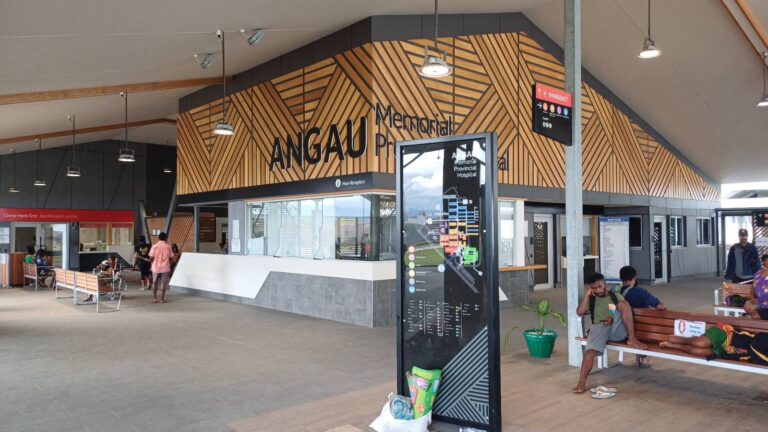
Speaking to InsidePNG, the woman said that seeking treatment at Angau Memorial Provincial Hospital in Lae has become very expensive. Patients arriving from Finschhafen frequently find that medicines are out of stock and diagnostic equipment is non-functional.
According to the local source, patients are regularly issued prescriptions to purchase their own supplies from private pharmacies and referred to private hospitals for scans because Angau’s ultrasound machine is non-operational.
“Finschhafen’s Butaweng Health Center couldn’t provide the X-ray and Ultra Sound services for the people to have access to due to so many reasons including the continuous blackouts,” she said.
Critical Shortages at Butaweng
Community members say that Butaweng is a major health center that requires urgent attention to prevent the need for nerve-wrecking travel to Lae. Currently, even basic consumables like Panadol and IV fluids are reportedly unavailable, and a lack of health officers and diagnostic tools has led to preventable deaths.
“Our leaders supposed to look into it. Why do we have to come to Lae here at the Angau Memorial Provincial Hospital and die? From Finschhafen up to Lae is really far and it costs us K100 per passenger by boat. In an emergency situation to seek medical treatment, we sometimes hire the boat at a cost of K1000.”
Her concern deepened as she told InsidePNG that delayed travels due to weather circumstances and funding constraints has led to some lives being lost along the way.
This situation has been a recurrence for many years where health services decline and people have to find their own way to seek treatment.
“Sometimes we lost lives along the way to Lae from Finschaffen due to bad weather. We could’t afford air transport because it’s very expansive. We just couldn’t afford. Due to these reasons, many locals have lost their lives because they couldn’t get the medical treatment they need,” said the woman.
“Our leaders must step in immediately and attend to our needs for health services and fix what is lacking in our District and LLG,” she added.
Editor’s Note: Rainbo Paita, who recently became the Governor for Morobe Province following the untimely passing of former Governor Luther Wenge, continues to serve as the member for Finschhafen District.
In a move to bridge corporate social responsibility with grassroots advocacy, Ok Tedi Mining Limited (OTML) has announced a new partnership with Femili PNG to combat the ongoing crisis of domestic and family violence in Papua New Guinea.
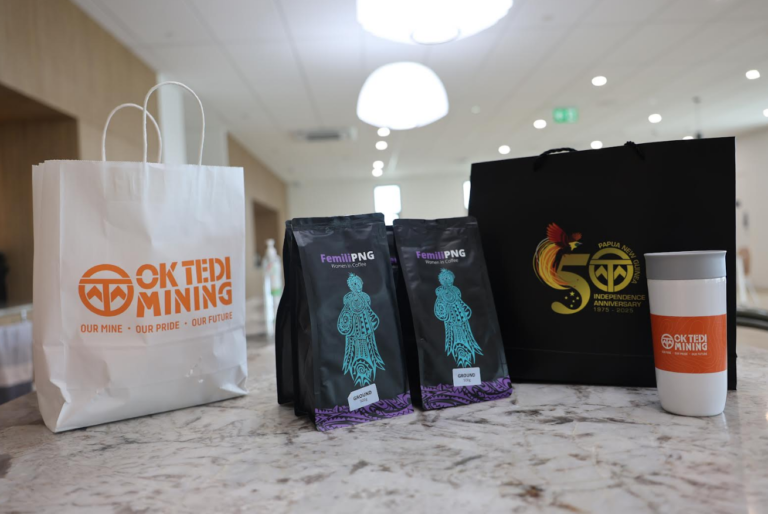
The mining giant utilized the high-profile stage of the recent PNG Investment Week conference in Sydney to spotlight the cause. Rather than traditional corporate branding, Ok Tedi purchased and distributed Femili PNG’s specialty coffee, sourced from the Western Highlands as complimentary gifts to international delegates.
The initiative serves a dual purpose to promote premium PNG exports while directly funding essential services for survivors of gender-based violence.
The collaboration comes at a critical time for PNG, where domestic violence remains a systemic challenge. According to Ok Tedi representatives, the partnership is intended to be more than just a donation; it is a public-facing commitment to community safety.
“Domestic violence continues to affect far too many families in Papua New Guinea, and we all have a responsibility to be part of the solution,’’ said Ruth Waram, Ok Tedi’s Manager for Media and Public Relations.
Waram emphasized that the coffee purchase was a strategic choice to amplify Femili PNG’s mission.
“Our purchase of these coffee packs is more than a gesture, it is a statement of solidarity and a commitment towards promoting safer, stronger communities across PNG,” she added.
Femili PNG, a leading non-governmental organization, operates on the front lines of the crisis. Proceeds from their coffee sales are funnelled directly into:
Case management services for survivors.
Safe accommodation and emergency housing.
Outreach and advocacy programs nationwide.
Jocelyn Condon, Executive Director of Femili PNG Australia, noted that corporate backing is vital for the sustainability of these services.
“Funds raised from every purchase of coffee directly supports the services Femili PNG provide to survivors who need safety, care, and a pathway to rebuild their lives,” Condon said.
“Ok Tedi’s support in this initiative, and hopefully into the future, give us all great hope for the potential of business to step forward and resource the movement for positive change.”
Looking Ahead The collaboration at the Sydney conference, hosted by the PNG Chamber of Resources and Energy, marks a growing trend of PNG’s extractives industry engaging with social issues. By integrating a non-profit’s product into a major investment event, Ok Tedi has signalled that the social in ESG (Environmental, Social, and Governance) remains a priority for the company’s operations within the country.
The Papua New Guinea Lewas quest for a spot in the T20 World Cup hit a hurdle on Sunday as they fell to a 41-run defeat against a clinical Ireland side.
Competing in Match 4 of the ICC Women’s T20 World Cup Global Qualifier 2026, the Lewas struggled to keep pace with the Irish scoring rate at the Mulpani Cricket Ground. After winning the toss and electing to bat, Ireland posted a competitive 146 for 6, driven by a balanced performance across their batting order.
Chasing a target of 147, the Lewas’ batting lineup found it difficult to find the boundary against a disciplined Irish attack. Despite batting out their full 20 overs, PNG finished on 105 for 6.
While the defeat is a setback for their immediate standings, the Lewas camp viewed the clash as a vital benchmark for the team’s development.
“The match provided valuable experience for the Lewas against quality opposition as they continue their campaign in the Global Qualifiers,” the team noted in a post-match statement.
The Lewas remain in the hunt for qualification but will need to sharpen their execution in the middle overs to stay competitive against the tournament’s top-seeded teams. The leadership group emphasized that the focus remains on building consistency and executing key moments as the pressure of the group stages intensifies.
The PNG Lewas will now refocus on their upcoming fixtures, where wins are becoming increasingly essential to keep their dreams of a global stage appearance alive.
Nearly six years after the COVID-19 pandemic sent many city residents over the hills and far away, regional Australia is again experiencing sustained population growth.
Consistent growth in the regions has re-emerged in the last two years, driven largely by city escapees according to research by the Regional Australia Institute.
City residents moving to the country outnumbered migration in the opposite direction by 36 per cent in the September 2025 quarter, the think tank’s Regional Movers Index showed.
The net number of people moving to Australia’s regions increased by 11.8 per cent, slightly below a recent recorded two-year high.
“Planning and investment to accommodate this growth is a key challenge for governments, industry and communities,” the institute said in releasing the index on Monday.
Separate figures from the Bureau of Statistics showed the regional population grew by nearly 114,000 in 2023/24, with the biggest surge on Queensland’s Sunshine Coast.
The growth has long put pressure on regional housing markets and infrastructure.
Dwelling values rose by 2.4 per cent in the three months to October 2025, as buyers shunned higher prices and competitive buying conditions in the cities, according to a recent report by analytics firm Cotality.
Regional rental vacancy rates were 1.7 per cent in the final months of 2025, with rents up 6.2 per cent in the country compared to 4.8 per cent across the capitals.
The Institute has called for a greater focus on the pressures facing regional communities, creating a framework to boost livability, jobs and skills and sustainability by 2032.
The Regional Movers Index, which uses Commonwealth Bank customer data to track population movement, showed Sydney and Melbourne were losing residents to the regions at a higher rate than the other capitals.
The top five areas for regional movers were Queensland’s Sunshine and Fraser coasts, Greater Geelong and Moorabool in Victoria and Lake Macquarie in NSW.
Emerging hot spots for sea and tree-changers were Latrobe, Devonport and the Huon Valley in Tasmania and Wodonga and the Colac Otway Shire in Victoria.
The Tasmanian and Victorian regions were appealing to new residents for their industries, lifestyle and landscape, the bank’s regional and agribusiness executive general manager Kylie Allen said.
“While the outlook is positive, attracting and retaining skilled professionals remains a challenge across regional areas,” Ms Allen said.
“Even with a growing population, some sectors remain under pressure.
“Continued investment in training and upskilling will be key to meeting demand.”
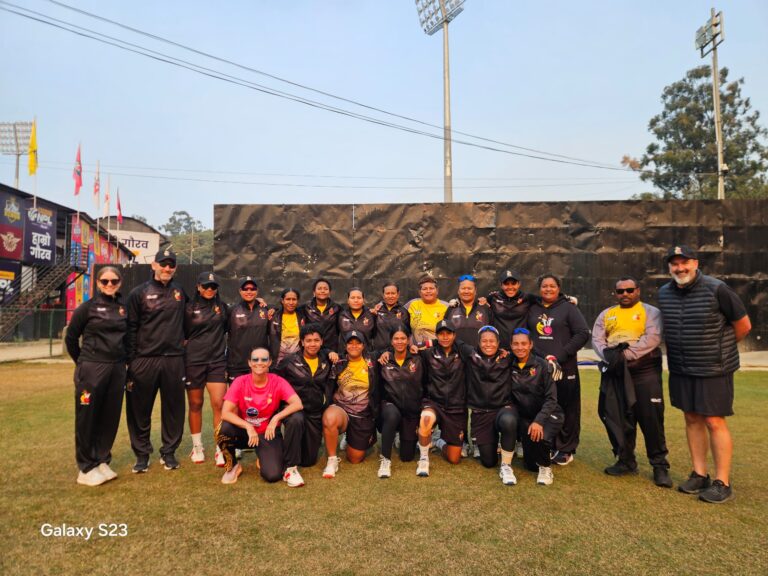
The Papua New Guinea Lewas have officially transitioned to the final stage of their World Cup journey, arriving in Nepal following a high-intensity preparation stint in Australia.
The national women’s cricket team is eyeing a historic milestone as they prepare to compete in the ICC Women’s T20 World Cup Global Qualifier, running from 18th January to 1st February 2026.
The Lewas recently wrapped up a successful campaign at the Australian Country Cricket Championships in Adelaide. Finishing fifth overall, the team used the tournament as a high-performance laboratory to test tactics and build squad cohesion against elite opposition.
The tour was made possible through the PacificAus Sports partnership between the Australian Government and Cricket Australia, a program designed to bridge the gap between Pacific athletes and international competition.
Australian High Commissioner to PNG, His Excellency Ewen McDonald, emphasized that the partnership transcends the scoreboard.
“Papua New Guinea and Australia share a strong connection through cricket, and the PNG Lewas continue to inspire both at home and across the Pacific region,” High Commissioner McDonald said.
“The Australian Government is proud to support women’s cricket in PNG through PacificAus Sports, helping provide opportunities for elite competition, professional development and international exposure as the talented team strives for T20 World Cup qualification.”
The Road to England 2026
The stakes in Nepal could not be higher. The Lewas are one of ten nations vying for just four available slots for the ICC Women’s T20 World Cup, scheduled to take place in England this June.
Cricket PNG Board Chairman, Michael Harrison, noted that the Australian leg of the journey was a vital stepping stone for the challenges ahead in Nepal.
“The Australian Country Championships provided exactly the level of competition we needed at this stage of preparation,” Harrison said.
“The learnings from Adelaide, combined with our transition into Nepal, place the Lewas in a strong position as they pursue a historic top-four finish and qualification for the ICC Women’s T20 World Cup.”
Discipline and Depth
National selectors are confident that the rigorous schedule has hardened the squad for the pressures of a Global Qualifier. Hudson Leka, Chairman of the National Selection Panel, praised the team’s growth during their recent matches.
“Selection and preparation have focused on consistency, adaptability and the ability to perform under pressure,” Leka stated.
“The Australian tournament tested those qualities, and the team is now fully focused on delivering in Nepal.”
With enhanced high-performance planning and specialist coaching support backed by the Australian Government, the Lewas now stand on the precipice of securing their place on the world’s biggest stage.
PNG Lewas: Road to the World Cup Fact Sheet
The PNG Lewas enter this final qualifying phase in Nepal with significant momentum, currently ranked 13th in the world in T20 Internationals. Under the leadership of Captain Brenda Tau, the squad features a balanced mix of experience and rising talent, including key players like Pauke Siaka, Sibona Jimmy, and Henao Thomas.
The team earned their place in this Global Qualifier by dominating the East Asia-Pacific region, and they are now looking to secure one of the four available tickets to the main event in England and Wales this June.
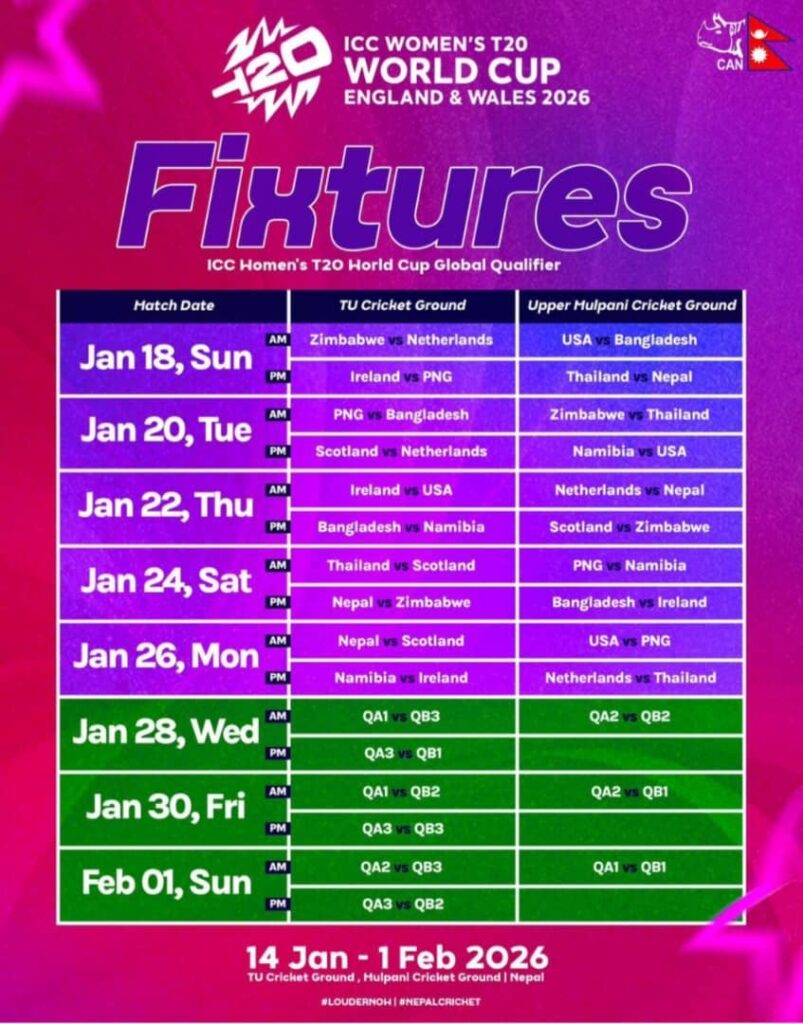
The tournament in Nepal is hosted across two venues in Kathmandu: the Tribhuvan University International Cricket Ground and the Upper Mulpani Cricket Ground. The Lewas have been placed in a challenging Group A alongside Ireland, Bangladesh, Namibia, and the USA.
Their campaign officially begins this Sunday, January 18, with a high-stakes opening match against Ireland, followed by a clash with Bangladesh on January 20. The group stage concludes with matches against Namibia on January 24 and the USA on January 26, after which the top teams will progress to the Super Six stage to determine the final World Cup qualifiers.
This campaign represents a critical milestone for Papua New Guinean cricket, supported by the ongoing PacificAus Sports partnership which provided the elite training environment in Adelaide. With only a top-four finish required to secure their first-ever T20 World Cup appearance, the Lewas are fully acclimated to the conditions in Kathmandu and prepared to make history for the Pacific region.
Australia is currently grappling with a severe mental health crisis among young men, with suicide remaining the leading cause of death for males aged 15 to 24.
Addressing this challenge requires moving beyond traditional methods that often fail to reach those most in need. Leading this shift is Headstart, a Melbourne-based, Gen Z-led organization that is transforming how young men connect with mental health support.
A New Approach: “By Boys, For Boys”
Founded in 2024 by Nick Irving, Headstart was born out of the gaps in the existing mental health system. Irving observed that traditional care often relies on a “blanket approach” that doesn’t always account for the specific factors affecting an individual.
Instead, Headstart utilizes a lived-experience model, hiring workers who have personally navigated mental health challenges, disability, or the juvenile justice system. This peer-to-peer connection is designed to break down the barriers of formal clinical settings.
“A lot of the existing mental health systems are quite one dimensional and set within their ways, but for us it comes down to showing up to what suits the individual best,” Mr. Irving said. “When young men are guided by mentors who genuinely get them, the connection is instant and that’s where growth starts.”
Breaking the Barriers of Traditional Care
For many families, the struggle isn’t just finding care, but finding care that is accessible. Julia, a mother of four, found that traditional supports were ineffective for her son, Thomas, who struggled to even leave his bedroom after the COVID-19 lockdowns.
The “relaxed way of communicating” used by Headstart proved to be the turning point for Thomas. By meeting young men where they are, rather than requiring them to visit an office, the organization fosters a level of trust that clinical environments often lack.
The impact of this relatable approach is clear:
9 in 10 families report improvements in their son’s routine, independence, and wellbeing.
Partnerships are already established with Monash Children’s Hospital and the Victorian justice department.
Expansion plans are underway to move beyond Melbourne into Sydney and regional areas.
Moving Beyond the “Band-Aid”
The organization’s mission is to move away from temporary fixes toward sustainable growth. As Nick Irving explains, the current system often relies on a “Band-Aid approach” where medication is the primary response. Headstart instead focuses on relatability as the catalyst for change.
“We know that being relatable to these boys and leading with the approach that we do is critical for changing outcomes,” Irving said.
Through this Gen Z-led initiative, Australia is seeing a shift toward mental health care that prioritizes empathy, shared experience, and individual needs over rigid institutional structures.
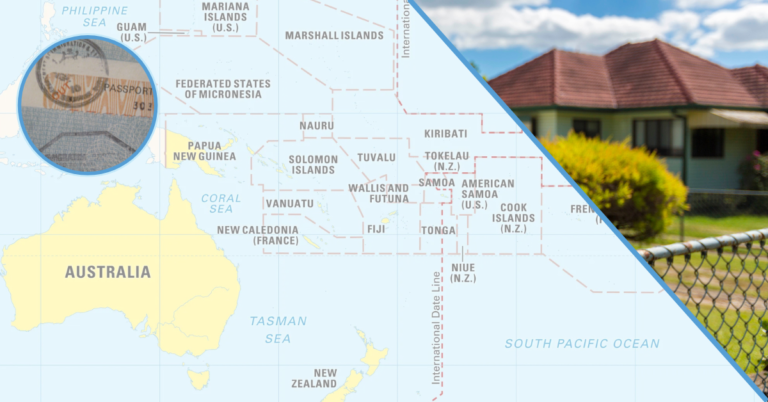
As a wave of Papua New Guineans and Pacific Islanders move and begin settling in Australia under the new Pacific Engagement Visa (PEV), the reality of the Australia’s housing crisis is reshaping where these new residents choose to call home. While Sydney and Brisbane have long been popular destinations, record-high rents are forcing a strategic shift toward emerging suburban hubs and more affordable southern capitals.
The latest Domain Rent Report highlights a stark divide in the market.
Melbourne has emerged as the most accessible entry point for newcomers, offering the cheapest house rents in the country at a median weekly rate of $580.
In contrast, Sydney remains the most expensive hurdle for families, with median rents hitting $800, followed by Brisbane at $670.
Housing experts note that this financial pressure is driving many to relocate further from city centers and into greenfield developments where infrastructure and lifestyle are rapidly improving.
For those navigating this transition, community support networks are proving vital.
In Melbourne’s more affordable western and eastern corridors, suburbs like Werribee West and Box Hill organizations such as PNGAA Victoria and the Louise Multicultural Community Centre offer essential settlement services ranging from English classes to networking for PNG and Pacific families.
These areas are also served by the Migrant Information Centre and the Settlement Engagement and Transition Support (SETS) program, which provide direct advocacy for healthcare and education.
Despite the current rental surge in the northern states, property analysts expect a long-term shift in demand. Gareth Croy, Managing Director of financial and property firm Your Future Strategy, predicts that Melbourne will stand out as a “hero” for growth after the early 2030s.
“Based on the growth rates across other capital cities, it (Melbourne) is going to become substantially cheaper, and therefore it’s going to draw demand because that’s the option that people can afford,” Mr. Croy said.
In Queensland, the PNG Federation Queensland Inc and Mana Pasifika serve as critical cultural anchors for those moving into high-demand Brisbane suburbs like Bracken Ridge and Kedron.
Meanwhile, in Sydney’s western “second CBD” of Parramatta, the NSW Council for Pacific Communities and the PHIVE community hub provide resources for those managing a median house price of $1,480,000.
Ultimately, the choice of where to settle is being dictated by employment proximity rather than a desire for city-center living.
“It’s good old fashioned property economics around people wanting to live close to employment, so reducing travel time to and from work,” Mr. Croy said.
“So proximity to the CBD is less important for people and the creation of that hub is becoming desirable for people to just stay around that same area.”
Prime Minister James Marape has signalled what he describes as a major performance-based reshuffle of his government, swearing in three new ministers on Tuesday.
While the Prime Minister framed the move as a strategic “reset” following Papua New Guinea’s 50th Independence anniversary, the reshuffle comes at a time of heightened scrutiny of government delivery and internal power dynamics within the Marape-Rosso administration.
Coalition Maintenance or Meritocracy?
The swearing-in of Kompiam-Ambum MP, Sir John Pundari, Tewai-Siassi MP, Dr. Kobby Bomareo and Menyamya MP, Solen Loifa at Government House on Tuesday, according to Prime Minister Marape, is a direct response to the growing influence of the “Our Pati” bloc.
Marape acknowledged the political necessity of the move, noting that Our Pati is now the second-largest party in the coalition.
“Some of the key reforms that were made would not have been passed without the numerical strength and contribution of Our Pati,” the Prime Minister admitted.
By elevating Solen Loifa, the Prime Minister is attempting to project an image of renewal.
“He belongs to the cadre of young emerging leaders… who must be brought into Cabinet to prepare them to lead even when some of us are out of time,” Marape stated.
“These are not ceremonial appointments. They come with hard tasks and clear deadlines,” he stated, emphasizing that the new ministers are entering a “decisive 20-year development window.”
Accountability and the 90-Day Housing Mandate
In a move that puts the entire front bench on notice, Marape has demanded “health and performance reports” from all ministers.
Nowhere is this pressure more evident than in the Housing portfolio. Re-appointed Minister Dr. Kobby Bomareo has been issued a 90-day deadline to deliver a comprehensive national housing and land access programme.
Marape stressed that the goal is to make home ownership achievable for the workforce by removing GST and Stamp Duty on first-home purchases under K700,000.
“This is not just about buildings. It is about making land and housing accessible to our people,” he said.
Recalling the “Old Guard” for National Security
The return of Sir John Pundari, a veteran politician whose career began in 1992, suggests that despite “reset” rhetoric, the administration remains heavily reliant on the political “old guard.” However, the appointment goes beyond mere recycling; it exposes a desperate reliance on provincial identity over systemic reform.
Marape specifically linked Pundari’s appointment to the Ministry of Police to his roots in Enga Province, framing his proximity to the chaos as a strategic asset.
This justification, however, invites a scathing critique of Pundari’s decades-long tenure. If Pundari’s deep-rooted connection to Enga is his greatest strength, one must ask why that same influence failed to stem the tide of high-powered weaponry during his thirty years in the political upper echelon.
By setting a 12-month target for national stabilization, Marape is essentially gambling on the idea that the same political machinery that watched Enga descend into gun-fuelled anarchy can now, suddenly, dismantle it.
The “Old Guard” isn’t just returning to fix the problem; they are returning to fix a crisis that matured under their long-term stewardship.
The ICT Leadership Question: Who is in Charge?
As Peter Tsiamalili Jnr moves into the heavyweight role of Works and Highways Minister, a pressing question remains for the public: Is he still the Acting Minister for ICT?
This leadership vacuum comes at a critical time for the Digital Government Act 2022. The public remains anxious about how their personal information is being stored and used within the new “SevisPNG” digital ID ecosystem, especially as the government pushes for 100% digital integration by 2027.
The Starlink Standoff: Connectivity vs. Law
The lack of a permanent ICT head has intensified the debate over Starlink.
For the average citizen, the standoff feels like a contradiction. While the “Reset@50” agenda promises universal internet access, the country’s most viable satellite solution is currently being “hunted” by regulators. Without a clear ministerial lead to navigate the legal battle with the Ombudsman, many fear PNG will remain a digital outlier in the Pacific; disconnected, over-regulated and left behind.
Mining: Resetting the Resource Framework
Solen Loifa takes over the Mining portfolio with a strict deadline.
Marape intends to overhaul the nation’s resource laws within the year.
“Before September 16, 2026, we want to announce to the country and to the investment community the regime under which mining, petroleum and other resource sectors will operate,” Marape said, signalling a shift toward “taking back more for PNG.”
Ministerial 90-day Performance tracker (Q1 2026)
Portfolio & Minister
Primary 90-day Target
Key Metric & Big Bets
Housing (Dr Kobby Bomareo)
National Housing & Land Access Program
• Finalize removal of GST and Stamp Duty for first-time home buyers. • Identify specific state land parcels for first-home worker allocations.
Police (Sir John Pundari)
Highlands Stabilization Framework
• Deploy strategies to “remove guns” and stop tribal fighting in Enga, Hela, and SHP. • Integration of village court official payments into the formal system.
Mining (Solen Loifa)
Resource Regime Finalization
• Progress the Wafi-Golpu and Porgera strategic developments. • Draft the new “Take Back PNG” policy framework for the Sept 2026 deadline.
Works & Highways (Peter Tsiamalili Jnr)
Connect PNG Implementation
• Oversee the K1.7 billion infrastructure budget. • Audit existing contracts to ensure no “conflict of interest” in construction projects.