Archive

March 2026

Browsing

It has been twelve years since the first LNG Gas was exported out of Papua New Guinea and it has been twelve years since the National Government promised a 4.27 percent equity to landowners and Provincial Governments impacted by the PNG LNG Project.

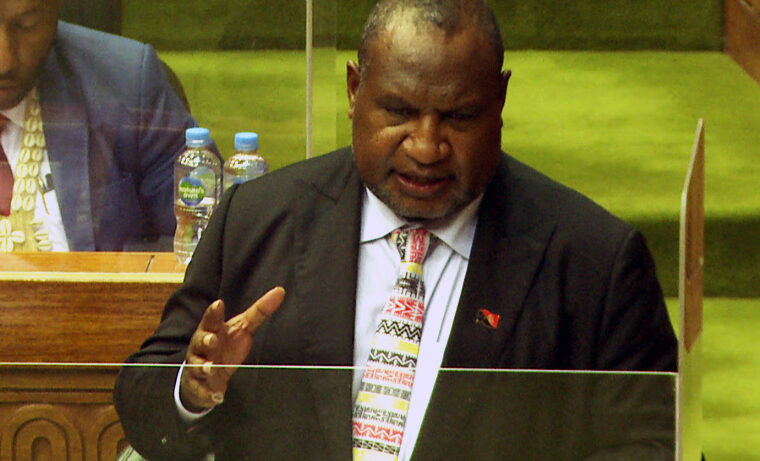
Komo Hulia MP Daniel Tindipi put the question to Prime Minister James Marape during parliament question time on Tuesday.

In response, Prime Minister James Marape reaffirmed the Government’s commitment to resolve this long-standing issues surrounding the 4.27 per cent PNG LNG equity, vowing to strengthen benefit-sharing arrangements for landowners and provinces, and advance national energy security.

Marape acknowledged that the 4.27 per cent equity component originally envisaged as a strategic benefit for landowners and the five provincial governments impacted by the PNG LNG project, remains an outstanding national issue more than a decade after the first gas production commenced in 2014.

“This equity component was intended as a meaningful participation mechanism for our landowners and provincial governments. It is now 12 years since first gas, and it is clear that this matter has not been fully resolved,” Prime Minister Marape said.

According to Marape, the 4.27 per cent equity originated from arrangements negotiated during the 2008–2009 Umbrella Benefit Sharing Agreement (UBSA), when the State, landowners, and provincial governments came together to enable the final investment decision of the PNG LNG project.

He said the equity was conceived as a form of “gifted participation” to ensure that the benefits of one of Papua New Guinea’s largest resource projects would extend beyond statutory entitlements under the Oil and Gas Act.

“This was over and above the legally mandated 2 per cent royalty and equity benefits. It was intended to give our people a stake in the project’s success and long-term returns,” he said.

However, the Prime Minister highlighted that despite the project’s significant contributions to the national economy including billions of kina in revenue since 2014 the intended beneficiaries have not been afforded the opportunity to exercise ownership or fully realize the value of this equity.

Marape confirmed that the Government has formally tasked Kumul Petroleum Holdings Limited with undertaking a full and transparent review of the 4.27 per cent equity, including its historical treatment, financial utilisation, and current status.

“We have asked Kumul Petroleum to present a complete information package to Cabinet. This includes what happened to the equity at the time of first gas, how it has been used over the years, and what value it holds today,” he said.

He stressed that the review will not be limited to the 4.27 per cent equity alone but will form part of a broader assessment of the State’s entire equity portfolio in the PNG LNG project, including the 16.57 per cent stake held through Kumul Petroleum.

“This is a holistic review. We are examining the full structure of our national equity interests to ensure accountability, transparency, and maximum benefit for our people,” he added.

Prime Minister made it clear that once Cabinet receives the full report, the Government will make a policy decision on how the 4.27 per cent equity should be allocated and managed going forward.

He emphasized that the Government is determined to ensure that landowners and provincial governments are properly recognized as beneficiaries, while also safeguarding long-term national interests.

“We will not rush this decision. It must be structured carefully to ensure fairness, sustainability, and direct impact,” he said.

The Prime Minister outlined a three-pronged approach under consideration:

  • Direct Benefit Distribution: Ensuring that a portion of the equity delivers tangible financial returns
    directly to landowners and provincial governments without unnecessary intermediaries.
  • Future Generational Savings: Establishing mechanisms to preserve part of the equity value for
    future generations, potentially through trust structures or sovereign-style funds.
  • Transparent Governance Framework: Implementing strong governance and accountability
    measures to ensure that benefits are managed responsibly and equitably.

The Prime Minister further clarified that while the 4.27 per cent equity is an important benefit, it is not a statutory entitlement under the Oil and Gas Act, unlike the 2 per cent royalty and equity provisions already being distributed.

“This component was a negotiated benefit, an additional allocation made in good faith to support landowners and provinces. That is why we must handle it carefully and responsibly,” he said.

He noted that existing benefit distribution mechanisms for statutory entitlements are already in place and could be leveraged to ensure efficient and transparent delivery of any future equity benefits.

Responding to calls for a review of existing agreements, including the Umbrella Benefit Sharing Agreement and related licence-based arrangements, Prime Minister Marape said the Government is open to reviewing these frameworks where provisions allow.

“We will seek technical advice on the review clauses within these agreements. If provisions exist for periodic review, we will activate them to ensure that agreements remain fair and relevant to present-day realities,” he said.

He acknowledged that some agreements may be overdue for review and assured stakeholders that the Government will engage constructively with landowners, provinces, and project partners.
Advancing Domestic Energy Utilisation

Prime Minister James Marape has assured Papua New Guineans that the government is putting in place emergency standby fuel arrangements and relief measures to shield the country from soaring global oil prices triggered by escalating conflict in the Middle East.

In a statement released yesterday, PM Marape said the government was not taking any chances with fuel security, especially given threats to key shipping routes such as the Strait of Hormuz.

“We are putting in place standby facilities to guarantee fuel security for our nation going forward,” the Prime Minister said.

“In light of what is happening globally, especially in the Middle East, we are not taking any chances.”

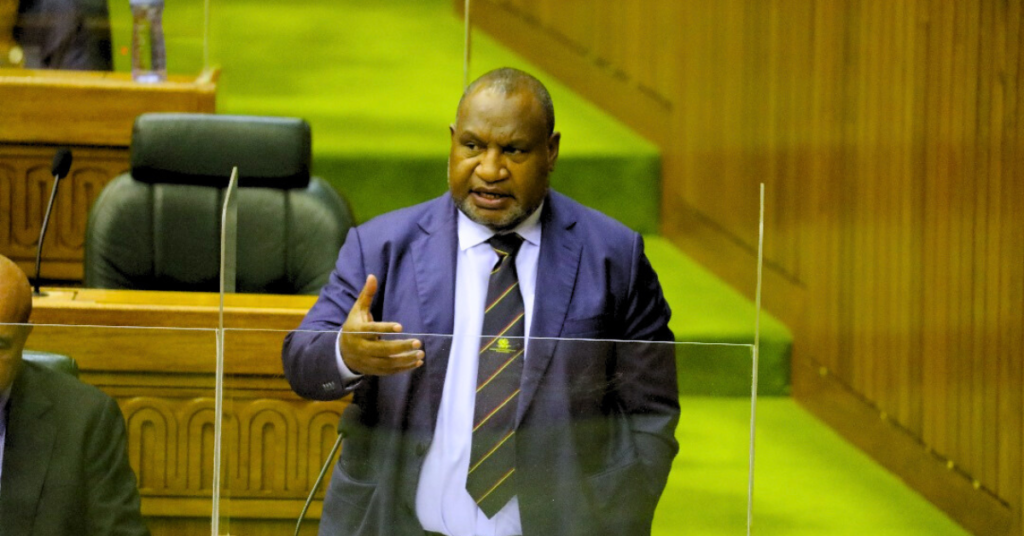
Prime Minister James Marape
Prime Minister, James Marape.

He confirmed that economic and energy officials have been instructed to prepare relief measures, including possible targeted subsidies, to prevent international price spikes from hitting households and businesses too hard.

“Our goal is to ensure that the impact of global fuel price increases is not heavily felt here at home,” PM Marape said.

“We want to maintain fuel prices below the rate of inflation and ensure they remain at a realistic and affordable level for our people.”

The Prime Minister singled out State-owned Ok Tedi Mining Limited and its energy arm for early action, thanking the company for securing additional aviation fuel shipments and maintaining diesel stocks.

“Ok Tedi has moved early to secure additional aviation fuel shipments and, together with existing stocks and fuel already in transit, is helping to ensure continuity of Jet A1 supply for the aviation sector,” he said.

He also revealed ongoing talks with major importers Puma Energy and ExxonMobil to keep fuel flowing and examine cost-containment options.

The statement comes as global oil prices have surged dramatically. Before the latest Middle East flare-up, crude was trading around USD 64 per barrel. It rose to USD 100, then leapt above USD 150 this week, with some market forecasts now pointing towards USD 200.

Economist Paul Barker, responding directly to the Prime Minister’s statement, welcomed the government’s focus but warned that PNG faces serious longer-term challenges if the middle-east crisis drags on.

“It’s important that the PM, Treasurer and team give major focus and preparation on this, to ensure steady supply of needed fuel and to help restrain undue price impacts on consumers, especially lower income earners,” Mr Barker said.

Paul Barker, Economist.

He stressed the need to keep the public calm and avoid panic buying or hoarding, which could worsen shortages.

Barker noted that Ok Tedi has been keeping aviation fuel flowing for months during PNG’s foreign-exchange crunch and earlier disputes with Puma Energy. However, he raised concerns that the mining giant is being asked to step well outside its core expertise.

“There is invariably concern that this mining company may be being asked to diversify its activities well outside its core areas of expertise and focus, at some potential cost to its own functions and perhaps standards,” he said.

On the global picture, he explained that roughly 20 percent of the world’s oil normally passes through the Strait of Hormuz, which is now effectively closed to most shipping except Chinese vessels and some escorted Indian ships. This has thrown supply chains into chaos, with tankers stranded far from usual refineries.

“Prices have risen from about USD64/barrel before the attack was launched, up to USD100, before slightly dropping back… but that was soon shelved with Iran’s threat to close the straits,” Barker said.

“Oil prices this week have leapt above USD150/barrel with supplies offered well above that and forecasts rising over days to USD 200.”

While prices can fall quickly, as they did after the 2022 Ukraine invasion spike, Barker said this conflict shows “no clear path of resolution” and Iran could sustain the threat for a long time.

“PNG can help mitigate costs in the shorter run, but if high prices are sustained, which seems likely unless there’s some constructive breakthrough, it would be challenged to sustain strong counter-market pressure,” he said.

He added that the only silver lining for PNG would be higher revenues from the country’s own gas and oil projects, which could deliver a windfall to the State through taxes and equity stakes.

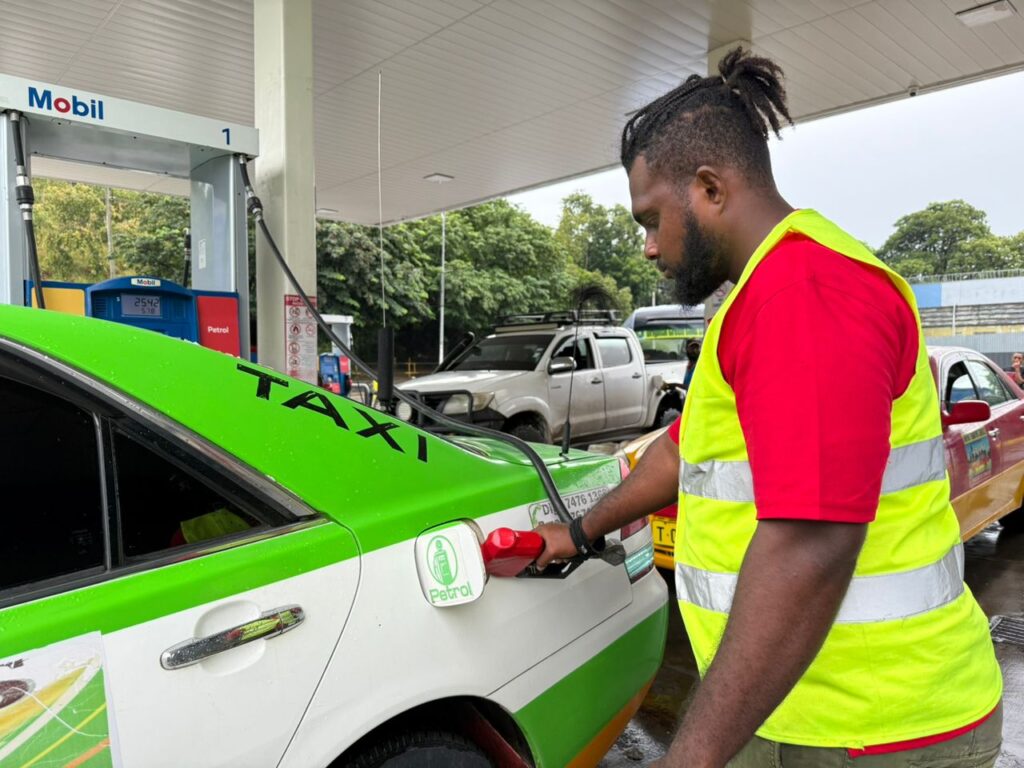
Darked skinned young man holding a fuel pump and putting petrol into a car.

Meanwhile, the Independent Consumer and Competition Commission confirms that the Middle East crisis has disrupted domestic price hikes. While petrol cost is up by K0.13 per litre and diesel by K0.22 per litre for the month of March, these increases are based on the benchmark prices from February.

ICCC says domestic prices for the next month (April) will see the impact of the current Middle East crisis, and further updates will be released next month given the one-month lag in price calculations.


Community advocacy group ACT NOW! has once again calls on the PNG Forest Authority to publish the complete log export data for 2024 and 2025.

Campaign Manager Eddie Tanago says while the government has promised to ban all round log exports from January 2026, the PNGFA is yet to publish data on log export volumes for 2024 and 2025.

“For fifteen years detailed statistics about the volume of log exported from every logging operation across the country was available from independent monitoring firm SGS. But in 2024 SGS withdrew their services because of a backlog of unpaid invoices.

“Although the PNGFA said it was taking over the monitoring operations, since 2024 not one single report has been published and there is no monthly or annual data available for 2024 or 2025”.

ACT NOW! says with the lack of information available on log export volumes, the public will lose confidence in the Marape-Rosso governments plans to ban round log export.

“The Prime Minister has staked his international reputation on the promise to end all round log exports from PNG, it is therefore essential that PNGFA immediately publishes its data for 2024 and 2025.

In June last year, the PNGFA assured the Parliamentary Special Committee on Public Sector Reform that it would provide regular reports with all the monthly log export volumes from individual logging projects, but nothing has been produced.

ACT NOW! says the lack of log export data reflects a general failure by the PNG Forest Authority to publish even basic information on its management of forest resources.

The Forestry Act says there should be a public register of information on all commercial logging operations and logging permits but it seems this has never been established.

ACT NOW! says the lack of publicly available information on the logging industry and the lack of export data is just one reason why the sector continues to be plagued by widespread illegal logging and presents a major money laundering risk.

This has contributed to PNG’s recent grey listing by the international financial community.


Pin It