Category

News

Category

THE Papua New Guinea Chamber of Resources & Energy (PNG CORE) is urging a unified effort from community leaders, landowners, and small-scale miners to combat the growing problem of unregulated alluvial mining across the nation.

This call comes amidst increasing concerns about the negative impact on the mining industry, local communities, and legitimate small-scale operators.

Recent reports have highlighted a concerning rise in illegal mining activities, including gold smuggling, which has coincided with a decline in lawful alluvial gold production. This trend has raised alarms throughout the sector, prompting swift action from regulatory bodies.


MRA Issues Stop-Work Notice

In response to these developments, the Mineral Resources Authority (MRA) has issued a public stop-work notice specifically targeting unauthorized alluvial mining operations that utilize heavy machinery.

This enforcement action follows confirmed reports of individuals and companies engaging in illegal mining within designated alluvial mining districts and other regions.

The MRA emphasized that these operations are in direct violation of the Mining Act 1992 and warned that continued breaches would lead to legal consequences.


Government Takes Hard Stance

Mining Minister Rainbo Paita issued a stern warning to all operators “Operate within your permits or leave.”

Paita reaffirmed the government’s zero-tolerance approach to illegal mining, underscoring that all mining activities must adhere to the terms of their permits and licenses.

He stressed that failure to comply undermines the integrity of the sector and will not be tolerated.


PNG CORE Highlights Broader Concerns

As the leading representative body for the minerals sector, PNG CORE is deeply concerned about the environmental degradation, social disruption, and economic damage caused by these unregulated activities.

Such operations not only endanger surrounding communities but also hinder sustainable development opportunities and create unfair competition for compliant miners.

PNG CORE is appealing to community leaders and landowners to proactively safeguard their land and the future of their people.

This includes denying access to illegal miners, reporting suspicious activities to authorities, and verifying all mining engagements with the MRA before proceeding.

Small-scale miners are also strongly encouraged to pursue legal operations by securing the necessary licenses and permits for machinery use.

PNG CORE states that legal compliance ensures safer and environmentally responsible mining practices, contributing meaningfully to both community welfare and national development.


Coordinated Action Essential

Addressing illegal and unregulated alluvial mining requires a coordinated, multi-stakeholder approach. Key areas of focus include formalization of operations, environmental stewardship, community health, and strengthened governance.

“PNG CORE unequivocally condemns unregulated alluvial mining.

“These activities are not only environmentally destructive and socially harmful, but also represent unfair competition that undermines legitimate, regulated alluvial miners and the broader resource sector committed to operating sustainably, safely, and in partnership with landowners and communities.

“PNG CORE fully supports the national mining laws and the essential regulatory role of the Mineral Resources Authority,” said PNG CORE Vice President, Assik Tommy Tomscoll.


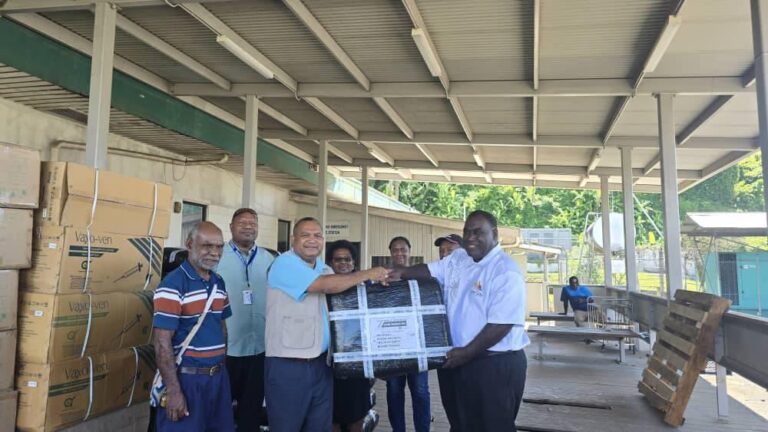
Children in Papua New Guinea’s Highlands region will receive better medical care thanks to a significant donation of equipment to Mt. Hagen Hospital.

The PNG Chamber of Resources and Energy (PNG CORE) Charity Golf Challenge, an annual fundraising event, raised over K280,000 to purchase vital medical devices for the hospital’s pediatric ward.

The new equipment includes essential tools like a phototherapy light for newborns with jaundice, portable ultrasound machines for quick diagnoses, and a patient monitor for real-time tracking.

These items will help doctors and nurses provide critical support to young patients, especially as the hospital faces a growing number of children needing care due to internal migration and conflict in the region.

Jane Holden, CEO of the Western Highlands Provincial Health Authority, highlighted the urgent need for this support, explaining that the pediatric ward, originally designed for 48 beds, is now caring for over 100 children.

Despite these challenges, Mt. Hagen Hospital consistently provides high-quality care with limited funding.

Western Highlands Governor, Wai Rapa praised PNG CORE for recognizing Mt. Hagen Hospital’s vital role as a referral center for the entire Highlands region.

PNG CORE President Anthony Smaré emphasized that the donation is more than just equipment but a symbol of their commitment to supporting healthcare in regions that often go unnoticed.

This initiative, supported by various companies and the government, marks the beginning of a long-term partnership to improve healthcare for children in the Highlands.


Migrant women working in rural Australia are carrying unplanned pregnancies, having unwanted abortions or even giving their babies to authorities due to fear, poverty and poor healthcare coverage.

This is the “unseen population” that NSW general practitioner Trudi Beck wants every Australian to know about.

Dr Beck, a GP obstetrician from Wagga Wagga, told a NSW parliamentary inquiry into modern slavery that she routinely sees pregnant Pacific Islander workers, who are not entitled to free or subsidised healthcare in Australia.

The vast majority of those women opted for an abortion, though it didn’t always appear to be their preference, Dr Beck said.

The women, who are usually working under the Pacific Australia Labour Mobility (PALM) scheme, fear they will breach their visa conditions if they cannot work due to pregnancy.

“I find it really difficult to provide termination services for a woman where that’s not her deeply-held desire … that’s the crux of the matter for me,” Dr Beck told the inquiry sitting in Griffith on Thursday, in sometimes emotional evidence.

“If this woman was in her home country and had the means to live above the poverty line, she would have this baby.

“That is just such an ethics and values clash for me and that’s what makes me want to reach out to people to say: can we make this better?”

Some women who could not access abortion services in time gave birth in their home countries while on annual leave, Dr Beck said.

The inquiry has been told PALM workers are particularly vulnerable to exploitation because their visa does not allow them to change employers, forcing some to abscond.

Many disengaged workers have settled in the NSW Riverina, where they live in hiding, Leeton Multicultural Support Group chairman Paul Maytom said.

Mr Maytom said 10 pregnant migrants have approached the organisation for help, including one woman who gave her prematurely-born baby to authorities after her older child was also taken in as a ward of the state.

“She said, ‘I didn’t know what to do because I have no money, so I agreed to it, but I want my babies back’, Mr Maytom said.

“That’s tough.”

Griffith domestic violence service Links For Women supported 47 female PALM workers in 2023-24.

The women were assaulted by either male employers or their co-workers, forcing them to flee, manager Madeleine Rossiter said.

It’s estimated more than 40,000 people are enslaved across the nation, subject to violence, threats, punishing hours, low pay, poor housing and restricted movements.

More than 16,000 are believed to be trapped in modern slavery in NSW, one of the few states that does not regulate the hire companies central to migrant recruitment.

The inquiry continues.
Reports of modern slavery can be made to 1800 FREEDOM (1800 37 333 66)


Written by: Stephanie Gardiner (AAP)

Pacific workers are being urged to chase up “many millions” in lost superannuation from their stints in Australia, with that problem also leading to calls for reform.

Difficulties navigating Australia’s complex tax system, particularly for foreigners, mean Pacific Australia Labour Mobility (PALM) workers often leave their hard-earned super languishing.

During a nine-month stint in Australia at the guaranteed base wage levels, PALM workers typically accumulate around $3,800 in pre-tax superannuation.

Like other guest workers, PALM workers can apply to access those funds once they’ve left the country, but most either do not – or can not.

Group of young Pacific PALM workers sitting at a table.
All guest workers can apply to access their superannuation once they’ve left, but many do not. (University of South Australia/AAP PHOTOS)

“PALM workers are collectively leaving many millions of dollars in superannuation unclaimed,” Robert Whait, University of South Australia senior lecturer told AAP.

The PALM scheme has expanded in recent years to average around 30,000 workers from 10 Pacific nations in Australia at any one time, doing jobs that employers cannot fill.

Industries includes agriculture and food processing, but also aged care, hospitality, tourism, and even a pilot in early childhood education.

Dr Whait manages the UniSA tax clinic, which offers advice “to help vulnerable Australians with their taxes”, and on the foreign affairs department’s suggestion, widened to take in PALM workers.

“PALM workers have the same rights we do … but the main issue is that under the current law, they can only access that superannuation when they leave Australia and their visa is canceled,” he said.

“Either they’re not aware of it, or the process to put in the forms is difficult because of various barriers, so lots of money is left unclaimed which they could be taking home with them to use, directly with their families and helping out their lives.”

Barriers include the unavailability of key forms in languages other than English, the reliance on internet and computer access, and verification.

PALM workers also get slugged with extra taxes that effectively claw back half of their earnings: the 15 per cent tax on contributions and a 35 per cent “departing Australia superannuation payment” tax.

The messy situation has led Dr Whait, with Connie Vitale from Western Sydney University, to author a paper looking at policy reforms, especially given super primarily exists to fund the retirement of Australian workers.

Options canvassed include adding super into their take-home pay (as occurs in New Zealand) or sending it to a super fund in the worker’s home country, either as they earn, or when they head home. 

Dr Whait believes the latter options would better serve the primary of purpose of super – to assist workers in retirement – and allow Pacific super funds greater pools of funding to invest at home.

“The money from PALM superannuation could be used to help infrastructure in their countries and help their communities, so that was probably the tipping point in in recommending that approach,” he said.


Written by: Ben McKay (AAP)

The Mineral Resources Development Company (MRDC) has confirmed its significant role in the upcoming 2025 PNG Resources Week, stepping up as a Platinum Sponsor.

This move, announced by the Papua New Guinea Chamber of Resources & Energy (PNG CORE), highlights MRDC’s continued investment in the national conversation surrounding resource development and its impact on communities.

MRDC’s sponsorship is a contribution that supports PNG CORE’s function as a central platform for the resource sector.

PNG CORE facilitates vital discussions among landowners, communities, government, the private sector, academia, and industry leaders. This collaboration is essential for addressing challenges and opportunities within Papua New Guinea’s development landscape.

MRDC’s financial backing directly enables PNG CORE to host high-profile events like PNG Resources Week, providing a necessary forum for these diverse voices.

Sponsorship Aligns with Community Investment Record

The theme for the 2025 PNG Resources Week, “50 Years of Resources Building PNG Communities,” directly aligns with MRDC’s established track record of community investment. Since 2018, MRDC has committed nearly K80 million through its Community Investment Trust Fund (CITF).


These investments have supported infrastructure projects in key areas such as education, health, social and economic programs, and renewable resources. Such initiatives play a role in augmenting government services and contributing to improved quality of life in communities affected by resource operations.

Perspectives on the Partnership

PNG CORE Chief Operating Officer, Mrs. Pansy Taueni-Sialis, acknowledged the sponsorship’s practical benefits.

“We thank MRDC for coming on board as a Platinum Sponsor for the 2025 PNG Resources Week. Their support enables PNG CORE to continue creating platforms that unite stakeholders and spark transformative conversations.

MRDC’s work in reinvesting in communities and advocating for landowner interests resonates strongly with our mission to capture the hearts and minds of Papua New Guineans. Together, we are building a legacy of pride, progress, and partnership in the resource sector.”

Augustine Mano, Managing Director of Mineral Resources Development Company, emphasized the event’s importance for landowners. “We have been a long-standing partner of PNG CORE and a major sponsor of its initiatives. The event is an important platform for our landowners to engage, share experiences, and collaborate in areas of mutual interest,” Mano stated.

MRDC’s Platinum sponsorship provides substantial support for the 2025 PNG Resources Week, ensuring the event can effectively gather key stakeholders to discuss and influence the future of PNG’s resource industry. The PNG Resources Golden Exhibition will also feature prominently, marking half a century of development in the nation’s resource sectors.


Pacific media outlets In-depth Solomons and Inside PNG face existential threats, while Benar News has already gone under, as America withdraws from the region.

America’s retreat from foreign aid is being felt deeply in Pacific media, where pivotal outlets are being shuttered and journalists work unpaid.

The result is fewer investigations into dubiously motivated politicians, glimpses into conflicts otherwise unseen and a less diverse media in a region which desperately needs it.

“It is a huge disappointment … a senseless waste,” Benar News’ Australian head of Pacific news, Stefan Armbruster, told AAP after seeing his outlet go under.

Benar News, In-depth Solomons and Inside PNG are three digital outlets which enjoyed US support but have been cruelled by President Donald Trump’s about-face on aid.

Benar closed its doors in April after an executive order disestablishing Voice of America, which the United States created during World War II to combat Nazi propaganda.

An offshoot of Radio Free Asia (RFA) focused on Southeast Asia and the Pacific, Benar kept a close eye on abuses in West Papua, massacres and gender-based violence in Papua New Guinea and more.

The Pacific arm quickly became indispensable to many, with a team of reporters and freelancers working in 15 countries on a budget under $A1 million.

“Our coverage of decolonisation in the Pacific received huge interest, as did our coverage of the lack women’s representation in parliaments, human rights, media freedom, deep sea mining and more,” Mr Armbruster said.

In-depth Solomons, a Honiara-based digital outlet, is another facing an existential threat despite a proud record of investigative and award-winning reporting.

Last week, it was honoured with a peer-nominated award from the Foreign Correspondents’ Club of Japan for a year-long probe into former prime minister Manasseh Sogavare’s property holdings.

“We’re just holding on,” editor and co-founder Ofani Eremae told AAP.

A US-centred think tank continues to pay the wage of one journalist, while others haven’t drawn a salary since January.

“It has had an impact on our operations. We used to travel out to do stories across the provinces. That has not been done since early this year,” Mr Eremae said.

A private donor came forward after learning of the cuts with a one-off grant that was used for rent to secure the office, he said.

Its funding shortfall – like Port Moresby-based outlet Inside PNG – is linked to USAID, the world’s biggest single funder of development assistance, until Mr Trump axed its multi-billion dollar budget.

Much of USAID’s funding was spent on humanitarian causes – such as vaccines, clean water supplies and food security – but some was also earmarked for media in developing nations, with the aim of bolstering fragile democracies.

Inside PNG used its support to build an audience of tens of thousands with incisive reports on PNG politics: not just Port Moresby, but in the regions including wantaway province Bougainville that has a long history of conflict.

“The current lack of funding has unfortunately had a dual impact, affecting both our dedicated staff, whom we’re currently unable to pay, and our day-to-day operations,” Inside PNG managing director Kila Wani, told AAP.

“We’ve had to let off 80 per cent of staff from payroll which is a big hit because we’re not a very big team.

“Logistically, it’s become challenging to carry out our work as we normally would.”

AAP has confirmed a number of other media entities in the region which have suffered hits, but declined to share their stories.

The funding hits are all the more damaging given the challenges faced by the Pacific, as outlined in the  Pacific Islands Media Freedom Index.

The latest report listed a string of challenges, notably weak legal protections for free speech, political interference on editorial independence, and a lack of funding underpinning high-quality media, in the region.

The burning question for these outlets – and their audiences – is do other sources of funding exist to fill the gap?

Inside PNG is refocusing energy on attracting new donors, as is In-depth Solomons, which has also turned to crowdfunding.

The Australian and New Zealand governments have also provided targeted support for the media sector across the region, including ABC International Development (ABCID), which has enjoyed a budget increase from Anthony Albanese’s government.

Inside PNG and In-depth Solomons both receive training and content-focused grants from ABCID, which helps, but doesn’t fund the underpinning costs for a media business or keep on the lights.

Both Mr Eremae, who edited two major newspapers before founding the investigative outlet, and Mr Armbruster, a long-time SBS Correspondent, expressed their dismay at the US pivot away from the Pacific.

“It’s a huge mistake on the part of the US … the world’s leading democracy. The media is one of the pillars of democracy,” Mr Eremae said.

“It is, I believe, in the interests of the US and other democratic countries to give funding to media in countries like the Solomon Islands where we cannot survive due to lack of advertising (budgets).

As a veteran of Pacific reporting, Mr Armbruster said he had witnessed US disinterest in the region contribute to the wider geopolitical struggle for influence.

“The US government was trying to re-establish its presence after vacating the space decades ago. It had promised to re-engage, dedicating funding largely driven by its efforts to counter China, only to now betray those expectations,” he said.

“The US government has senselessly destroyed a highly valued news service in the Pacific. An own goal.”


Written by: Ben McKay (AAP)

THE 2025 Sir Anthony Siaguru Walk Against Corruption, a powerful demonstration of collective resolve against graft, drew over 2,000 participants from 186 teams to Port Moresby on Sunday.

This annual event, spearheaded by Transparency International PNG (TIPNG), served as a vital platform for citizens, civil society, and the private sector to underscore the critical importance of integrity, transparency, and good governance in Papua New Guinea.

The Walk’s theme, “Integrity & Action Now“, resonated deeply throughout the diverse crowd, highlighting the urgent need for tangible steps in combating corruption.

Organizations like the Papua New Guinea Chamber of Resources & Energy (PNG CORE), which fielded four teams, showcased their unwavering commitment to these principles.

Their banner, “Integrity at the CORE: Strengthening PNG’s Resources for Generations“, captured the sentiment that ethical leadership and responsible resource development are paramount for the nation’s future prosperity.

Men and women wearing blue shirts holding a banner during the walk of corruption
PNG CORE had four teams at the 15th Sir Anthony Siaguru Walk Against Corruption 2025,
walking under the theme: “Integrity at the CORE: Strengthening PNG’s Resources for Generations”.

This highly visible civic movement plays a crucial role in fostering public awareness and galvanizing collective action against corruption in all its forms.

Participants, including PNG CORE, emphasized the shared responsibility of promoting accountability and safeguarding national wealth for future generations.

The sheer numbers involved in the walk sent a clear message: that a significant portion of PNG society is united in its stance against corrupt practices.

Mrs. Pansy Taueni-Sialis, Chief Operating Officer of PNG CORE, articulated the core message of the event, echoing TIPNG Chair Peter Aitsi’s sentiments.

“Saying no to corruption starts with us and is reflected through our actions,” Taueni-Sialis stated, emphasizing the personal commitment required from every individual.

She highlighted the broad participation, including family members and students, as a testament to the growing understanding and response to the call for a corruption-free Papua New Guinea.

Beyond the symbolic march, the event also encouraged community engagement, with PNG CORE sponsoring the “Best Dressed School Team” category, won by Kopkop Lower Secondary School. This initiative further reinforced the importance of instilling values of integrity and accountability from a young age.

Kids who took part in the walk against corruption wearing white tshirts and holding blue goodie bags they won for being the best dressed group.
Students of Kopkop College with their PNG CORE merchandise bags after winning the award
for Best Dressed -School.

The enduring leadership of TIPNG in fostering a culture of accountability and civic engagement was widely commended. The 2025 Walk Against Corruption served as a powerful reminder that sustained efforts, collaborative partnerships, and a unified voice are essential in upholding the values of integrity, transparency, and sustainable development for the betterment of Papua New Guinea.


A woman with ties to Papua New Guinea is facing serious charges in Australia, accused of luring young Papua New Guineans with promises of education scholarships and then forcing them to work on farms. She has been charged with human trafficking and debt bondage offences.

The woman, who holds dual Australian and Nigerian citizenship and is based in PNG, was arrested at Brisbane Airport in Australia on Wednesday after arriving from Papua New Guinea.

Australian federal police allege that between 2021 and 2023, fifteen PNG nationals who travelled to Australia for study were instead forced to work against their will. Some were allegedly made to work seven days a week and up to ten hours a day.

The 56-year-old woman is accused of enticing these young people, aged between 19 and their mid-30s, to Queensland, Australia, with the false promise of education scholarships.

It’s alleged that these students were forced to sign legal documents and agree to repay costs for tuition, airfares, visa applications, insurance, and legal fees.

There are also allegations that she threatened their family members back here in Papua New Guinea.

Police claim the woman made the students work on farms across Queensland, which is against their visa conditions, and that she received their wages directly as repayment for their supposed debts.

The Australian Federal Police have described these allegations as deeply troubling.

“These are individuals who are young, that’s a point of vulnerability,” AFP Detective Superintendent Adrian Telfer said.

“They’re extremely isolated. They are pursuing an education, a dream to come here to Australia, opportunities that they don’t get in their own country, and they’re placed into a position that they weren’t prepared for and didn’t know how to get out of.”

He added that some of the victims are still in Australia and are receiving support from the Red Cross.

The woman appeared in the Brisbane Magistrates Court on Wednesday and was charged with 31 offences.

These include four counts of trafficking in persons, which can lead to a maximum of 12 years in prison, and 13 counts of debt bondage, which is a form of modern slavery. She was granted bail and is expected to return to court on September 19.


Source: Australian Associated Press

Between Australia and New Zealand sits a chain of underwater volcanoes that are home to an abundance of fish, ancient corals and other marine life.

Known as Lord Howe Rise, the vast underwater landscape largely exists outside state maritime boundaries, beneath the high seas.

That makes the ecologically-rich habitat fair game for industrial fishing, including long-lining and bottom-trawling techniques in the spotlight following the latest instalment from acclaimed nature documentarian David Attenborough.

Footage in Ocean powerfully reveals to viewers for the first time, trawlers dragging heavy nets across the sea bed in an indiscriminate search for just a few prized species.

As well as scooping up vast volumes of bycatch, such trawling has been found to churn up carbon that would have otherwise stayed locked in place on the sea floor, some of which ends up in the atmosphere to fuel climate change.

The documentary lands ahead of a major United Nations ocean conference in France in June.

Conservation groups are hopeful the film will help garner support for a landmark treaty to better protect the roughly two-thirds of marine habitat outside the boundaries of individual countries.

The high seas biodiversity agreement would lay the foundations to safeguard 30 per cent of the world’s oceans by 2030 in marine sanctuaries, helping preserve threatened species and support fish stocks for communities reliant on the food source.

According to the Department of Climate Change, Energy, the Environment and Water, Australia, a founding signatory to the agreement in 2023, and the re-elected Albanese government have promised to ratify its commitment “as quickly as possible”.

“Australia is one of a small number of countries that requires implementing legislation to be in place before the treaty can be ratified,” a spokesperson says.

A multi-agency government delegation still being finalised is set to attend to conference in France.

To bring the treaty into force, 60 countries need to enshrine the treaty in national law via ratification.

So far, about 40 have either done so or signalled that they will. 

 WWF-Australia head of oceans and sustainable development Richard Leck is confident the treaty will come into force. 

“But it means countries like Australia, who have indicated they support the treaty, really need to step up to their parliamentary processes and make sure that that actually gets through their systems,” he says.

Greenpeace Australia Pacific senior oceans campaigner Georgia Whittaker says marine animals are being “pushed closer to the brink of extinction” every day that passes without stronger protections.

Fresh analysis of fisheries data from the environmental campaigners reveals damage caused by industrial longline fishing – long stretches of baited hooks – to shark populations.

Almost half a million near-threatened blue sharks were taken as bycatch in the the central and western Pacific in 2023, the highest number ever recorded and double 2015 numbers.

Greenpeace has been angling for a marine sanctuary in the Lord Howe Rise and Tasman Sea region in anticipation of the oceans treaty going ahead.

Marine scientist and Research Connect Blue director Rachel Przeslawski says there is still much to learn about the diverse underwater tracts off Australia’s east coast.

The mighty chain of seamounts – underwater mountains – experience an inverse relationship to biodiversity to that of their on-land cousins.

Life is most abundant higher on the peaks, where there’s more sunlight and nutrients, with visiting humpback whales and other migratory species among the creatures found in their midst.

The deeper waters of the surrounding abyssal plains tend to host sparser populations of “weird critters” that have adapted to dark, nutrient-poor and hostile conditions. 

Some seamounts are as shallow as 200m and a few breach the surface, Lord Howe Island and Middleton and Elizabeth reefs among them.

Australian trawlers are no longer active in the area but vessels from other countries are causing damage, Dr Przeslawski tells AAP, with sea beds taking years or even decades to recover.

She says any marine sanctuaries devised under a high seas agreement would ideally be completely no-take.

Many existing marine parks are only partially protected, with permitted sections to be fished or mined.

“Is it going to be toothless?” Dr Przeslawski asks.

“Or will it actually have some bite and the ability to affect some of these really ecologically damaging activities?”


Written by: Poppy Johnston (AAP)

With the withdrawal of much of USAID’s presence from the Pacific, I quietly hoped that the region could absorb it — maybe even take it as the jolt needed to “go all in on betting on ourselves”. We are building resilience to this donor merry-go-round and, if history is any guide, it will likely cycle back at some point.

What stands to have lasting long-term impact is US President Trump’s Executive Order 14285, aimed at fast-tracking deep-sea mineral (DSM) exploration in the Pacific, outside the oversight of the International Seabed Authority (ISA). It potentially opens the door to a “critical minerals race” fuelled by geopolitics, with the Pacific Ocean at its centre, sidelining Pacific nations who have registered through the ISA. Beyond the clear subversion of international law, the implications for the Blue Pacific’s marine biodiversity and future generations are profound.

If DSM ventures proceed outside ISA oversight, it provides yet another example of why it is so important for the Pacific nations to begin framing a rules-based order to protect the Blue Pacific Continent.

But this urgency raises a more uncomfortable truth — one that continues to undercut Pacific efforts — that, at its core, the problem is not external actors. It’s not the US. It’s us.

At its source, Pacific regionalism is about enabling Pacific nations to work better together. While it is important to acknowledge the many challenges that confront regionalism, we must also recognize that we are not immune from ourselves.

Despite our aspiration of what Pacific regionalism “ought” to be, we remain embedded in a Euro-centric model — one in which we are shaped, not by what we choose to be, but what we are paid to become.

Our region has, for decades, been carried by a vision of solidarity and collective action. Epeli Hau’ofa gave us the metaphor — our sea of islands — and we speak often of the Blue Pacific Continent and the 2050 Strategy for it as an expression of agency and collective sovereignty.

And yet, without solidarity, these narratives ring hollow. When it comes to some of the most pressing challenges of today — ocean governance, regional security, human rights — we are divided, hesitant or silent enablers.

A Pacific High-Level Talanoa (dialogue) on Deep Sea Mining was convened in February, with officials tasked to develop options for a regional approach for Forum Leaders; consideration in Honiara later this year. But DSM is not merely a regional or legal issue. It exposes deeper political, structural and cognitive fractures within the region, revealing the fragility of consensus-building, dollar-diplomacy and internalised dependencies. In this respect, regionalism is not failing because of external pressure; it is eroding under the weight of our reluctance to make hard, collective choices.

This is not about attributing blame. Rather, it’s an opportunity to reflect.

Having spent most of my career working in and around national governments, I’ve been part of the very machinery that enables these dynamics. At the moment, it feels like we’re advancing national interests, responding to pressing needs or navigating political realities. It feels like we’re working together. But are we truly collaborating or are we simply managing each other?

When you step back — and especially from a distance — the picture sharpens. There’s a certain perspective that comes when you step outside the system as I have. A part of you has never really left yet you’re removed from the grind. That’s where reflection lives, I think — somewhere between hope and cynicism, believing in the idea of Pacific-led regionalism in a reality ripe with the limitations of process, power and political motivations.

In 2019, Pacific Islands Forum (PIF) leaders endorsed a comprehensive review of the regional architecture in Tuvalu, aligning it with the 2050 Strategy for the Blue Pacific Continent. The regional architecture here refers to the Pacific nations, external partners, regional institutions, processes — and most importantly — Pacific people who give life to Pacific regionalism. It was an important moment — an attempt to take stock and reimagine — but, six years on, the review is ongoing.

A new High-Level Panel established by PIF Troika Leaders has begun its consultations across the region on the regional architecture. The now-former Prime Minister Fiame Naomi Mata’afa of Samoa recently said that the consultations seeks to answer three questions: Is Pacific unity still there? Do we still want it? If we do, what do we want it to look like?

The review will consider options for the rationalisation — or amalgamation — of regional institutions, amid growing concern that there are simply too many. Yet the regional architecture is now more complex, fragmented and contested than perhaps at any other point in its history. Compared to six years ago, the region is navigating a far more strained geopolitical landscape. Pacific nations have become more vulnerable — economically, environmentally and strategically — at the very time when external engagement has become more heavy-handed. This has contributed to a deepening over-reliance on Australia, New Zealand and, increasingly, China.

Nowhere is this more evident than in the Pacific’s regional security architecture. The Boe Declaration on Regional Security, endorsed in 2018, was intended to re-centre the region’s security needs squarely on climate change, human security and sustainable development.

But as external powers seek access and influence in the Blue Pacific Continent, the region has become heavily securitised and militarised — further complicating efforts to foster regional unity and cooperation. This has led some Pacific academics to call for the demilitarisation of the region.

Initiatives like AUKUS, expanded military partnerships and intelligence-sharing arrangements mask a creeping model of regionalism that appears to be preparing itself for future conflict. We are told this will keep us safe — but at what cost to our sovereignty, and to our future generations?

And this takes us back to the question that continues to plague Pacific regionalism: Who is driving regionalism, if not us?

Outside of process-oriented solutions, we tend to avoid holding heart-to-heart political talanoa on confronting and divisive issues including the influence of Australia, New Zealand and external partners, the China-Taiwan issue, DSM, regional security, and the place of territories within our shared future. It has long been argued, for example, that decolonization and regionalism are inseparable.

It would be a mistake, however, to assume that regionalism lives and dies at the hands of political leaders alone. Political will does not exist in a vacuum. It grows (or withers) within an ecosystem of public expectations, institutional interest and electoral cycles.

The end-game of regionalism is not the communique delivered at the annual PIF Leaders Meeting. It is a set of practices, compromises and choices that we, collectively, either uphold or allow to erode. Without conviction — without a shared belief in the value of standing together — these gatherings risk becoming rituals of aspiration with little action.

I firmly believe that Pacific regionalism is ultimately about people and relationships. But relationships are extremely difficult to manage, especially in a region as diverse and dispersed as ours. Sub-regionalism, domestic pressures and competing priorities all take their toll. And then there are the silences — the moments when we choose not to speak, not to take a stand, not to challenge each other when the stakes are high.

There is no single fix for the problems of Pacific regionalism. But perhaps the shift we need is not just structural reform — but a relational shift as well — from fragmented interest to a sense of shared purpose — moving beyond the talk. And it begins not with external forces, donors or declarations, but with us.

That’s the hardest part. It requires sacrifice, trust, willingness to endure short-term pains for longer-term gain. Hopefully, the current review of the regional architecture can encourage us to take that leap.

If we don’t, someone else will happily do so. And we will continue to follow.


Sione Tekiteki

Written by: Sione Tekiteki

Pin It