Author

Australian Associated Press

Browsing

The stars have aligned for England international Morgan Knowles to start the NRL season at lock forward where he has such a rich pedigree.

The 28-year-old has reunited at the Dolphins with his former St Helens coach Kristian Woolf, with whom he won three consecutive Super League grand finals and a Challenge Cup final.

Hooker Jeremy Marshall-King set to miss up to four months with a knee injury so versatile Kurt Donoghoe, who mostly played No.13 in 2025, is set to start the season at hooker.

Max Plath, another lock option, is not expected to return from an ACL rupture until round three, while captain Tom Gilbert is likely to initially slot into the back-row after his pectoral/shoulder comeback.

Knowles played in the the recent Ashes series at lock and was named in the Super League Dream Team in the position.

“That’s my position …loose forward,” Knowles said.

“Ideally that’s where I want to play but the competition is fierce and there are loads of great players.

“First and foremost for myself I want to earn the respect of my teammates. Selection will come off the back of it.”

Leaving Saints was not easy for a man who played 246 games for the club and describes himself as “proudly Cumbrian and proudly English”.

Knowles watched the likes of the Burgess brothers and James Graham make the jump from Super League to NRL with distinction and is determined to do the same.

“I’ve only known one club. I came through the academy at Saints and had my full career there,” Knowles said.

“It’s refreshing being at a new club and a new competition in the NRL. Obviously I had a relationship with Woolfy from working with him over in England. I trust him so when the opportunity came up I jumped at it.

“It was a tough decision. I love the club at St Helens. I was just ready for a new challenge, to take myself out of my comfort zone and come over here and prove myself again. 

“If I could do a quarter of what some of those English boys have come over and done I’d be very happy.”

Knowles has forged a reputation for being mobile, tough and hard-working.

The NRL should suit him.

“The ruck is a little bit different (in the NRL) and the boys are used to training at that speed so that is something I will have to try and catch up with,” Knowles said.

“I am a lighter middle forward so it suits my game a little bit more.”

The no-nonsense approach of Knowles gells with coach Woolf and it is a partnership the Saints legend knows will work a treat. 

“It was pretty daunting coming over to a different competition, different country and not knowing anyone,” he said.

“Having the comfort of him knowing the player I am and person, and me likewise having that trust, was a big reason behind my decision.

“Woolfy thinks a lot of St Helens too so (contract negotiations) were always respectful but we kept in contact since he left. 

“He said, ‘if you ever want to come out I want to be in the conversation’.  I was coming to the end of my contract at St Helens and I trust him, so when the opportunity came up I jumped at it.”


Copyright @ AAP 2026

More than half a million accounts have been wiped from Facebook, Instagram and Threads since under-16s were banned from social media in December.

Meta, the tech giant behind the three platforms, said it had removed 544,052 accounts belonging to teens in a compliance update a month after the ban came into force on December 10.

Between December 4 and 11, Meta said it took down 330,639 Instagram accounts, 173,497 Facebook accounts, and 39,916 Threads accounts it believed belonged to those under 16.

Teenagers are also banned from using other platforms such as TikTok, Snapchat, X, Reddit, Kick, and YouTube, with the onus on tech giants to detect and deactivate accounts.

Fines of up to $49.5 million apply if they fail to take “reasonable steps” to remove under-16 users.

Communications Minister Anika Wells said the ban would protect children from online harms and the negative impact of addictive algorithms.

“With one law, we can protect Generation Alpha from being sucked into purgatory by predatory algorithms described by the man who created the feature as ‘behavioural cocaine”,” she said in a National Press Club speech before the ban’s launch.

In its update, Meta took aim at the ban, arguing it failed to increase the safety and wellbeing of young Australians as they could still use platforms like YouTube in a logged-out state.

“The premise of the law, which prevents under 16 year-olds from holding a social media account so they aren’t exposed to an ‘algorithmic experience’ is false,” the tech giant said.

“Platforms that allow teens to still use them in a logged-out state still use algorithms to determine content the user may be interested in – albeit in a less personalised way that can be appropriately tailored to a person’s age.”

App stores should be required to verify age and obtain parental consent before children can download any app, Meta said.

“That is the only way to guarantee consistent, industry-wide protections for young people … and to avoid the whack-a-mole effect of catching up with new apps that teens will migrate to,” it said.

Prime Minister Anthony Albanese has said the rollout wouldn’t be perfect but other countries were following in Australia’s footsteps.

“It won’t be perfect because this is a big change,” he said before the ban kicked.

“I’ve been asked … what will success look like? Success is the fact that it’s happening. 

“Success is the fact that we’re having this discussion, parents are talking to their children around the breakfast table.”

Meta wants the government to engage with tech companies to “find a better way forward” including incentivising industry to raise the standard in providing safe algorithms.


Copyright @ AAP 2026

Perhaps not surprisingly, 45-year-old Venus Williams views age as just a number.

The seven-time grand slam champion will this month become the oldest woman to feature in the main draw of the Australian Open, after being granted a wildcard.

Williams, who hasn’t played outside North America since 2023 having battled health and injury problems, is also competing in the Hobart International starting Monday.

Ranked 582, she played Auckland last week and took a set off world No.52 Magda Linette in an opening-round loss.

“(I’m) hitting the ball so well. Had a lot of opportunities to take control of that match and let some slide away,” Williams said in Hobart on Sunday.

“It’s great to be in those positions to actually cross the line. I can’t expect to be perfect … as much as I want to be.”

Williams has played more than 1000 top-level singles matches since turning professional in 1994 as a 14-year-old and spent 11 weeks at world No.1.

Williams and younger sister Serena, the winner of 23 grand slam singles titles including seven Australian Opens, have been credited with redefining women’s tennis and attracting new audiences.

The veteran now comes up against players more than half her age who have grown up with modern string and racquet technology.

“I feel like Serena and I were part of a big change in women’s tennis. Over time too the equipment has changed,” Williams said.

“I’ve had to adjust my game based on (things like) new strings. I think I’m a student of the game, I like to watch and learn from other players.

“(But) when you walk on the court, I’m so focused on what I want to accomplish. Winning and losing knows no age.”

Williams hasn’t played in Melbourne, where she made the final in 2003 and 2017, for five years and will break the age record set by 44-year-old Kimiko Date in 2015.

She was coy on whether it would be the last time people would see her on Australian soil.

“I don’t know and even if I did know I wouldn’t say. Right now I’m focused on the moment,” she said.

In her first visit to Tasmania, wildcard Williams will meet fellow veteran, 38-year-old German world No.43 Tatjana Maria, in the Hobart first round.

“When I first got here … in the air you could smell eucalyptus and I was like ‘this is my place’. I was like, we’ll get my passport changed,” she joked.

She said she was hoping to draw on the rage of Serena, who lost in the quarter-finals in Hobart in 2007 before going on to win her third Australian Open title.

“I remember how upset she was, I’ll never forget that,” Williams said.

“She was able to channel all that … to being able to play well in the Australian.”

Williams returned to the tour in July less than a year after having surgery for uterine fibroids and said her motivation remained high.

“It’s a beautiful sport. I love what I do and it’s a blessing and honour to keep doing it,” she said.


Copyright @ AAP 2026

If you think you’re paying too much for a cup of coffee, there’s good news and bad.

The positive is that the extraordinary spike in the cost of beans, which caused cafes and supermarkets to increase prices in the past two years, has stabilised.

Drought in Brazil, the world’s dominant coffee grower, led to an 86 per cent spike in Arabica bean futures – the benchmark price for wholesale importers – since the start of 2024, Rabobank commodities analyst Paul Joules says.

As conditions gradually recover, prices have retreated from the record highs of about $US4.20 a pound in February 2025 to about $US3.70 a pound, and Mr Joules expects further falls by the end of 2026.

The bad news is that this doesn’t mean consumers will be paying any less for a cup of java any time soon.

Ben White, national sales manager at specialty roasters Padre Coffee, warns coffee drinkers should expect cafe prices to rise another $1 to $1.50 this year.

Commodity prices are still much higher than the pre-2024 average, which rarely climbed above $US2 a pound.

Even if they return to those levels, other cost pressures have been unrelenting.

For Padre, which operates five cafes across Australia and a roasting operation, raw beans account for approximately two-thirds of the cost of producing a bag of roasted coffee, with other inputs such as rent, electricity, wages and packaging comprising the remainder.

Then there’s the cost of turning the roasted beans into a cup of coffee, which means more variable costs such as milk and disposable cups, and overheads including electricity, rent and capital expenses.

“Profits have been absolutely squeezed for cafe operators,” Mr White says.

Coffee prices have undoubtedly risen as a result but despite apocalyptic warnings that Australians will soon find it hard to buy a coffee for single figures, they have not kept pace with costs.

The cost of an average flat white rose about 10 per cent nationwide between 2023 and 2025, according to digital payments data retrieved from cafes across Australia by point-of-sale software provider Square.

In Sydney, a flat white cost about $5.04 on average in 2025, up from $4.61 in 2023. 

Cafes have suppressed price rises amid tepid demand and high competition, which has seen profit margins fall from about 3.5 per cent to less than 2.5 per cent, Australian Restaurant and Cafe Association chief executive Wes Lambert says.

“This is putting a lot of pressure on the industry and the cafe segment in particular, and that’s leading us to see, according to CreditorWatch, one in nine cafes and restaurants going into liquidation in the past 12 months,” he says.

“Ultimately, unless demand increases or prices increase, the industry is going to stay in the doldrums when it comes to profitability.”

Consumers will essentially have to decide on a trade-off between low prices and quality of product and service, Mr White says.

“There’s always going to be a customer base that is price-conscious but ultimately we’ve identified that quality is a really big factor, as well as that customer experience,” he says.

It’s a similar story for chocolate makers, although relief for the industry might come sooner.

Cocoa futures shot up at the start of 2024, amid similar weather disruptions in West Africa, where the bulk of beans are produced.

After peaking at about $US12,000 a tonne, wholesale prices are back down to about $6000 a tonne following an aggressive supply response by growers, including ramping up fertilisers and pruning to boost yields, Rabobank’s Mr Joules says.

Because cocoa and coffee trees take a relatively long time to cultivate compared to other agricultural commodities such as wheat, supply chains are particularly susceptible to inclement weather and shortages take a while to resolve.

Mr Joules isn’t expecting the cocoa market to return to surplus until the 2026/27 season.

Currently, prices remain about two to three times the long-term average.

Independent chocolate makers like Li Peng Monroe and Peter Channells of Canberra-based chocolatier Jasper and Myrtle are particularly susceptible to price fluctuations.

The pair are relatively lucky to have missed out on the worst of the price spike.

They ordered their last major shipment of 150 tonnes of cocoa beans from Bougainville in Papua New Guinea in 2023, when prices were about half what they are now.

But if prices remain at current levels when they need to restock at the end of this year, the viability of the business will be at risk.

“Obviously, I’ve got to find the capital to pay for the shipment, and it’s not tens of thousands – they might be hundreds of thousands (of dollars), so not many small businesses will have that kind of money sitting around,” Ms Monroe says.

Given chocolate makers are also facing the same inflation pressures in their overheads as cafes, Mr Channells says he can’t imagine any producers dropping prices

Growth should at least stabilise now the worst of the supply challenge is over.

“But the chocolate system is highly dependent on what happens in West Africa and that can turn on a dime at any minute,” he says.


Copyright @ AAP 2026

South Sydney have offered an NRL lifeline to free agent Adam Elliott, the veteran forward signing in 2026 for the Rabbitohs on a one-year deal.

The 31-year-old suffered an arm injury with Newcastle in round 12, ending his campaign last year. His contract was not renewed by the Knights at the end of the season.

Elliott has played 173 NRL games since making his debut for Canterbury Bulldogs against Manly in 2016 and also had a season with Canberra before landing in Newcastle.

Souths’ head of recruitment Mark Ellison said Elliott would add experience and depth to their forwards ranks.

“Adam has been a consistent performer at the NRL level for a decade now and we feel he will add experience and create more depth within our forwards stocks this season,” Ellison said.

“He is renowned as a hardworking and aggressive forward, a punishing defender, and he has a reputation as a leader of men and a player that teammates want to play with.”

Souths recently suffered a blow when Kangaroos star Keaon Koloamatangi signed a five-year deal with St George Illawarra Dragons from next year.  

Wayne Bennett’s men were ravaged by injury last season with captain Cameron Murray, Latrell Mitchell, Cody Walker and Campbell Graham all enduring lengthy spells on the sidelines, leading to the Rabbits’ 14th-placed finish. 

But all are expected to return and join Elliott, who represented the Indigenous All Stars in 2019 and 2024, as well as Country Origin in 2017.


Copyright @ AAP 2026

Across the Pacific, rural women are bearing the brunt of a changing climate.

Floods devastating crops, disappearing resources for cultural weaving and economic hardship fuelling gender-based violence, human-driven global warming is taking a toll on women in the region.

Louisa Wall is a First Nations representative and former Aotearoa New Zealand MP who has long advocated for gender equality and human rights.

Funnelling more resources into projects to help Pacific women adapt to climate change is a priority for her as someone who has recently taken on the role of Oceanic Pacific Mobilisation Advisor at the upcoming Women Deliver gender equality conference to be held in Melbourne.

There are already funds available for climate adaptation, such as the recently-installed Pacific Resilience Facility, set up to ensure long-term, community-scale financing for flood-resilient roads and other projects.

But Ms Wall wants more going to women and girls directly.

“You already have a vulnerable population group, which are women and children, and then you add in this existential threat of climate,” she told AAP.

“It exacerbates the ability of women to live healthy, contributing, successful lives, where they have the autonomy to cultivate their own food or to use the raw materials around them to build crafts.”

Ms Wall will join like-minded advocates in pushing the issue ahead of the 2026 United Nations climate talks.

The annual talks are to be held in Turkey but with Australia in a “president of negotiations” role and a pre-COP meeting to be held in the Pacific islands.

Australia and the Pacific were bidding to co-host the conference in Adelaide but pulled out last-minute after a protracted stand-off with Turkey.

Ahead of COP31, Ms Wall will be helping have Pacific women’s voices heard at the flagship gender equality summit to be held in Melbourne in April next year.

Taking place in the Oceania Pacific region for the first time, the forum will provide an opportunity for women to share first-hand experiences of life under a changing climate and showcase female-led adaptation measures already taking place, Ms Wall said.

A common experience across the Pacific is the loss of raw materials used in weaving mats, baskets and other wares, crafts that can have cultural significance and provide a source of income for women.

Food security is another major problem, with crops knocked around by storms, pests and other conditions fuelled by climate change, and fishing stocks depleted by compromised coral reefs and marine habitats.

And, with worsening economic instability from failed crop yields and no goods to sell, the risk of physical and sexual violence is growing.

More competition for resources can prevent children going to school, Ms Wall said, forcing more women into early marriages and perpetuating cycles of inequality.

Ms Wall acknowledged her own privilege as someone spared from the horrors of sea level rise-forced migration and other extreme climate impacts, and stressed the importance of giving rural Pacific women the space to share their own stories.

“It’s incredibly important that women’s voices are part of any discussions related to climate change,” she said.

“The implications actually are about whether or not people can survive.”


Copyright @ AAP 2025

Pacific workers who flock to Australia on temporary visas are too afraid of losing their jobs to fight for better pay and working conditions.

More than 31,000 workers from 10 island nations have signed up for the Pacific Australia Labour Mobility scheme to work across the country in roles employers cannot fill.

Regarded as one of Australia’s flagship development programs for the Pacific, employees fill jobs in industries such as agriculture, meat processing and aged care while also providing workers with desperately needed income to send home.

However, a survey of 370 PALM scheme workers by the Migrant Justice Institute found widespread issues, with many fearing retaliation for speaking up.

The study found more than 64 per cent of workers would change employers after being underpaid and facing unsafe working conditions, however the majority kept their silence because they were afraid to lose their jobs.

Another 33 per cent were worried about causing problems for co-workers, and 32 per cent were afraid they would be given fewer hours or even more challenging work.

One in four were afraid of never being allowed to return to Australia.

“Palm workers can’t talk because they don’t have any right this is due to the visa status Palm workers are holding,” a Fijian worker from NSW said. 

“They can’t leave their work if they find hardship at work.”

A Queenslander worker agreed, telling researchers they “did as they were told”.

“(We) take whatever you’re given and be thankful that you’re given a job with good money, compared to what you get in Fiji,” she said. 

Workers can access a dedicated help line within the Department of Employment and Workplace Relations and Country Liaison Officers from their home governments.

However, the survey found that these safeguards are ineffective. 

“Unless workers have the possibility to change employers when things go wrong, they won’t speak up,” said associate Professor Laurie Berg, Co-Director of Migrant Justice Institute. 

“Fear of losing their job, and their ability to participate in the program and return, are powerful forces keeping them silent – 97 per cent of workers in our survey want to work in Australia again.”

“The federal government has allocated significant resources to worker support in the PALM scheme, but these initiatives are not empowering workers to come forward with concerns about working conditions or even workplace safety.”


Copyright @ AAP 2025

The Solomon Islands prime minister has made a concerted pitch for new trade and investment opportunities, as Australia looks to strengthen its security relationships in the Pacific.

Jeremiah Manele says Australia and the Solomon Islands need to partner at a moment of opportunity as well as challenges.

“The global economy is shifting. New markets are emerging,” Mr Manele told at a bilateral business summit in Brisbane on Tuesday.

“It is through partnerships with businesses that we will create jobs, build firms and generate prosperity,” he said, appealing to Australia’s private sector to invest in his archipelago.

The Solomon Islands is one of Australia’s nearest neighbours, but one of the poorest nations on earth, with GDP per capita around a thirtieth of Australia.

Mr Manele is eager for economic growth, with prospects in mining, agricultural and forestry projects.

“We are committed to revitalising our economy, strengthening connectivity, ensuring peace and unity across our islands and investing in our people,” he said.

“But we recognise the government cannot achieve its transformational agenda alone.”

Mr Manele said Australian investment would contribute to the Solomons’ economic transformation and aid infrastructure development via partnerships in construction.

Australia is the biggest supplier of humanitarian and foreign aid to the Solomon Islands and one of its biggest trading partners, alongside China.

Mr Manele pointed to the success of the Pacific Australia Labour Mobility (PALM) scheme, which allows Australian businesses to recruit workers from the Solomon Islands to bridge labour shortages in rural and regional Australia.

He described it as a mutually beneficial scheme that had contributed to the economy of both nations.

But he did not mention the two most vexed issues between the two countries: climate and China’s increasing presence in the South Pacific.

Mr Manele was welcomed to Brisbane by federal Speaker Milton Dick, who subtly appealed for closer defence ties.

While Australia builds its security partnerships in the region, including a treaty with Papua New Guinea, Honiara has appeared less receptive to formal tie-ups with Canberra. 

Mr Dick said while there was “an ocean between us”, Australia was a partner the Solomons could count on, pointing to the two nations’ shared history as World War II allies.

Mr Dick’s father Alan served in the Pacific in World War II.

“He felt then, as my brother and I do, a deep commitment to peace and stability in the Pacific,” he said.

“Economic prosperity and security go hand in hand.”


The Dolphins have had plenty of “finest hours” this year, but their 43-24 win over North Queensland was one of the best, despite nervous moments in the second half.

With 10 of their top 30 out injured, the Dolphins were brave and brilliant at Suncorp Stadium on Thursday night to destroy the Cowboys and all but finish their top-eight hopes.

The Dolphins roared back into the NRL top eight with a brilliant attacking display inspired by new No.6 Jake Averillo and rampant fullback Hamiso Tabuai-Fidow. 

Back-rower Connelly Lemuelu had one of his best games as a Dolphin behind a rampant Averillo who continues to shine no matter what position he plays.

“I love what he brings to the team,” Dolphins coach Kristian Woolf said.

“He’s just a real footy player. Wherever we put him he gets the job done. He’s played four positions the last five weeks and handled every one of them really well.” 

Dolphins back-rower Oryn Keeley, who was sensational, was put on report for a dangerous tackle on Jaxson Paulo, and the Cowboys lost star winger Murray Taulagi to a left hamstring injury while scoring his second try. 

The Dolphins led 24-6 at halftime after the Cowboys had 29 tackles inside the opposition quarter compared to two for the Dolphins.

The hosts, in front of 23,172 fans, went out to a 34-6 lead in the 47th minute with tries to Harrison Graham and Jamayne Isaako and appeared set for 50 points.

The Cowboys had other ideas. Taulagi went over out wide, No.6 Jaxon Purdue drew fullback Scott Drinkwater, and half Tom Dearden finished a long-range attacking play to score a third try in eight minutes. 

Averillo put the result to bed with a 76th-minute try.

The first half showcased the Dolphins at their best. Keeley crashed over after a stellar pass from skipper and halfback Isaiya Katoa inside five minutes.

The Cowboys hit back minutes later, with Taulagi scoring his 60th career try out wide with a brilliant cutout pass by Drinkwater. 

The hosts were under assault early but hung on with true grit, before a 95m burst by  Averillo after a Cowboys error gave the Dolphins a 12-6 lead.

Averillo was at it again in combination with star centre Herbie Farnworth to send Tabuai-Fidow flying in for another long-range try. 

Tabuai-Fidow dropped his next chance cold from a Farnworth pass, but Averillo was on fire with another super pass. Lemuelu streaked away and Tabuai-Fidow did the rest. 

The second half was see-sawing, but the Dolphins never looked like losing to a Cowboys side who must now win all their remaining games to make the top eight.

“It was very disappointing conceding the points we did in that first 40,” Cowboys coach Todd Payten said.

“It put us under far too much pressure and it was too much to chase down. We showed a heap of fight to get us back in the game but there were a couple of costly moments with 12 or 13 minutes to go.” 

The Dolphins once again showed how resilient they are, no matter who is playing. Prop Peter Hola made his club debut while rookies Aublix Tawha (prop) and Tevita Naufahu (wing) were also strong.

“I just love the way they keep turning up for each other,” Woolf said.


Source: AAP

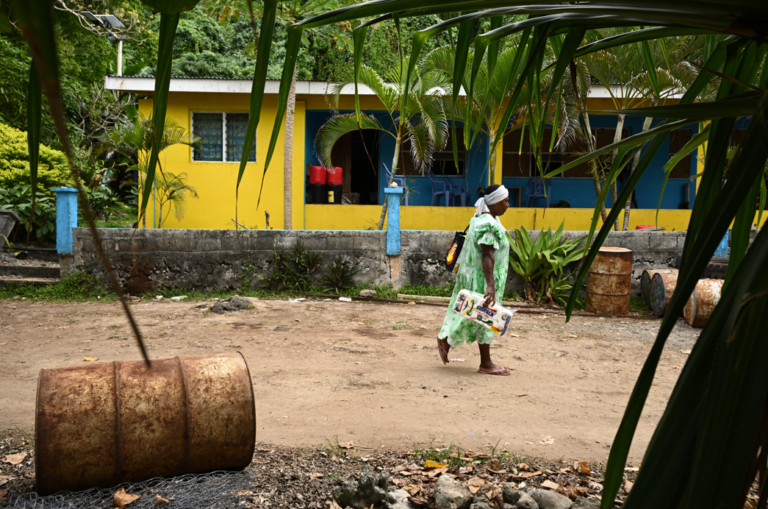
It seems incredible, given the vast ocean surrounding the atolls in Bougainville’s north, that these palm-clad places could experience drought.

Yet the tiny specks in the Solomon Sea to Australia’s northeast have suffered six months without rainfall, imperilling lives and sparking a mighty effort to bring relief.

Gideon Haukani, who grew up on the Nuguria islands, says the desperation has forced the closure of schools “because teachers need to go and look for food for their family”.

Locals wake as early as 2am to paddle by canoe to nearby islands on the hunt for coconuts or food to bring home.

As well as obvious challenges like water shortages and failing crops, the drought has drawn less expected difficulties.

Dwindling water sources have led to sandfly and mosquito populations intensifying near human settlements, leading to mass bites and infections. 

Around 150km southwest of Nuguria, on Nissan Island, Sylvia Rennethsie says the unyielding heat eviscerated her yam crop and took a toll on her community.

“A widow fell off and slit her face on a stone because she was hungry,” she tells AAP.

“She got skin disease due to excessive heat. To make it worse, there was no medicine … the government cannot afford medicine so we suffer the consequences.”

Mr Haukani’s Nuguria is one of a series of atolls and islands in the north of Bougainville, the wantaway region in Papua New Guinea’s far east.

Tourism is non-existant and few outsiders visit, though whaling ships passed through in the 19th century.

Nissan Island was briefly a theatre of World War II visited by future US President Richard Nixon, then a humble supply officer.

For thousands of years before that, the isolated chain has been home to subsistence-focused communities.

“People are living a simple life,” Mr Haukani says.

That was until the drought, which began in November last year, which Mr Haukani rates the worst elderly locals can remember.

Needing humanitarian relief, Australia answered the call, funding a $500,000 package through CARE Australia including immediate needs – primarily water and food – and later, the installation of water tanks.

But it is one thing to offer relief and quite another to deliver it.

Emily Meren, CARE Papua New Guinea‘s humanitarian projects manager, says they received a green light in April to take aid to Pinapel Island and Nuguria, deemed to have the highest need.

That involved procuring and sailing goods from Morobe province on mainland PNG some 900 kilometres east to Buka, the Bougainville capital, taking two weeks.

As that ship had other contracts to attend to, the group was then stranded in Buka for a fortnight while sourcing another vessel to sail north for the 11-day distribution journey.

Logistical difficulties such as these are a reality of life in under-developed and under-resourced PNG, and Ms Meren encountered no different on arrival at Mantoia on Pinapel Island.

“There was no jetty, mind you, so we had to anchor offshore and the community had only two outboard motors functioning,” she says.

“The whole community’s lined up to like an assembly line to pass the relief items to shore and it took us well into the evening … it was exhausting for everyone.”

Next came packing and a fair distribution negotiated through chiefs, before a second drop-off at the village of Rogos on Pinapel’s other side.

“We had to ask the leaders in Mantoia to walk across (the island) to support their people at Rogos to speed it up,” Ms Meren says.

Then, another 12 hour overnight sailing north to finish the job at Nuguria, where conditions were worsened by previous storms.

“In good times, they have bananas or cassava growing,” Ms Meren says.

“When the drought heats, all of those dry up so they have to go back to mangrove seeds and coconuts to live on, which means drinking water from coconuts as well.

“But in Nuguria, there was a king tide last year and so many of the coconut trees died out.”

The logistical delays meant that by the time they landed, minor rainfall had arrived, along with some rice from another aid effort, helping avoid a catastrophic situation.

The aid allowed locals to top up their dwindling tanks – installed more than a decade ago as part of another CARE relief effort – and turn their minds to prevention efforts.

Islanders are in no doubt more is needed to safeguard the communities: regular ferries, economic development, better health support.

“Because it’s so isolated, when teachers or others come back for their break, its very hard to get back,” Mr Haukai says.

“A health officer came to Buka and was stranded because there was no transport going back home for six months.

“There is no economic projects that are happening … we have resources in the sea, we have fish, sea cucumbers, copra, coconut but we don’t have a relay-able service to ship their products.”

Ms Rennethsie also laments the changing climate and increasing likelihood sea level rise will alter their lives.

When a patchy signal allows, she shares a picture of a young child via Whatsapp, explaining the drought caused misery for her family.

“She does not like to eat anything else apart from pawpaw and her parents found it hard to deal with her demands during the drought,” she says.

“I am afraid the effect of climate change might have a great impact on my island … we are a vulnerable community.”


Written by: Ben McKay (AAP)

Pin It