Author

Australian Associated Press

Browsing

In the Papua New Guinea highlands, tribal violence is an unfortunate way of life and, increasingly, death.

In February 2024, bystanders were among 49 people killed in a gun battle between clans in Wabag, the capital of the Enga province.

That clash was the destructive climax of a spate of fierce inter-tribal battles in Enga, where hundreds have been killed and thousands displaced, fearing for their lives.

The reasons behind the violence are complex, including land ownership, with displacement of tribes causing cascading issues around custodianship of country.

The arrival of industry, including forestry and mining, can upset traditional community authority structures, and challenge chiefly systems.

The single greatest impact behind the swollen death tolls is perhaps the arrival of modern weaponry which replaces traditional weapons with lethal firearms.

The UN estimates there are 112 inter-group conflicts in Papua New Guinea, and recent massacres extend beyond Enga.

In 2019, more than 20 died in Hela province after an initial attack, which killed six, led to a retaliation including the murder of pregnant women and children.

It was in Hela and Morobe provinces that agency Conciliation Resources began a peace-building project, drawing from years of expertise and a scoping assessment of the likelihood of success.

“It was to enhance the skills and capacities of the people working on these conflict challenges,” Ciaran O’Toole, Melbourne-based regional director, tells AAP.

“Working to enable specific communities, in particular those affected by violence, to design and develop their own peace-building work (and) provide … small grants for them to conduct dialogue or provide livelihood for some of the young men engaged in violence.

“It was very targeted on what we would call the drivers of the violence.”

That was, until a stop-work letter arrived early this year.

“It was quite blunt. It was very quick. There wasn’t any lead time to wind down. It was just ‘stop work’,” Mr O’Toole said.

The peace-building project was one of thousands axed by the US President Donald Trump’s executive order to pause and re-evaluate foreign aid in January.

Alongside peace-building programs, multi-billion dollar health initiatives to treat HIV and malaria, food provision, and climate-mitigation projects funded by USAID were ended.

Months later, it is estimated that roughly 90 per cent of USAID’s $A53 billion annual spend has been cancelled, representing roughly a third of all foreign aid.

Australian development agencies are among those counting the cost.

In a survey of members, peak body Australian Council for International Development (ACFID) has revealed at least $A400 million worth of projects have been defunded by the United States.

ACFID believes that is a lowball figure, given many NGOs are yet to see the full picture of cuts, and others were not able to complete the survey during the upheaval.

“This means communities losing access to healthcare, girls losing access to education and families losing access to food programs,” ACFID chief executive Matthew Maury said.

The hardest-hit region for Australian agencies is the Pacific, with the loss of $A113 million worth of support, predominantly climate change resilience and disaster preparedness, health and gender projects.

Other axed projects include education and nutrition projects in Timor-Leste, drought recovery in Fiji, climate-resilient food systems in Nauru, and sexual and reproductive health services right across the Pacific.

Given the challenges and sensitivity that comes with securing funding from donor governments, not every agency is keen to speak on the record about their loss.

Caritas Australia programs director Dan Skehan said Caritas partners in Fiji and Samoa were also hit by USAID cuts.

“They were receiving USAID funding specifically for WASH, which is water, sanitation and hygiene work … delivering water to much needed communities, be that schools, communities or in some instances health facilities,” he tells AAP.

In this instance, Caritas Australia – part of the world’s second largest humanitarian grouping, second only to the Red Cross – was able to redirect support to these programs at a reduced scale.

“(Where) something like vital water to community hasn’t been delivered, we’ve made decisions to at least finalise the project activities,” he said.

The aid sector has also been plunged into chaos, and in many cases, retrenchment by the USAID cuts.

Caritas has shed hundreds of jobs in places like Bangladesh, and a smaller number in the Pacific.

“This is an enormous funding cut … there’s been an enormous amount of disruption in the sector,” Mr Skehan said.

“There would be large number of staff who have been serving communities of very skilled workers who no longer, unfortunately, have a job.

“What’s most important, and we’ve always got to hold at the centre, is it’s the communities and the vulnerable people that we serve that are most impacted.”

It’s not just the US which is cutting development assistance.

In April, the UK cut foreign aid by 40 per cent – a move which shocked many given it came from a centre-left Labour government – while last month, New Zealand axed $A91m in climate-related assistance.

Mr O’Toole said the huge US retreat on aid had “given permission to other governments to cut back on their aid budgets as well”.

“We’re all feeling the hurt across all of this change and I think all aid organisations are feeling this pain,” he said.

The sector hopes Australia, which has made incremental increases under Anthony Albanese, will step up to fill the gap.

There are some positive signs from Canberra, including a flexibility afforded to agencies to move funds earmarked for one purpose onto others in light of cuts.

Mr Maury hopes future budgets will see aid rise not just in real terms but as a percentage of the budget.

“Australia has a proud history of supporting development, particularly in the Pacific,” Mr Maury said.

“Yet as global needs rise, our aid budget has fallen to just 0.65 per cent of the Federal Budget … restoring aid to one per cent would reaffirm our commitment and secure Australia’s place at the forefront of development.”


Written by: Ben McKay (AAP)

As transmission rates soar, Papua New Guinea has declared a national HIV crisis to try and galvanize action to prevent the spread of the virus.

UNAIDS and the World Health Organisation estimate the Pacific nation recorded 11,000 new cases last year alone.

That’s equivalent to 30 new positive tests a day including seven newborns, who can be prevented from contracting HIV through antiretroviral therapy.  

PNG Health Minister Elias Kapavore said the trend was “deeply concerning”.

“As such, I am declaring this a National HIV crisis,” he told a press conference in Port Moresby.

The declaration is more than symbolic, activating a national emergency response plan enabling cross-sector co-ordination and investment in HIV services.

Adding to the anguish at the figures is the advancement of treatment and prevention options for HIV.

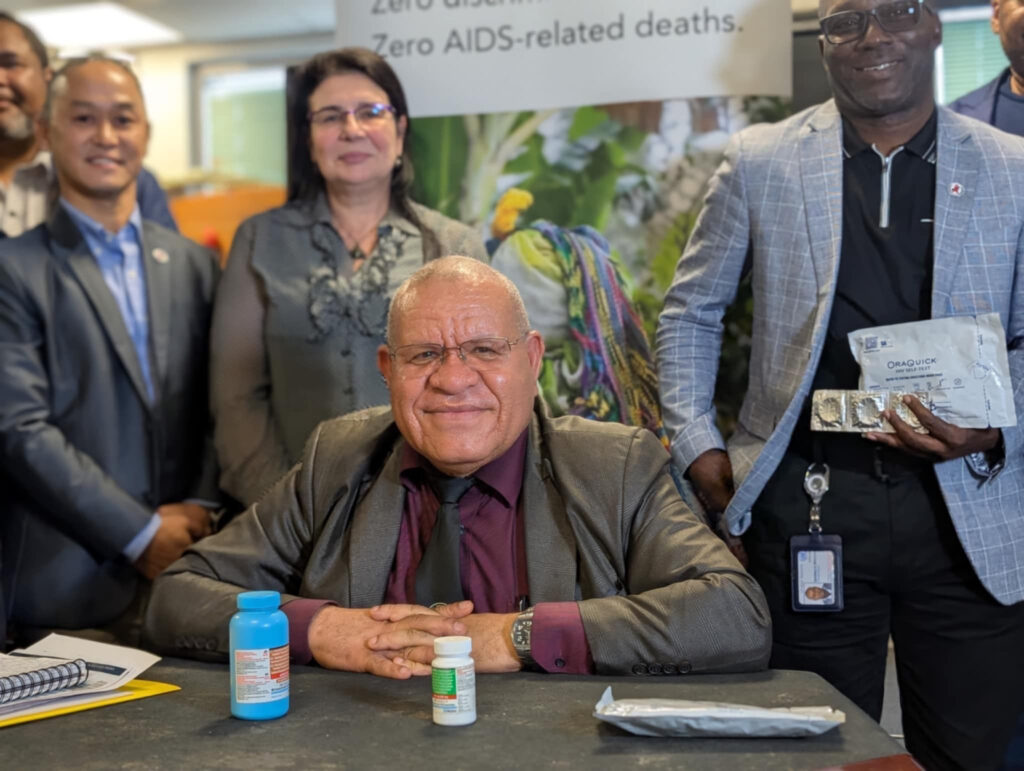
Bald brown man wearing a suit, Ken Wai comments on HIV crisis in PNG
In a supplied image, Papua New Guinea Health Secretary Ken Wai poses with some HIV antiretroviral medication at the National Department Of Health Building in Port Moresby, Papua New Guinea, on Thursday, June 26, 2025. Papua New Guinea health officials are ramping up efforts to fight HIV transmission. (AAP Image/Supplied by UNAIDS)

Most crucial is improving testing rates, so that more of the estimated 120,000 in Papua New Guinea with HIV can seek treatment.

Acting PNG health secretary Ken Wai said testing every pregnant woman can allow them to know their status and then access medication that prevents transmitting the virus to their child.

“We must scale-up access to HIV testing and treatment, particularly for groups most at risk. These priority initiatives should be offered at health facilities nationwide, and will require community leadership and support,” he said.

Mr Kapavore called HIV “a disease of inequality”.

“It is time for all of us to step up. I personally commit to raising this issue with my fellow ministers and parliamentarians and ensuring the urgent allocation of resources to protect our people – especially the next generation of Papua New Guineans,” he said.

The uptick reverses a decade of progress made to 2010, when World Vision reported new infections fell by roughly half to roughly 6000 a year.


Written by: Ben McKay (AAP)

Migrant women working in rural Australia are carrying unplanned pregnancies, having unwanted abortions or even giving their babies to authorities due to fear, poverty and poor healthcare coverage.

This is the “unseen population” that NSW general practitioner Trudi Beck wants every Australian to know about.

Dr Beck, a GP obstetrician from Wagga Wagga, told a NSW parliamentary inquiry into modern slavery that she routinely sees pregnant Pacific Islander workers, who are not entitled to free or subsidised healthcare in Australia.

The vast majority of those women opted for an abortion, though it didn’t always appear to be their preference, Dr Beck said.

The women, who are usually working under the Pacific Australia Labour Mobility (PALM) scheme, fear they will breach their visa conditions if they cannot work due to pregnancy.

“I find it really difficult to provide termination services for a woman where that’s not her deeply-held desire … that’s the crux of the matter for me,” Dr Beck told the inquiry sitting in Griffith on Thursday, in sometimes emotional evidence.

“If this woman was in her home country and had the means to live above the poverty line, she would have this baby.

“That is just such an ethics and values clash for me and that’s what makes me want to reach out to people to say: can we make this better?”

Some women who could not access abortion services in time gave birth in their home countries while on annual leave, Dr Beck said.

The inquiry has been told PALM workers are particularly vulnerable to exploitation because their visa does not allow them to change employers, forcing some to abscond.

Many disengaged workers have settled in the NSW Riverina, where they live in hiding, Leeton Multicultural Support Group chairman Paul Maytom said.

Mr Maytom said 10 pregnant migrants have approached the organisation for help, including one woman who gave her prematurely-born baby to authorities after her older child was also taken in as a ward of the state.

“She said, ‘I didn’t know what to do because I have no money, so I agreed to it, but I want my babies back’, Mr Maytom said.

“That’s tough.”

Griffith domestic violence service Links For Women supported 47 female PALM workers in 2023-24.

The women were assaulted by either male employers or their co-workers, forcing them to flee, manager Madeleine Rossiter said.

It’s estimated more than 40,000 people are enslaved across the nation, subject to violence, threats, punishing hours, low pay, poor housing and restricted movements.

More than 16,000 are believed to be trapped in modern slavery in NSW, one of the few states that does not regulate the hire companies central to migrant recruitment.

The inquiry continues.
Reports of modern slavery can be made to 1800 FREEDOM (1800 37 333 66)


Written by: Stephanie Gardiner (AAP)

Queensland have stopped New South Wales from pulling off the greatest comeback in State of Origin history, keeping the series alive with a thrilling 26-24 win in Perth.

After three weeks of turmoil that included the axing of captain Daly Cherry-Evans, the Maroons produced a Queensland performance for the ages to win 26-24.

It didn’t come easy after the Maroons led 26-6 at half-time and then let in four second-half tries to allow the Blues to get within two points with six minutes left.

But just as NSW threatened to pull off the first 20-point comeback in Origin history, Payne Haas dropped a ball on attack late and the Maroons held on.

Goalkicking proved the difference with NSW scoring more tries but Zac Lomax converting just two of five.

The result sets up a series decider in Sydney on July 9, with NSW suddenly searching for answers after being well below their best at Optus Stadium.

NSW coach Laurie Daley refused to blame his team’s wayward goalkicking for the loss.

“Yeah, you want to kick goals, but there were a lot more things that we needed to do that I was disappointed in,” Daley said.

“Goal kicking is way down the list. It’s more about our execution, intent. There were a lot of things we didn’t do well in the first half. 

“We showed what we were capable of doing in the second half, but you can’t play a (first) half of football like that against quality opposition and expect to be close.”

On a frantic night that boiled over on several occasions, Jarome Luai was placed on report after rubbing his hand over Reuben Cotter’s face.

Luai appeared to make contact with Cotter’s eye before Maroons fullback Kalyn Ponga then made a raking gesture with his hand to officials. 

Luai was later hit with a grade-two contrary conduct charge for unnecessary contact with the face and will cop a fine of $3900 with an early guilty plea.

That alone summed up the night for the Blues, who at one stage trailed the penalty count 9-0 and had a crucial Nathan Cleary try overturned by an obstruction.

Even so, this was a good night for the Maroons on a day that began with coach Billy Slater apologising for press conference comments that referenced the late Paul Green.

Man-of-the-match Cameron Munster was superb in his first game as Queensland captain, while his halves partner Tom Dearden also impressed after taking Cherry-Evans’s jersey.

“I’m just proud of our boys to turn up for Billy,” Munster said. 

Cameron Munster addresses his Queensland Maroons team after their win in State of Origin II. (Dan Himbrechts/AAP PHOTOS)
Cameron Munster addresses his Maroons team after their win in State of Origin II. (Dan Himbrechts/AAP PHOTOS)

“Because there’s been a lot of speculation in the media and we needed to turn up for our coach tonight, and we did.”

Slater was proud of his team’s efforts.

“It’s a heart stopper,” he said.

“Boy, it took a whole heap of courage and character and effort, a bit of spirit.

“That’s the pride I feel for our footy team, and I’m sure five-and-a-half million Queenslanders feel that pride right now as well.”

NSW looked as if they were going to continue their form from the series-opening 18-6 win at Suncorp Stadium early, crossing first through Brian To’o.

But what followed was an example of the Queensland spirit that Origin has largely been built on.

The Maroons attack came to life, with Robert Toia sending Hamiso Tabuai-Fidow over for one and the winger jumping over Brian To’o for another.

Munster scored once when Harry Grant got out of dummy-half, while Kurt Mann offloaded for a Kurt Capewell four-pointer before the break.

Capewell’s try looked likely to be a heartbreaker for the Blues, after Cleary had been denied for the obstruction moments earlier.

But any thought Queensland had of cruising to victory was quickly killed off in the second half.

Winger Brian To'o led a spectacular Blues fightback with this early second-half try. (Richard Wainwright/AAP PHOTOS)
Winger Brian To’o led a spectacular Blues fightback with this early second-half try. (Richard Wainwright/AAP PHOTOS)

To’o had his second shortly after the break when NSW stripped Queensland for numbers, before Stephen Crichton went through three defenders to make it a 12-point game.

The comeback was then well and truly alive when Cleary and Luai combined to help Latrell Mitchell send To’o over for his third.

And when Mitchell pulled off a one-on-one strip on Tino Fa’asuamaleaui and Angus Crichton ran onto a Luai grubberkick, NSW looked set to storm home.

But in the end Queensland stood tall at the death, sealing a famous backs-to-the-wall win to keep hope of winning back the Origin shield.

The other concern for NSW is Cleary’s groin, with the superstar Penrith halfback unable to kick for much of the match after reporting tightness in the build up.


Written by: Scott Bailey (AAP)

Nathan Cleary has warned that NSW’s squad has the feel of Penrith’s best days again, with he and Jarome Luai slipping straight back into their old combination.

Cleary has a chance to win his fourth State of Origin series as NSW halfback on Wednesday, with the Blues heavy favourites to taste victory at Optus Stadium.

It will come on an historic night for the Panthers star, who will join Andrew Johns and Mitchell Pearce for the most games in the NSW No.7 jersey, with 16.

Cleary and Luai have been teaming up since the age 15, winning 107 of the 134 games they have played together at all levels before the latter’s move to Wests Tigers this year.

Luai’s call up to the NSW’s 18-man squad for the injured Mitch Moses now means there are nine members of Penrith’s NRL premiership dynasty in the Blues’ group, with Matt Burton 18th man.

Nathan Cleary addresses the media ahead of Origin II in Perth. (Dan Himbrechts/AAP VIDEO)

“It is a bit of that feel of that 2021 grand-final team,” Cleary said on Tuesday. 

“(Jarome and I) understand each other’s games pretty well. So in that regard, it was a pretty seamless transition with him coming back in. 

“He was a part of the series last year too. He has those combinations already with the guys around him. 

“Our combination doesn’t change. It’s probably more him coming back into the side with those other guys. And I thought he’s done that really well.”

Jarome Luai will be back together with his old Penrith 'other half' Nathan Cleary in Origin II. (AAP Image/James Worsfold)
Jarome Luai will be back together with his old Penrith ‘other half’ Nathan Cleary in Origin II. (AAP Image/James Worsfold)

Cleary will be one of the most scrutinised players on the field in Perth on Wednesday night.

Despite the four premierships rings at Penrith, there is still a slight stigma attached to the halfback in that he is yet to own an Origin series.

Cleary has often been among the Blues’ best in big wins, but critics point to the fact he is yet to have a standout moment at the clutch in close games.

However, that is largely due to the fact that when NSW have won in the past seven years, Cleary has starred and the Blues have won comfortably.

Nathan Cleary (right) speaks with coach Laurie Daley during a NSW Blues State of Origin Captian’s Run at Optus Stadium, in Perth, Tuesday, June 17, 2025. (AAP Image/Dan Himbrechts)

As he prepares to equal the mark made by Johns and Pearce, Cleary said he was far removed the man who debuted under coach Brad Fittler in 2018.

“(Origin) comes with more expectations now, with the standing in the game and the amount of games I’ve played,” Cleary said. 

“But I’m in a position to play my best footy, I had a very simplified role (back then) and contributed where I could. 

“It’s the same now, I want to do my role and my best for the team, but it’s having a greater influence on what we’re able to do.”

The 27-year-old is now comfortable with shouldering the pressure associated with having become one of the faces of the game in recent years.

Cleary has long labelled the 2019 season as one of the most important of his career, narrowing his focus and making him mature after a poor year for Penrith.

He believes this season has also made him a better footballer, with the Panthers trying to climb from the bottom of the ladder after round 12 and back into finals contention.

Queensland coach Billy Slater addresses Aaron Woods’s ‘grub’ remarks at a Perth press conference. (Dan Himbrechts/AAP VIDEO)

Now into his 10th NRL season, Cleary said his relationship with the sport had also changed since his Penrith debut in 2016 and his NSW start two years later.

“I’m still passionate about it, I still love watching it. But I would say in terms of professionalism, that’s changed,” Cleary said.

“This is a duty to my teammates, to my club when I’m playing for my club, and for my state when I’m playing for my state. 

“I just went out there and played when I was younger. Now it’s much more regimented with what I need to do to play my best. 

“I think I’m definitely more consistent because of that, rather than when I was an 18-year-old.”


Written by: Scott Bailey (AAP)

Pacific workers are being urged to chase up “many millions” in lost superannuation from their stints in Australia, with that problem also leading to calls for reform.

Difficulties navigating Australia’s complex tax system, particularly for foreigners, mean Pacific Australia Labour Mobility (PALM) workers often leave their hard-earned super languishing.

During a nine-month stint in Australia at the guaranteed base wage levels, PALM workers typically accumulate around $3,800 in pre-tax superannuation.

Like other guest workers, PALM workers can apply to access those funds once they’ve left the country, but most either do not – or can not.

Group of young Pacific PALM workers sitting at a table.
All guest workers can apply to access their superannuation once they’ve left, but many do not. (University of South Australia/AAP PHOTOS)

“PALM workers are collectively leaving many millions of dollars in superannuation unclaimed,” Robert Whait, University of South Australia senior lecturer told AAP.

The PALM scheme has expanded in recent years to average around 30,000 workers from 10 Pacific nations in Australia at any one time, doing jobs that employers cannot fill.

Industries includes agriculture and food processing, but also aged care, hospitality, tourism, and even a pilot in early childhood education.

Dr Whait manages the UniSA tax clinic, which offers advice “to help vulnerable Australians with their taxes”, and on the foreign affairs department’s suggestion, widened to take in PALM workers.

“PALM workers have the same rights we do … but the main issue is that under the current law, they can only access that superannuation when they leave Australia and their visa is canceled,” he said.

“Either they’re not aware of it, or the process to put in the forms is difficult because of various barriers, so lots of money is left unclaimed which they could be taking home with them to use, directly with their families and helping out their lives.”

Barriers include the unavailability of key forms in languages other than English, the reliance on internet and computer access, and verification.

PALM workers also get slugged with extra taxes that effectively claw back half of their earnings: the 15 per cent tax on contributions and a 35 per cent “departing Australia superannuation payment” tax.

The messy situation has led Dr Whait, with Connie Vitale from Western Sydney University, to author a paper looking at policy reforms, especially given super primarily exists to fund the retirement of Australian workers.

Options canvassed include adding super into their take-home pay (as occurs in New Zealand) or sending it to a super fund in the worker’s home country, either as they earn, or when they head home. 

Dr Whait believes the latter options would better serve the primary of purpose of super – to assist workers in retirement – and allow Pacific super funds greater pools of funding to invest at home.

“The money from PALM superannuation could be used to help infrastructure in their countries and help their communities, so that was probably the tipping point in in recommending that approach,” he said.


Written by: Ben McKay (AAP)

STATE OF ORIGIN‘S MOST UNLIKELY COMEBACKS:

MAGUIRE’S MIND GAMES LEAD TO HEIST OF 2024

Just last year NSW were able to pull off exactly what the Maroons are attempting to do. After A series-opening flogging at home where Joseph-Aukuso Suaalii was sent off, Michael Maguire began throwing barbs at Billy Slater and the series turned. NSW demolished the Maroons in Melbourne, before winning a decider at Suncorp for the first time since 2005.

THURSTON DOES IT WITH ONE ARM IN 2017

Queensland looked shot after Andrew Fifita led an assault on Suncorp Stadium and NSW won the series opener there 28-4. The Blues then led 16-6 at halftime in Sydney, before Johnathan Thurston engineered a comeback while playing with a season-ending shoulder injury. Momentum had swung, and the Maroons won comfortable in Cameron Munster’s debut in Brisbane.

QUEENSLAND SAVE STATE OF ORIGIN IN 2006

There were genuine fears over the future of State of Origin when NSW won a thrilling game one in Sydney and looked on track for a fourth straight series win. The Maroons hit back with a 30-6 flogging in Brisbane, before Darren Lockyer’s famous effort to intercept a Brett Hodgson pass late in Melbourne secured a win for the Maroons and forever altered the course of Origin history with seven more consecutive series wins to follow.

JOHNS’ LAST HURRAH IN 2005

NSW had a mountain to climb after another all-time classic in the series opener, coming back from 19-0 down to lose 24-20 in golden point. Enter Andrew Johns. The Newcastle legend came back from injury set up a 32-22 win in Sydney before a 32-10 domination in Brisbane three weeks later. It would prove the champion halfback’s last Origin match, and the end of an era of Blues’ domination before Queensland’s dynasty began the following year.

BLUES’ 1994 RESURRECTION AFTER MAROONS MIRACLE

Mark Coyne scored the most famous try in State of Origin history to take Queensland to victory in game one, but it was NSW who pulled off the ultimate miracle over the next month. Defence won the game for the Blues in Melbourne, before a second straight victory on the road at Suncorp Stadium won them the series for the third straight year. It marked the first time a team came from 1-0 down to lift the shield.


Written by: Scott Bailey (AAP)

A defiant Billy Slater has declared that the Queensland Maroons won’t be pressured into kicking off to NSW firebrand Spencer Leniu in State of Origin II.

As Maroons prop Tino Fa’asuamaleaui said he was not scared of Leniu on Tuesday, Slater would not be drawn on whether the Maroons would kick to the Blues front-rower.

Of the four long kick-offs from Queensland in their game one loss, none went to Leniu or Payne Haas, in what has since been labelled by some as a pre-determined plan.

The situation left Leniu fuming, with the Sydney Roosters prop appearing to swear in frustration as the Maroons changed the direction of their kick to avoid him.

Haas has largely stayed away from the debate over the past week, but on Monday said he would want the ball kicked off to Leniu if he was in the Maroons side, since he’d want the chance to take down a powerful rival.

Former NSW front-rower Willie Mason has also accused the Maroons of being “s**t scared” of Leniu, while Braith Anasta labelled Queensland “weak”.

Slater dodged a question on Tuesday on whether Leniu would have the chance to take a hit-up from a kick-off at Optus Stadium.

But the Maroons coach did defend his team’s right to prioritise their own tactics over the entertainment factor.

“We don’t ask Nathan (Cleary) to kick to a specific corner. He does what he wants,” Slater said of the Blues halfback. 

“He gets his game on. So, we’ll be getting our game on.

“I get all the dilemma about it, but at the end of the day, it’s about building a game and a game plan that best suits you.  

“It’s not about what (the media) want or anyone else wants.”

Asked about the issue, Maroons front-rower Fa’asuamaleaui rejected any suggestion Queensland’s pack were scared of Leniu.

“I’m not scared of anyone,” Fa’asuamaleaui said.

“I just want to do my job for Queensland and I’m not going to back down from anyone and that’s our whole team. 

“We’re just going to get out there, get our game on and do what we do best and play our game.

“(We’re) not backing down from anyone.”

Slater wouldn’t say whether the Maroons would make late changes to their pack, or if Kurt Mann could start at hooker in place of Harry Grant.

The Maroons have won six of eight games when Grant has come off the bench, as opposed to a 0-4 record with him starting.

NSW second-rower Angus Crichton had accused Queensland of mind games last week, refusing to believe Jeremiah Nanai and Pat Carrigan weren’t starting.

Hamiso Tabuai-Fidow has already let slip that he will move to the right wing at Optus Stadium, after playing left centre in the series-opening 18-6 loss in Brisbane.

That defeat has piled the pressure on Slater, who has already axed captain Daly Cherry-Evans and replaced him with Tom Dearden in the halves.


Written by: Scott Bailey (AAP)

Pacific media outlets In-depth Solomons and Inside PNG face existential threats, while Benar News has already gone under, as America withdraws from the region.

America’s retreat from foreign aid is being felt deeply in Pacific media, where pivotal outlets are being shuttered and journalists work unpaid.

The result is fewer investigations into dubiously motivated politicians, glimpses into conflicts otherwise unseen and a less diverse media in a region which desperately needs it.

“It is a huge disappointment … a senseless waste,” Benar News’ Australian head of Pacific news, Stefan Armbruster, told AAP after seeing his outlet go under.

Benar News, In-depth Solomons and Inside PNG are three digital outlets which enjoyed US support but have been cruelled by President Donald Trump’s about-face on aid.

Benar closed its doors in April after an executive order disestablishing Voice of America, which the United States created during World War II to combat Nazi propaganda.

An offshoot of Radio Free Asia (RFA) focused on Southeast Asia and the Pacific, Benar kept a close eye on abuses in West Papua, massacres and gender-based violence in Papua New Guinea and more.

The Pacific arm quickly became indispensable to many, with a team of reporters and freelancers working in 15 countries on a budget under $A1 million.

“Our coverage of decolonisation in the Pacific received huge interest, as did our coverage of the lack women’s representation in parliaments, human rights, media freedom, deep sea mining and more,” Mr Armbruster said.

In-depth Solomons, a Honiara-based digital outlet, is another facing an existential threat despite a proud record of investigative and award-winning reporting.

Last week, it was honoured with a peer-nominated award from the Foreign Correspondents’ Club of Japan for a year-long probe into former prime minister Manasseh Sogavare’s property holdings.

“We’re just holding on,” editor and co-founder Ofani Eremae told AAP.

A US-centred think tank continues to pay the wage of one journalist, while others haven’t drawn a salary since January.

“It has had an impact on our operations. We used to travel out to do stories across the provinces. That has not been done since early this year,” Mr Eremae said.

A private donor came forward after learning of the cuts with a one-off grant that was used for rent to secure the office, he said.

Its funding shortfall – like Port Moresby-based outlet Inside PNG – is linked to USAID, the world’s biggest single funder of development assistance, until Mr Trump axed its multi-billion dollar budget.

Much of USAID’s funding was spent on humanitarian causes – such as vaccines, clean water supplies and food security – but some was also earmarked for media in developing nations, with the aim of bolstering fragile democracies.

Inside PNG used its support to build an audience of tens of thousands with incisive reports on PNG politics: not just Port Moresby, but in the regions including wantaway province Bougainville that has a long history of conflict.

“The current lack of funding has unfortunately had a dual impact, affecting both our dedicated staff, whom we’re currently unable to pay, and our day-to-day operations,” Inside PNG managing director Kila Wani, told AAP.

“We’ve had to let off 80 per cent of staff from payroll which is a big hit because we’re not a very big team.

“Logistically, it’s become challenging to carry out our work as we normally would.”

AAP has confirmed a number of other media entities in the region which have suffered hits, but declined to share their stories.

The funding hits are all the more damaging given the challenges faced by the Pacific, as outlined in the  Pacific Islands Media Freedom Index.

The latest report listed a string of challenges, notably weak legal protections for free speech, political interference on editorial independence, and a lack of funding underpinning high-quality media, in the region.

The burning question for these outlets – and their audiences – is do other sources of funding exist to fill the gap?

Inside PNG is refocusing energy on attracting new donors, as is In-depth Solomons, which has also turned to crowdfunding.

The Australian and New Zealand governments have also provided targeted support for the media sector across the region, including ABC International Development (ABCID), which has enjoyed a budget increase from Anthony Albanese’s government.

Inside PNG and In-depth Solomons both receive training and content-focused grants from ABCID, which helps, but doesn’t fund the underpinning costs for a media business or keep on the lights.

Both Mr Eremae, who edited two major newspapers before founding the investigative outlet, and Mr Armbruster, a long-time SBS Correspondent, expressed their dismay at the US pivot away from the Pacific.

“It’s a huge mistake on the part of the US … the world’s leading democracy. The media is one of the pillars of democracy,” Mr Eremae said.

“It is, I believe, in the interests of the US and other democratic countries to give funding to media in countries like the Solomon Islands where we cannot survive due to lack of advertising (budgets).

As a veteran of Pacific reporting, Mr Armbruster said he had witnessed US disinterest in the region contribute to the wider geopolitical struggle for influence.

“The US government was trying to re-establish its presence after vacating the space decades ago. It had promised to re-engage, dedicating funding largely driven by its efforts to counter China, only to now betray those expectations,” he said.

“The US government has senselessly destroyed a highly valued news service in the Pacific. An own goal.”


Written by: Ben McKay (AAP)
Between Australia and New Zealand sits a chain of underwater volcanoes that are home to an abundance of fish, ancient corals and other marine life.

Known as Lord Howe Rise, the vast underwater landscape largely exists outside state maritime boundaries, beneath the high seas.

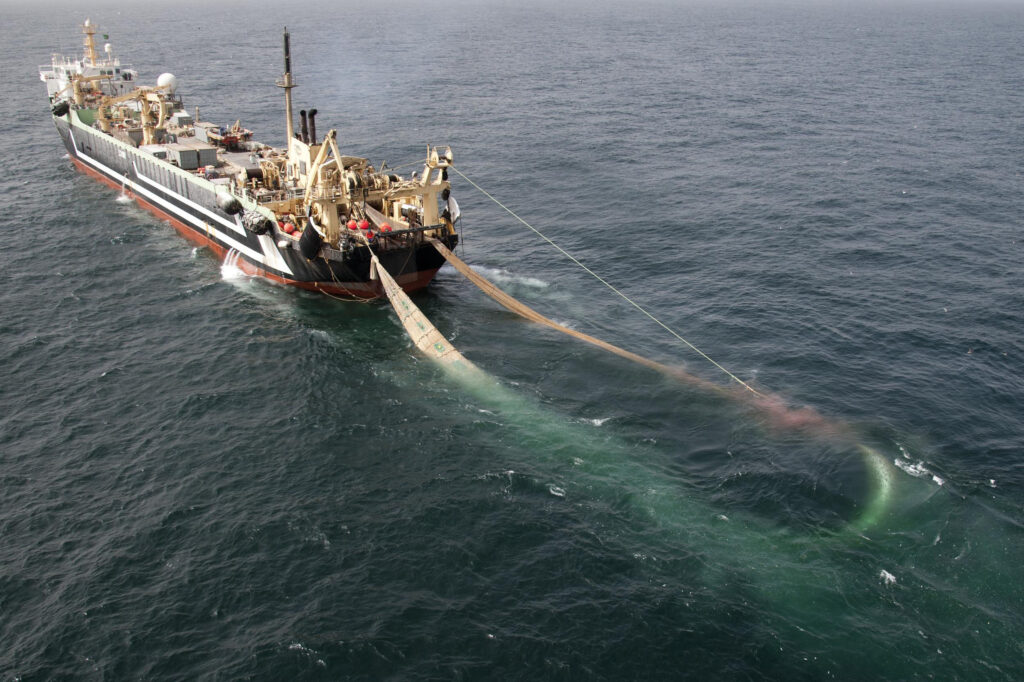
That makes the ecologically-rich habitat fair game for industrial fishing, including long-lining and bottom-trawling techniques in the spotlight following the latest instalment from acclaimed nature documentarian David Attenborough.

Footage in Ocean powerfully reveals to viewers for the first time, trawlers dragging heavy nets across the sea bed in an indiscriminate search for just a few prized species.

As well as scooping up vast volumes of bycatch, such trawling has been found to churn up carbon that would have otherwise stayed locked in place on the sea floor, some of which ends up in the atmosphere to fuel climate change.

The documentary lands ahead of a major United Nations ocean conference in France in June.

Conservation groups are hopeful the film will help garner support for a landmark treaty to better protect the roughly two-thirds of marine habitat outside the boundaries of individual countries.

The high seas biodiversity agreement would lay the foundations to safeguard 30 per cent of the world’s oceans by 2030 in marine sanctuaries, helping preserve threatened species and support fish stocks for communities reliant on the food source.

According to the Department of Climate Change, Energy, the Environment and Water, Australia, a founding signatory to the agreement in 2023, and the re-elected Albanese government have promised to ratify its commitment “as quickly as possible”.

“Australia is one of a small number of countries that requires implementing legislation to be in place before the treaty can be ratified,” a spokesperson says.

A multi-agency government delegation still being finalised is set to attend to conference in France.

To bring the treaty into force, 60 countries need to enshrine the treaty in national law via ratification.

So far, about 40 have either done so or signalled that they will. 

 WWF-Australia head of oceans and sustainable development Richard Leck is confident the treaty will come into force. 

“But it means countries like Australia, who have indicated they support the treaty, really need to step up to their parliamentary processes and make sure that that actually gets through their systems,” he says.

Greenpeace Australia Pacific senior oceans campaigner Georgia Whittaker says marine animals are being “pushed closer to the brink of extinction” every day that passes without stronger protections.

Fresh analysis of fisheries data from the environmental campaigners reveals damage caused by industrial longline fishing – long stretches of baited hooks – to shark populations.

Almost half a million near-threatened blue sharks were taken as bycatch in the the central and western Pacific in 2023, the highest number ever recorded and double 2015 numbers.

Greenpeace has been angling for a marine sanctuary in the Lord Howe Rise and Tasman Sea region in anticipation of the oceans treaty going ahead.

Marine scientist and Research Connect Blue director Rachel Przeslawski says there is still much to learn about the diverse underwater tracts off Australia’s east coast.

The mighty chain of seamounts – underwater mountains – experience an inverse relationship to biodiversity to that of their on-land cousins.

Life is most abundant higher on the peaks, where there’s more sunlight and nutrients, with visiting humpback whales and other migratory species among the creatures found in their midst.

The deeper waters of the surrounding abyssal plains tend to host sparser populations of “weird critters” that have adapted to dark, nutrient-poor and hostile conditions. 

Some seamounts are as shallow as 200m and a few breach the surface, Lord Howe Island and Middleton and Elizabeth reefs among them.

Australian trawlers are no longer active in the area but vessels from other countries are causing damage, Dr Przeslawski tells AAP, with sea beds taking years or even decades to recover.

She says any marine sanctuaries devised under a high seas agreement would ideally be completely no-take.

Many existing marine parks are only partially protected, with permitted sections to be fished or mined.

“Is it going to be toothless?” Dr Przeslawski asks.

“Or will it actually have some bite and the ability to affect some of these really ecologically damaging activities?”


Written by: Poppy Johnston (AAP)

Pin It