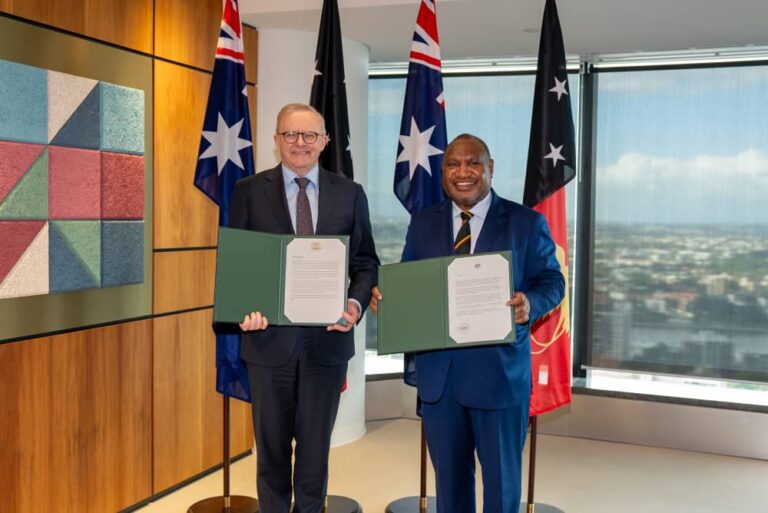
PAPUA NEW GUINEA and Australia are now, formally allies with the, entry into force of the Pukpuk Treaty. This means the articles outlined in the Bilateral Security Deal are now legally binding and can be implemented.
The announcement made on 11th July by both Prime Ministers will strengthen the integration between PNG and Australian Defence Forces.
For Papua New Guinea, the Pukpuk Treaty makes Australia the first country in its´ history to sign a security deal of this level.
While for Australia, PNG becomes the fourth country of alliance, 70 after Australia and the United States became allies.
Under this treaty, Papua New Guineans can join the Australian Defence Force and serve in the Australian Army, the Australian Defence Force will have access to agreed military bases in PNG and both countries will defend each other if a conflict arises in the region.
PNG Prime Minister James Marape, who attended the annual PNG-Australia Leader´s Dialogue said his government deliberately elevated this relationship from traditional cooperation to equal partnership.
“The real objective is to strengthen connections between our people, expand business-to-business engagement, increase investment flowing both ways, and create more opportunities for Papua New Guineans and Australians alike,” Marape said.
Australian Prime Minister, Anthony Albanese said the alliance between the two countries reflect the deep trust both countries share as the closest of neighbors, partners and friends.
“In an uncertain world, this treaty demonstrates our shared commitment to a region that is peaceful, stable and prosperous,” said Albanese.
This Treaty is underpinned by a mutual defence commitment, that recognized that an armed attack on either country is a threat to both nations, and the security of the region.
It commits both countries to consult, cooperate, and if required, act to meet a common danger, while explicitly safeguarding sovereignty.
In the last decade, Australia has been increasing its presence in the Pacific Island countries through security and economic agreements. This is desired to counter the growing concerns of China´s influence in the region.
In attempts to maintain a strong and active Australian presence, Canberra is looking beyond Papua New Guinean waters.
Earlier this week, the Australian Prime Minister and his delegates visited a number of the Melanesian countries.
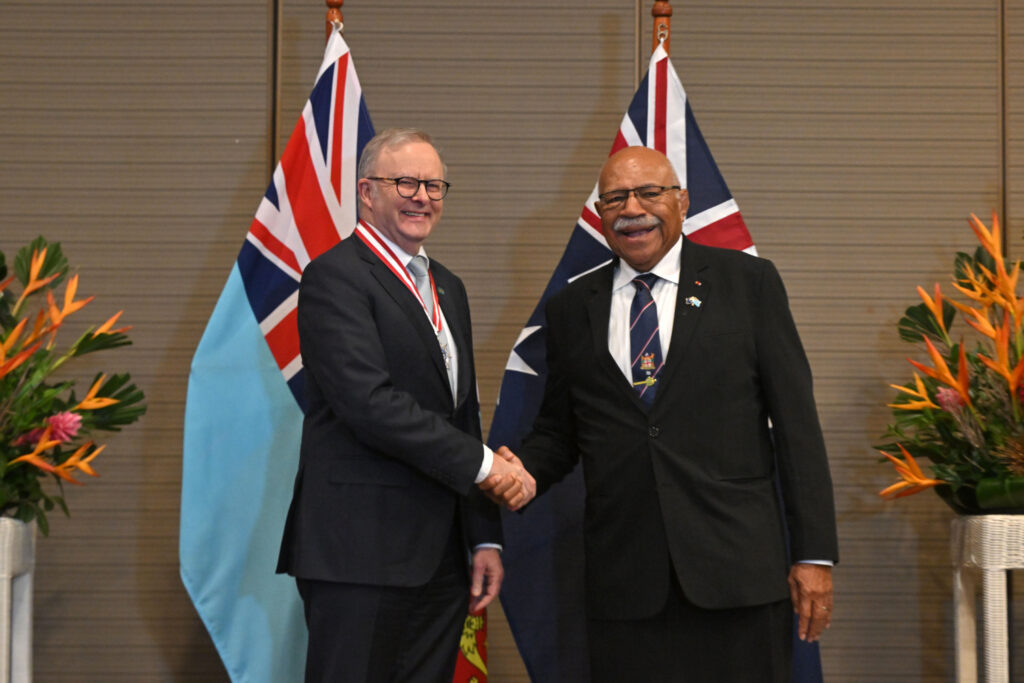
Australia’s Prime Minister Anthony Albanese and Fiji’s Prime Minister Sitiveni Rabuka before a bilateral meeting in Suva, Fiji, Monday, July 6, 2026. (AAP Image/Mick Tsikas)
Starting in Fiji, Australian Prime Minister Anthony Albanese and Fiji Prime Minister, Sitiveni Rabuka signed two deals in Suva.
Similar to the Pukpuk Treaty, the Ocean of Peace Alliance or the Veitacini Treaty between Fiji and Australia is a defence pact and a broader statement for security in the pacific region.
The second deal, called the Vuvale Union is closely tied to education services, workforce mobility, skills development and economic integrations.
In June, Australia also signed the Nakamal Agreement with Vanuatu. The agreement prevents foreign military bases to be established in the Melanesian country.
Solomon Island remains the only Melanesian Country yet, to sign a security deal with Australia. But this could change.
Talks between the Australian and Solomon Islands Prime Ministers during Solomon Islands the 48th Independence Anniversary suggests the two countries may start negotiations on a similar agreement like the Pukpuk Treaty
At the moment, Solomon Islands remains the only Pacific nation to have signed a security deal with China in 2022.
THE Queensland Maroons inability to handle favoritism and a disastrously poor defensive display have handed the Maroons a horrific new record, losing back-to-back State of Origin series deciders on home soil for the first time in history.
The Maroons have officially lost their aura at Suncorp Stadium, their spiritual home, following a crushing 2-1 series defeat to the New South Wales Blues that will haunt the state for years to come.
A brutal 30-12 defeat in Wednesday’s decider at the venue once deemed an impregnable fortress is now expected to cost several Maroons players their representative jerseys. This marks Queensland’s third consecutive defeat at Suncorp Stadium, a wound that will cut deep into the team’s soul as they face a massive post-mortem to figure out where it all went wrong.
While coach Billy Slater has achieved immense success with three series wins over the last five years, losing consecutive Brisbane deciders (following the 2024 heartbreak) will be incredibly bitter to swallow. The high-stakes environment has already claimed casualties; former skipper Daly Cherry-Evans saw his Maroons career end after leading the side to consecutive losses in Brisbane across the 2024 decider and the 2025 opener.
History shows the Maroons struggle heavily under the weight of favoritism, a trait they must urgently fix. Ahead of the clash, Captain Cameron Munster tried desperately to claim the underdog tag.
“The pressure is on us,” Munster admitted before the match, accurately pinpointing the immense weight of expectation tied to the historical importance of the former Lang Park.
During the broadcast, Blues legend Andrew Johns asked Maroons icon Cameron Smith if Queensland’s high early error count was driven by pressure or expectation. Smith’s telling reply was simply, “A bit of both.”
The opening half carried a ghostly resemblance to Game Two at the MCG, where NSW dominated early. However, unlike that match, where Queensland staged a roaring second-half blitz to win 44-24; there was no miracle comeback this time.
The Blues surged to an 18-0 lead and refused to collapse. While Queensland made a valiant effort to claw their way back, they were burned by a controversial length-of-the-field try to Blues centre Bradman Best after an apparent Jack Bostock knock-on went unpunished.
Ultimately, the Maroons dug their own grave with a lethargic start and an unacceptable tryline defensive display that allowed Cameron Murray to cross easily.
Slater’s coaching tactics will also face heavy scrutiny, particularly the puzzling decision to leave 14-game Origin veteran Pat Carrigan on the bench. When second-rower Kurt Capewell was forced off, Slater had to inject Jeremiah Nanai, completely burning the opportunity to utilize Carrigan’s experience.
The lone shining light for Queensland came in the second half via Brisbane fullback Reece Walsh. Coming off the bench, Walsh injected immediate spark and creativity, troubling the Blues’ line and proving he has the quality to reclaim the starting jersey he held in 2023 and 2024.
But individual brilliance wasn’t enough to save Queensland from a historic nightmare at home.
The Papua New Guinea Tourism Promotion Authority (PNGTPA), in collaboration with the National Capital District Commission (NCDC), has officially launched the National Capital District Accommodation Inventory & Capacity Survey.
The initiative was unveiled during a stakeholder workshop at the Holiday Inn in Port Moresby, where government officials and industry leaders gathered to map out a strategy for a more data-driven tourism sector.
The survey aims to establish a comprehensive, real-time database of all accommodation establishments throughout the National Capital District. According to PNGTPA officials, this move is essential for evidence-based decision-making, helping to guide future destination planning, attract targeted investment, and promote sustainable growth.
“Quality tourism planning begins with quality data,” said Mr. Kennewton Kennedy, PNGTPA Executive Manager for Partnership & Product Development.
“This initiative is about more than counting rooms. It is about understanding our tourism capacity, identifying opportunities for investment, and ensuring Port Moresby is well-prepared for major national and international events.”
A primary driver for the survey is the city’s preparation for upcoming high-profile events, most notably the PNG Chiefs Rugby League Games in 2028. By securing accurate information on room availability and capacity, authorities hope to streamline logistics and enhance the visitor experience.
Mr. Busa Jeremiah Wenogo, NCDC Economic and Business Development Manager, emphasized that the benefits of this project extend beyond the capital.
“Port Moresby is the gateway to explore the rest of Papua New Guinea,” Mr. Wenogo said.
“When we strengthen tourism in the National Capital District, we also strengthen tourism opportunities for every province.”
PNGTPA has issued a strong appeal to accommodation providers across the district to participate by providing accurate figures. To encourage transparency, the authorities have assured that all data collected will be handled confidentially and used exclusively for planning and development purposes.
Papua New Guinea has moved quickly to restrict poultry and egg imports from Australia following the discovery of a deadly strain of bird flu on the Australian mainland, though authorities have already refined the scope of the ban to target the highest-risk products.
The National Agriculture and Quarantine Inspection Authority (NAQIA) initially issued an urgent, blanket suspension on June 22, 2026, after two wild waterbirds tested positive for the highly contagious H5N1 strain of avian influenza in the southern part of Western Australia.
However, following rapid risk assessments and updated data showing the virus remains contained, NAQIA modified the restrictions just 24 hours later.
“On 23rd June 2026, further updates indicate the infection remained in the wild bird population and that domestic caged and free-range commercial farms were not affected,” Chief Veterinary Officer, Dr Ilagi Puana told InsidePNG News.
“As a result of this recent update, the temporary import suspension was lifted for all States in Australia except for Western Australia and that the products sourced from free range commercial farms remain suspended until further notice.”
Under the refined measures implemented on June 23, the trade restrictions are highly specific to how the birds are raised and where they originate;
Western Australia Free-Range Ban: Chicken meat and eggs raised in free-range systems from Western Australia remain strictly suspended. Free-range products from all other Australian states are still considered for import.
Barn-Raised & Processed Exceptions: Mechanically deboned meat (MDM) and mechanically separated meat (MSM) sourced from barn-raised and free-range chickens are permitted from all states. Furthermore, barn-raised products from Western Australia are allowed.
Shipments En Route: Importers with supply already on the water will not see their cargo turned away. NAQIA confirmed that “consignments prepared and exported before 22nd June are permitted from all States.” Any shipments exported after that date will face the targeted Western Australia free-range restrictions.
This targeted approach will likely cushion the blow for PNG’s food supply and trade. Australia is the country’s primary source of imported chicken, a trade worth over K340 million ($133 million AUD) annually, with PNG buying nearly half of all Australia’s chicken meat exports.
The Australian Department of Agriculture, Fisheries and Forestry confirmed it is working closely with NAQIA to resolve the remaining restrictions.
“The department is actively engaging with PNG to resolve this issue,” Australian officials said in a market trade update on Tuesday.
Before trade can fully return to normal, NAQIA is demanding strict safety milestones.
“Australia must provide assurance and guarantee that current birdflu situation remains restricted to wild birds and birdflu does not spillover into the free range commercial flocks,” stated Dr Puana.
While Western Australia’s Agriculture Minister, Jackie Jarvis, said there is no evidence of mass bird deaths yet, major poultry companies like Inghams have already locked down their Western Australian farms to protect their flocks.
The caution is well-warranted. The H5N1 strain is notoriously destructive, having devastated farming industries globally and leading to the culling of more than 200 million chickens in the United States alone in recent years. Because the virus is carried by migrating wild birds, NAQIA is taking no chances. The authority confirmed it already has an internal “monitoring programme in place” to watch wild migratory birds and local poultry farms within PNG.
Meanwhile, NAQIA is urging local communities to take immediate biosecurity precautions. For village chicken farmers across PNG, the authority says to protect local flocks from wild birds.
“Farmers must keep the flock indoors at all time.”
Brisbane coach Michael Maguire has scuppered suggestions Payne Haas could be released early to South Sydney before June 30, after naming the NSW prop captain against the Sydney Roosters. Haas will join the Rabbitohs next season, but Maguire rejected a reported inquiry about an immediate release.
“No. No chance. Basically Payne has invested everything into this year,” Maguire said. “He’s in my office, he’s working hard with the leaders.”
The Broncos have lost six games straight, but Maguire stated “this group is well and truly alive” ahead of Friday’s clash. Appointing Haas captain in Adam Reynolds’ absence was “an easy decision.”
“He is hungry as. He loves the club and we know he’s leaving at the end… but he also has a massive passion for what the club has done for him,” Maguire said. “I don’t look to the future. We are looking at now.”
Maguire said he believes fullback Reece Walsh can spark a finals run and praised veteran Ben Hunt, who steps in at No.7.
“We all know he loves playing seven… He said, ‘Madge, wherever I can play, I’ll play’,” Maguire said of Hunt. “Now gets the opportunity to play seven.”
Rugby league fans, most significantly Brisbane Broncos fans in Papua New Guinea will be glued to their screens this weekend as Broncos veteran Ben Hunt steps up to steer Brisbane through a massive injury crisis.
At 36-years-old, Hunt is facing a crucial dress rehearsal against the Sydney Roosters at Suncorp Stadium on Friday night. With Brisbane captain Adam Reynolds sidelined by injury and retiring at the end of the season, Hunt has been handed the number 7 jersey. It is a massive task for the veteran, with the Broncos desperate to snap a six-game losing streak.
While Hunt’s preferred position is halfback, having started there in 242 of his 365 NRL matches, his new contract extension for 2027 has drawn heavy criticism from Australian pundits, including former Broncos captain Corey Parker, who suggested Hunt should have retired.
However, the Broncos management has strongly backed the veteran, valuing his unmatched experience, strong work ethic, and ability to cover multiple positions in the spine.
Broncos hooker, Cory Paix fiercely defended his veteran teammate, highlighting the leadership Hunt brings to the squad.
“It’s great for the old bloke. He’s been massive ever since he came back to the club and for me personally as well,” Paix said.
“He has been a great servant of the club and brings so much to this group in terms of leadership. In terms of energy, he has still got that in numbers, so he is the first one in and last to leave, and I am sure he will bring that next year as well.”
Hunt, who has also starred at hooker for Queensland in State of Origin, will partner with 22-year-old Thomas Duffy in the halves this weekend, with Duffy filling in for the injured Ezra Mam.
Paix noted that Hunt’s versatility, having even filled in at lock (No.13) this season is exactly what the club needs to keep the young squad competitive.
“(Hunt) has filled in at No.13 this season. It keeps everyone on their toes and fighting for positions, so it is great for any organisation.”
PAPUA New Guinea is on high alert as regional and international climate outlooks confirm a high likelihood of El Niño conditions developing and persisting through the second half of 2026.
The naturally occurring climate pattern, driven by warmer-than-normal sea-surface temperatures across the central and eastern tropical Pacific Ocean, threatens to bring an extraordinary and prolonged dry season to the country.
For PNG, El Niño commonly triggers below-normal rainfall, severe water shortages, crop stress, and major food-security pressures. Some regions will face heightened bushfire risks, while the Highlands region must brace for potential frost.
Regional forecasts warn that while some equatorial Pacific countries might see increased rain, PNG and nearby neighbors extending toward Vanuatu are facing a much higher probability of drier-than-normal conditions.
In response to the building climate threat, a directive has been issued for the Central Government to draw up a coordinated National Strategy within the next two weeks.
The immediate focus for the state machinery includes identifying highly vulnerable communities, mapping out available water sources, protecting and repairing local water systems, and promoting strict water conservation. Agriculture and food contingency plans are also being prepared alongside the monitoring of looming health impacts.
With the dry spells already creeping into parts of the country, the government is looking at modifying current Financial Instructions to ensure funding channels can quickly reach lower levels of government.
“Appropriate Financial and Administrative arrangements to support Provincial and District Governments to prepare for, are being examined, to mitigate and respond to Disaster situations arising from prolonged dry conditions,” Prime Minister James Marape stated.
However, because Papua New Guinea’s diverse geography means a single national blueprint will not work, the primary responsibility for immediate mitigation is being pushed directly to local leaders and provincial administrators. Communities near permanent river systems face vastly different realities than those in dry inland areas, isolated islands, or high-altitude zones.
“I just want to pass instruction to all Districts and all Provinces to be prepared for an extraordinary Dry Season if it does happen,” Marape said.
“Our country has a system where Provinces and Districts have channels of funding from the National Government. Cabinet is looking at tailoring provisions of our Financial Instructions to make sure that Districts and Provinces are assisted to prepare and respond to Disasters as they happen where appropriate, especially this prolonged Dry Season that is coming.”
With local authorities expected to lead the ground response, districts must independently identify their specific threats and pinpoint alternative water supplies.
“We are keeping tab on what is happening and, wherever possible, the National Government is intervening to make interventions,” Marape said.
“But in the meantime, we have asked Provinces and Districts to take ownership of this Disaster that may happen and have a localised approach.”
“Each area knows where water flows,” he added.
“We are a country that has a lot of river run-off, so those living beside river run-off, the Districts and Provinces should be having a response tailored appropriately. We will look at those who are far from rivers and see how best we could approach this as we go forward.”
As the country prepares for a difficult second half of the year, the emphasis remains on early preparation to protect livelihoods, crops, and local water security before drought conditions intensify.
“I have given the Central Government the next two weeks to come up with a Strategy to deal with this issue,” Marape said.
“But we have asked our Districts and Provinces to have local responses prepared and to assist in mitigation in case there is a prolonged Dry Season.”
“This is a time for preparedness, not panic,” the Prime Minister says.
“Every District and every Province must know its vulnerable areas, know its water sources, protect its people and prepare early.”
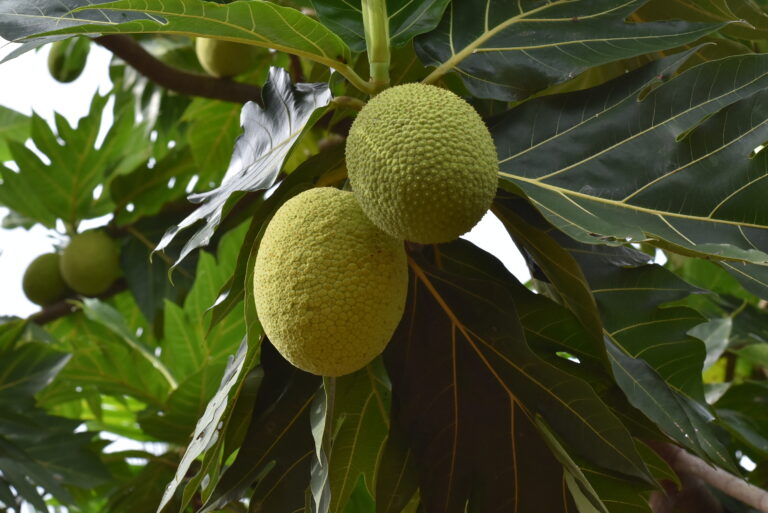
For many years, the breadfruit, scientifically known as Artocarpus Altilis and commonly referred to as Kapiak in ‘Tok Pisin’, has been taken for granted in Papua New Guinea as a source of energy. Often consumed simply as a quick fix for hunger, without knowing its value in the food chain.
As one of the highest yielding food trees, a single breadfruit tree can produce up to 200 fruits at any one time. Native to equatorial regions, it is mainly found in the Pacific ,South East Asia and the Carribean.
Traditionally, generations of our fore fathers have roasted breadfruit over open fires and serving it with young coconut water (kulau) as a snack. This was the most common method of cooking breadfruit many years ago.
In recent years, breadfruit has been identified by food scientists and researchers as the food that will save people in the region (South East Asia /Pacific) from hunger in times of natural disasters due to climate change given its nutritional value. It contains carbohydrates, rich in dietary fibre ,potassium Vitamin C and no sugar.
Papua New Guinea is one of the countries in the region that may face food shortage with the onset of El Niño, threatening food security. The National Agricultural Research Institute (NARI) embarked on a 4 year Breadfruit Project funded by the United Nations Food and Agriculture Organisation(FAO) through the International Treaty on Plants and Genetic Resources for Food and Agriculture (ITPGRFA), aimed at Raising the Profile of Breadfruit Production in Coastal and Island Food Systems in Papua New Guinea. The project is into its second year and will end in 2028.
As part of these efforts, The Breadfruit Project recently participated in the 2026 National Agriculture Research Systems(NARS) Agricultural Innovation Show(AIS) held at Bubia ,10 Mile,along Okuk Highway in Lae ,Morobe Province.
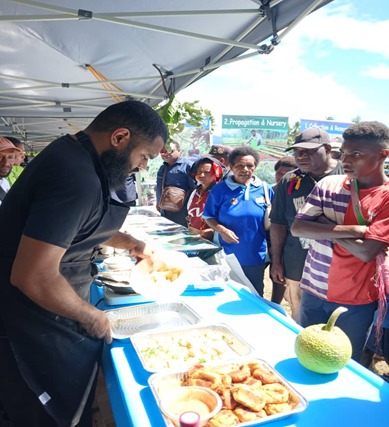
The exhibit showcased various information collected on breadfruit, including bi-products in forms of body oils, soaps and the preparation of breadfruit as a meal. The primary goal was to show how breadfruit can be prepared and eaten as a meal.
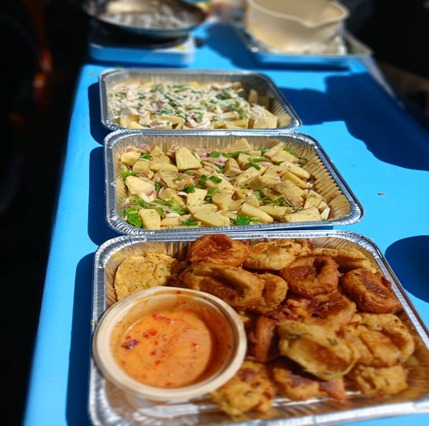
Contemporary Breadfruit Cooking with Nangu Chef at the 2026 NARS AIS,Bubia,Lae, Morobe Province.Contemporary Breadfruit Cooking on display at the 2026 NARS AIS,Bubia,Lae, Morobe Province. Image Credit: NARI
The Project featured ‘Nangu Chef’ at its stall to do contemporary cooking with Breadfruit that drew a huge crowd including students and other visitors. Nangu Chef is NARI’s official partner in the Breadfruit Food Value Chain, from Seed To Plate!
NINE Chinese nationals have been apprehended and charged for attempting to smuggle 14.5 kilograms of gold out of Papua New Guinea on a commercial Air Niugini flight in what PNG Customs officials believe to be the biggest single revenue protection haul in PNG Customs history.
The nine suspects were arrested following a three-hour terminal operation at Jackson’s International Airport on Friday, June 12, 2026, when authorities intercepted PX 8 before it could depart.
Customs investigators, while responding to reports from Border and Passenger Processing officers of one Chinese national, Kui Chen, received alerts from Air Niugini ground crew that PX 8 cabin crew had reported suspicious behavior of three other Chinese nationals who had already boarded the flight.
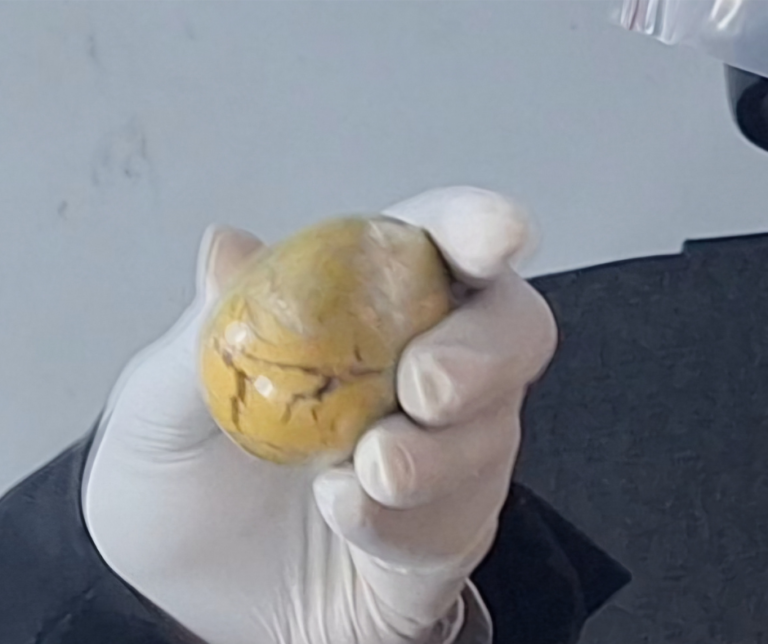
Two of these three on the plane had been seen passing packages to each other. Customs officials later confirmed the packages contained egg-shaped packages of gold sand wrapped in clear wrap.
A thorough search of the aircraft by Customs officers and the Air Niugini Cabin Crew further revealed 6 small bags containing between 3 to 4 egg-sized, plastic wrapped packets of fine gold sand each, which were hidden within the seat pillows and seats of the identified Chinese nationals.
A comprehensive re-screening of all the passengers on flight PX 8 enabled the identification of the rest of the passengers by the seats where the packages were discovered.
Special Bail Application Hearing
The nine have been formally charged by PNG customs and appeared for a special bail application hearing on Wednesday, June 17, 2026, when bail was granted.
Although Customs lawyers objected to the bail application on the basis that there was no proper residential address of their guarantors, and only a rental address presented by the applicants’ lawyer, and while all other grounds were objected to, the only consideration by the applicants’ lawyer that Customs did not object to was the over-crowding at the Boroko Holding Cells on which bail was granted.
IMAGE 1: Supplied Images of suspects after their arrest transfer to the Boroko Police Station Holding Cells.
Customs prosecution raised major red flags, arguing that the defendants were foreign nationals on short-term business visas with no established connections to Papua New Guinea.
They strongly objected to bail, revealing a critical gap in the initial processing; there was no evidence that the court documents or bail terms had been officially translated into a language the suspects actually understood.
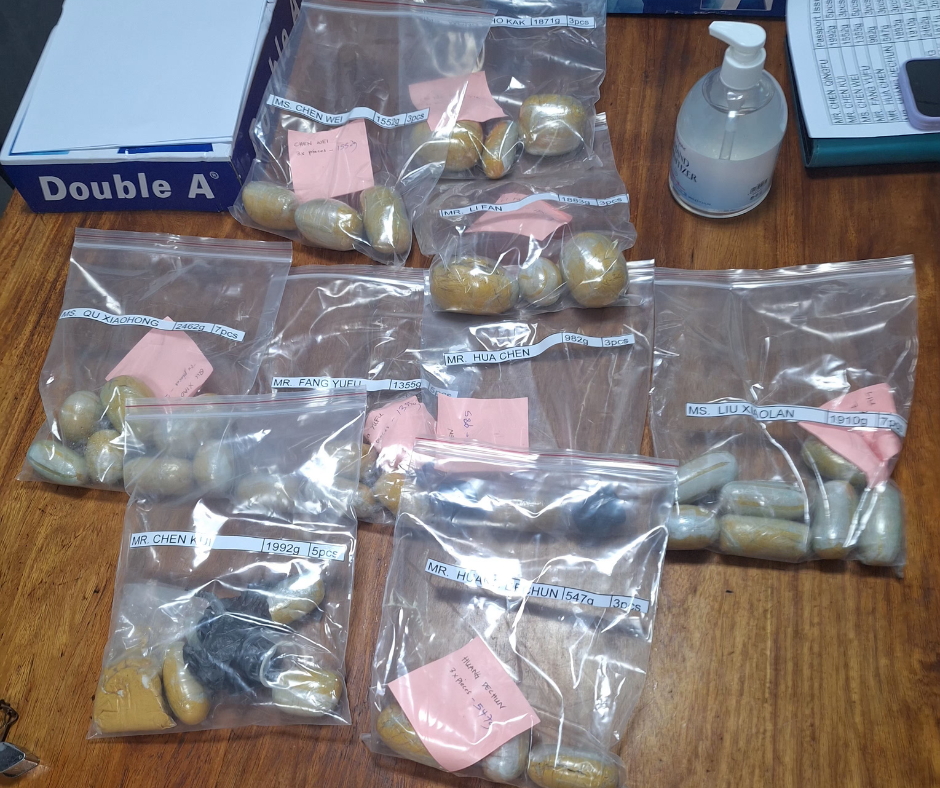
The prosecution also detailed the immense scale of the crime, confirming that laboratory experts are still conducting assays to determine the exact value of the 14.5 kilograms of pulverized gold sand at today’s international market price is estimated to be close to 2 million USD or roughly K8million.
IMAGE 2:Supplied image of the bags of packaged gold sand confiscated from the group of Chinese nationals.
Due to the high flight risk, the State initially demanded a K50,000 cash bail for each defendant and K12,000 for each guarantor.
While the Magistrate acknowledged the gravity of the customs offenses, the bench ruled that the suspects are entitled to the presumption of innocence, ultimately granting bail but placing them under a very tight legal leash.
Strict Bail Conditions
Strict bail conditions mean the nine accused must collectively meet heavy financial penalties and strict movement restrictions.
Their Approved Bail Conditions include:
K10,000 each for the 9 arrested;
K5,000 each for the two guarantors;
All passports and visas to be surrendered to the Court;
All are not to leave NCD or PNG, strictly confined to the city limits;
All suspects to report to the Clerk of Court Waigani District Court every Friday between 8am and 4pm;
Counsel and Guarantors to indicate to the court and/or Customs where the 9 Chinese nationals will be staying – and to file this information in an affidavit;
They are not to commit any offence whilst on bail;
They are to attend every court case until the matter is finally determined;
And their Guarantors to report every two weeks to the PNG Customs Office, beginning Friday, June 19th, 2026, to the Assistant Commissioner Enforcement.
Organized Syndicate
The prosecution’s case rests on the events at the international terminal, where a coordinated network was exposed trying to smuggle the contraband on Air Niugini’s flight PX 8.
The gold had been crushed and pulverized into fine sand and powder; a specific method of concealment designed to successfully evade the terminal’s standard metal detectors.
State investigators have mapped out a tight logistical timeline that points away from casual travel and directly toward a calculated syndicate.
Records show that the arrivals of the suspects were staggered within a tight five-day window between May 29 and June 2, 2026.
Furthermore, all nine individuals were traveling on medium-to-short-term business visas and had been in the country for less than a week before trying to exit with the contraband.
Most glaringly, each of them was brought into the country under the same corporate sponsor, Orvexis Trading Limited.
IMAGE 3: PNG IPA Records
According to official PNG Investment Promotion Authority (PNGIPA) records, Orvexis Trading Limited trades in wholesale and retail trade, sale and repair of motor vehicles, motorcycles, personal and household goods.
Orvexis Trading Limited was formally registered with PNGIPA on May 7th, 2026 and is owned by a Chinese national.
In a statement released on Friday the National Airports Corporation (NAC) says gold-smuggling syndicates are exploring and exploiting areas where there may be vulnerabilities and using creative concealment methods.
“NAC’s layered security approach, combining passenger profiling, random searches and close collaboration with PNG Customs, Air Niugini Aviation Security and Police have proven effective in exposing these operations. Officers have consistently refused bribery attempts, demonstrating professionalism and integrity in protecting national interests.
“The repeated detections highlight the importance of continued investment in airport surveillance, screening technology, intelligence sharing, and inter-agency cooperation.” NAC says.
Upcoming Proceedings
The nine suspects are currently facing severe charges under Sections 138 and 149(2) of the Customs Act 1951.
However, police investigators have already indicated that the formal charges are expected to be upgraded or supplemented with Money Laundering offenses.
While the defense succeeded in securing bail for the nine, the strict nature of the restrictions, from the K100,000 total payout to the mandatory weekly Friday check-ins, shows the state is taking no chances.
Relevant authorities will now be watching closely to see if this group complies with the court’s conditions, starting with their first mandatory appearance and following their initial check-ins, a formal court hearing on the substantive charges is set to commence today, Monday, June 22, 2026.
For the second consecutive year under Laurie Daley, NSW has squandered a 1-0 State of Origin series lead. Queensland dominated the Blues with a 44-24 victory in Game II on Wednesday night, sending the series to a July 8 decider at Suncorp Stadium—a venue where NSW has won just one decider in the past 20 years.
The defeat places immense pressure on Daley, who has never won a decider and has secured just one series victory across six full attempts.
Despite a strong start from rugby union convert Mark Nawaqanitawase, who helped guide NSW to a 12-8 halftime lead, the Blues fell apart in the second half as several tactical decisions backfired. On the field, Dylan Lucas missed a crucial tackle that led directly to a Queensland try, while Mitchell Moses missed eight tackles before being benched late in his return from a hamstring injury. Off the field, Daley dithered on the sidelines, leaving hooker Api Koroisau stranded on the bench as he delayed utilizing his final interchange.
The pre-game narrative had focused heavily on protecting Daley’s legacy, with NSW great Brad Fittler issuing a passionate pre-kickoff rallying cry.
“The coach was our best player ever and they can’t walk away from that,” Fittler said. “The players need to stand up for 80 minutes tonight. They need to be all heart – just like their coach.”
Instead, the Blues collapsed after the break. Daley now faces a must-win situation in Game III, where another loss would leave his coaching record at a dismal six series defeats from seven attempts.